
FB new server farm in Sweden. PrivacyInt FB transparency. Facebook Acquires friend.ly. FB under scrutiny in Europe and US. FB log of everyone who pokes you. FB privacy setting, an ongoing Education. Logging out of Facebook is not enough. FB Like Button. FB new design. FB facial recognition. Social Networking safe for kids? FB places. Facebook: Facts You Probably Didn't Know [INFOGRAPHIC] Did you know that the second most popular Facebook Page is that of Homer Simpson, right behind Michael Jackson?
![Facebook: Facts You Probably Didn't Know [INFOGRAPHIC]](http://cdn.pearltrees.com/s/pic/th/facebook-probably-infographic-3383647)
Or that the overall amount of time spent on Facebook each month is 8.3 billion hours? (We shudder to think how much of that time is spent on FarmVille). If you ever want to impress anyone with your knowledge of Facebook miscellanea, below is the ultimate cheat sheet in the form of a very large infographic. Enjoy! Michael Zimmer.org » Blog Archive » Facebook’s Zuckerberg: “Havi. Facebook’s Mark Zuckerberg has a history of speaking his mind on privacy, and what he speaks is often fraught with problems, ignorance, and arrogance.
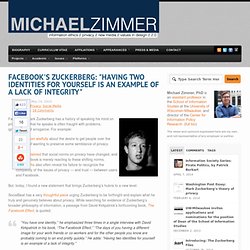
For example: He’s spoken wistfully about the desire to get people over the “hurdle” of wanting to preserve some semblance of privacy online.He’s proclaimed that social norms on privacy have changed, and that Facebook is merely reacting to these shifting norms.His remarks also often reveal his failure to recognize the complexity of the issues of privacy — and trust — between users and Facebook. But, today, I found a new statement that brings Zuckerberg’s hubris to a new level. SocialBeat has a very thoughtful piece urging Zuckerberg to be forthright and explain what he truly and genuinely believes about privacy. While searching for evidence of Zuckerberg’s broader philosophy of information, a passage from David Kirkpatrick’s forthcoming book, The Facebook Effect, is quoted:
Yet Another Facebook Privacy Fiasco on PCWorld Podcast 76 - PCWo. What Happens When You Deactivate Your Facebook Account. Facebook is a big part of millions and millions of peoples' lives, but what happens when you pull the plug?

Last night I met a man who walked to the edge of the cliff and nearly deactivated his Facebook account. He took a screenshot of what he saw after clicking the "deactivate my account" link on his account page - and it is pretty far-out. That man considered quitting Facebook because it was having an adverse emotional impact on him and I'll spare him and his contacts from posting the screenshot he shared with me. I have posted below though a shot of the screen I saw when I clicked that button myself. Check it out. Facebook's New Policies Make Harassment Easy.
S nightmare: Facebook 'Like' replaces links. Facebook's Web-wide "Like" button may spell trouble for GoogleFacebook recently added button to let people recommend Web sites to friends"Like" feature is more social version of Web linkBut search engines may not have access to data about recommendations Editor's note: Pete Cashmore is founder and CEO of Mashable, a popular blog about social media.
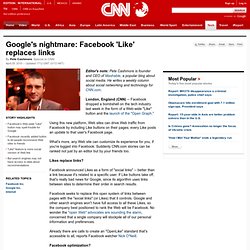
He writes a weekly column about social networking and technology for CNN.com. London, England (CNN) -- Facebook dropped a bombshell on the tech industry last week in the form of a Web-wide "Like" button and the launch of the "Open Graph. " Using this new platform, Web sites can drive Web traffic from Facebook by including Like buttons on their pages; every Like posts an update to that user's Facebook page.
What's more, any Web site can customize its experience for you, if you're logged into Facebook: Suddenly CNN.com stories can be ranked not just by an editor but by your friends too. Likes replace links? Facebook's High Pressure Tactics: Opt-in or Else. Facebook users who choose not to link their user accounts to Facebook's public Pages are ending up with blank profiles containing no information at all.
If you haven't experienced this problem, it's probably thanks to the somewhat high-pressure tactics Facebook is using to get you to accept these changes. The next time you visit your Profile page (if you haven't done so already), you'll be introduced to the new "Connected Profiles" option, one of the many potentially concerning privacy-related changes announced at Facebook's f8 developer conference last week. With this option, the text in your Facebook profile section where you list your hometown, education, work and interests, is now being linked to the respective pages on Facebook.
So for example, if you live in New York, that's linked directly to a page for New York. Firefox Steps Up to Challenge Facebook's Claim to Identity. The team behind Mozilla's Firefox browser announced today the availability of experimental code that website owners can add to their pages to allow site visitors to create an account, log-in or switch users with just a few simple clicks and no password to remember. The unveiling comes a week after Facebook fired a big shot across the web, staking a claim as the dominant provider of one-click portable identity. These two technologies seem aimed right at each other and engineers at both companies have no doubt been following each others' work closely.
The Mozilla technology is called Account Manager and is intended to become an open specification that any other browser can build on top of as well. Supporting browsers will automatically generate and remember diverse, high-strength passwords for users and allow multiple users to switch easily between accounts when visiting common websites on one computer. The interface mock-ups looks really nice, too. Big brother s'attaque aux réseaux sociaux. 01net.
What price privacy? Facebook Privacy Changes: 5 Can't-Miss Facts - CIO.com - Busines. CIO — Privacy has long been a thorny issue for Facebook: Three years ago, the social networking site unveiled its Beacon advertising project, which resulted in a class-action lawsuit.
December's privacy changes aimed at encouraging users to share more information publicly evoked plenty of criticism. Facebook: Relax, we won't sell your photos. On an otherwise placid holiday weekend, one blog's commentary on a change to Facebook's terms of service created a firestorm of banter on the Web: does the social network claim ownership to any user content on the site, even if the user deletes it?
Facebook reorganized its terms of service last Wednesday. In a blog post, company legal representative Suzie White provided an explanation. p2pnet World Headlines: April 24, 2010. How to Opt Out of Facebook's Instant Personalization. A Handy Facebook-to-English Translator. At last week's "f8" Facebook developer conference, Mark Zuckerberg's notable quotable was that Facebook is "building a Web where the default is social.
" To our ears, that sounds like "a Web where exposure is the norm. " To achieve this, Facebook is rolling out technologies that essentially put Facebook features on other sites, while those sites share data back to Facebook. Despite the voluminous buzz, many commentators have missed the most confusing announcement of all — new Facebook jargon. Time to Audit Your Facebook Privacy Settings, Here's How. Now that Facebook is loosening its data-sharing policies with third-party Web sites and applications, it's the perfect time for users to consider tightening up their privacy settings.
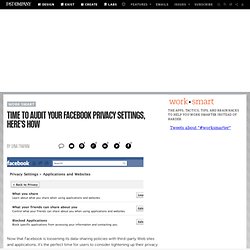
This week the mega social network announced new personalization features that extend the Facebook experience to third-party Web sites--unless you opt out, that is. Here's a rundown of the new features, and how you can opt out if you choose. The two new features Facebook launched of interest to users are called Social Plugins and Instant Personalization. Social plugins add Facebook interactions (such as "Like" buttons and comments) to non-Facebook Web sites. Instant Personalization makes your public Facebook data available to three select partners (Pandora, Yelp, and Docs.com) to help them show you content you might like. How to Disable "Instant Personalization" on Pandora, Yelp, Docs.com For example, if you're a fan of a certain musician, Pandora might automatically start playing tunes from that musician. How to Opt-Out of Facebook’s Instant Personalization - Gadgetwis. This week, Facebook introduced the “open graph,” a giant expansion of the “social graph” concept on which Facebook is built.
The word “open” alone should be a tip-off that there are significant new privacy issues to weigh. In the open graph, Facebook sees us as connected not just to other people – our friends — on Facebook, but to myriad things all over the Web. These things could be favorite bands, news outlets or restaurants. It is a potentially powerful idea – Facebook wants to uncover all these interests and predilections and let us share them with our friends, whether we are at Facebook or somewhere else, in ways that could deepen personal connections and help us discover cool and interesting information.
But there is a price paid in privacy. If you like the idea of broadcasting which articles, bands and restaurants you like, you are in luck. How to Restore Your Privacy on Facebook - Facebook - Gawker. Facebook privacy settings: What you need to know. Protect Your Privacy Opt Out of Facebook’s New Instant Personali. Facebook does it again! I see this when I check my page today. Connect with your friends on your favorite websites. Sounds great. Sounds suspicious. So like a good little librarian I click on the link at the bottom Learn More with “Understand Your Privacy” in small type beneath it. S privacy boss setting rules for the world.
Privacy has long been a thorny issue for Facebook: Three years ago, the social networking site unveiled its Beacon advertising project, which resulted in a class-action lawsuit. December's privacy changes aimed at encouraging users to share more information publicly evoked plenty of criticism. And this week at Facebook's f8 conference, Facebook announced even more changes that affect users' privacy. Keeping track of Facebook's ongoing updates, upgrades and changes--and how they affect your privacy--can be confusing and frustrating. We've sorted through the new wrinkles for you. Here's a list of five essential privacy settings you should review now and tweak accordingly to ensure your information remains safe. 1. What the "Like" button is: Facebook's big announcement this week from the f8 conference was the new "Like" button, which you'll start seeing on blogs and news sites across the Web. Private investigators are using Facebook to uncover false claims made to insurance companies.
Source: AP INVESTIGATORS are using social networking sites such as Facebook to uncover false claims made to insurance companies. They are perusing photos and comments made on the sites of claimants and witnesses to see if they tally with statements made to insurance companies. In some cases investigators are uncovering photos showing people who claim to have injuries preventing them from working doing activities such as skiing. But sites such as Facebook also have become a tool for investigators to uncover people doing undeclared jobs, to track down those who owe debts and uncover the shady past of job applicants. Investigation firm MPOL Investigations Australia has an agent dedicated to searching the social networking sites.
Using a social networking site, the company discovered that a claimant who was suspected of having undeclared income did have a hidden part-time job. Facebook: Privacy Enemy Number One? Facebook's notable announcements this week range from a holistic vision of a seamless, semantically-enabled Web of human relationships, to a simple "Like" button, which will soon be omnipresent on the Internet. The moves are ambitious, giving even fast-moving rivals like Twitter reason to worry. Still, the simple fact that gets lost in the rush towards ubiquitous social connectivity is that Facebook users still don't know what they are sharing, with whom, or why it matters. In short: Facebook remains a privacy minefield. During the event, Zuckerberg described what he calls the "Social Graph. " It's basically a map of all of our social relationships and the things that we care about. Facebook Takes on the World. A raft of F8 announcements prove that Facebook is ready to move beyond tending to existing customers, in order to take on all comers.
1.5M Facebook accounts up for sale - Security - News. Facebook : des millions de données personnelles piratées et mise. Facebook does not erase user-deleted content. Nearly a year on since Cambridge University researchers discovered that Facebook, along with other major social networks, doesn't erase server-side copies of your uploaded data, the world's biggest social network is still guilty of such a sin. Since then, the site has nearly doubled in size. It's now has the population of the third biggest country in the world, with tens of thousands of servers holding your data, which as soon as it is uploaded, belongs to them to do as and what they wish with it. Four US Senators are jumping on the privacy bandwagon concerned over users' privacy. As Sam Diaz points out, profile data by third-party developers (ie. anybody who can write an "application" for the site:
Russian Hacker Selling 1.5M Facebook. The Age Of Facebook. Two years ago I was on the Charlie Rose show and we talked about, among other startups and trends, Facebook. It wasn’t clear then that Facebook had what it took to become one of the great technology companies. They had conquered the college market and were destroying the hopes and dreams of MySpace. But they were also reeling from the Beacon debacle and hadn’t proven that they could turn those massive reach and page view numbers into sustainable revenue streams. You can watch the whole discussion about Facebook, which begins at about the 22:00 mark. See What Your Facebook Friends “Like” On Any Site. Nobody Can Stop Facebook Because Nobody Understands Facebook. Can companies turn confusion into a competitive advantage? Russian Hacker Selling 1.5 Million Facebook Accounts. A hacker who calls himself Kirllos has obtained and is now offering to sell 1.5 million Facebook IDs at astonishingly low prices — $25 per 1000 IDs for users with fewer than 10 friends and $45 per 1000 IDs for users with more than 10 friends — according to researchers at VeriSign's iDefense.
Looking at the numbers, Kirllos has stolen the IDs of one out of every 300 Facebook users. Information for sale includes login credentials; whether or not the e-mail addresses and passwords are legitimate is currently unknown. Typically, this information would be sold for between $1 and $20 per account, according to data from Symantec.
Fly A Kite for online safety. FB targets Gays. FB pssing PI to 1/3 party apps. Facebook privacy hole 'lets you see where strangers plan to go' Here's The Privacy Line That Facebook Just Crossed... Nouvelle faille de sécurité sur les données personnelles de Face. Facebook bug allowed users to eavesdrop on chats. High performance access to file storage. Facebook Privacy Complaint: A Complete Breakdown - PCWorld.
All Facebook - The Unofficial Facebook Blog - Facebook News, Fac. Facebook users risk blackmail, privacy czar warns - The Globe an. EU data officials question Facebook privacy - V3.co.uk - formerl. Canada privacy chief criticizes new Facebook changes. New Facebook Privacy Complaint Filed with Trade Commission. "Privacy and Publicity in the Context of Big Data" Graph API. Facebook's Eroding Privacy Policy: A Timeline. The Evolution of Privacy on Facebook. Facebook Privacy: A Bewildering Tangle of Options - Graphic - NY.
Don't invade Kagan's privacy - Joe Conason. The Evolution Of Privacy On Facebook. EU privacy watchdogs say Facebook changes 'unacceptable' What the data crunchers know about you. Report: Facebook CEO Mark Zuckerberg Doesn’t Believe In Privacy. Websites 'keeping deleted photos' Video - Breaking News Videos from CNN.com. DC ACM Lecture: "Understanding Privacy" by Daniel Solove. How Useful is Facebook Users’ Information? Facebook careful about privacy guidelines at FTC. Facebook Social Plug-ins privacy concerns sorted out by Palo Alt. Technology Review: Blogs: arXiv blog: The Fundamental Limits of. Glitch Brings New Worries About Facebook’s Privacy. The Relationship Between Facebook and Privacy: It’s Really Compl. f8 Live on Facebook. Les deux visages de Mark Zuckerberg. Facebook’s Gone Rogue; It’s Time for an Open Alternative. The Tell-All Generation Learns When Not To, at Least Online - NY.
Ask Facebook Your Privacy Questions - Bits Blog. Facebook Executive Answers Reader Questions - Bits Blog - NYTime. Facebook hacker jailed over false rape claim. Will Facebook Privacy Ties Wreck Chris Kelly's AG Campaign? - Sa. Have Your Say: Are you worried about Facebook privacy? Blog of Rights: Official Blog of the American Civil Liberties Un. Facebook's Biggest Issue Is Its Serious Bait-And-Switch. Facebook Privacy: Mea Culpa Reality Check - PCWorld Business Cen.