
Peer production. Peer production occurs in a socio-technical system which allows thousands of individuals to effectively cooperate to create a non-exclusive given outcome.[5] These collective efforts are informal.
Peer production is a collaborative effort with no limit to the amount of discussion or changes that can be made to the product. Commons-based peer production. The term is often used interchangeably with the term social production.
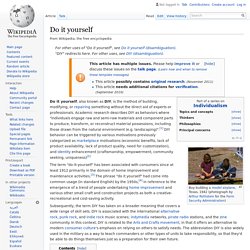
Do it yourself. The term "do-it-yourself" has been associated with consumers since at least 1912 primarily in the domain of home improvement and maintenance activities.[3] The phrase "do it yourself" had come into common usage (in standard English) by the 1950s,[4] in reference to the emergence of a trend of people undertaking home improvement and various other small craft and construction projects as both a creative-recreational and cost-saving activity.
Subsequently, the term DIY has taken on a broader meaning that covers a wide range of skill sets. DIY is associated with the international alternative rock, punk rock, and indie rock music scenes; indymedia networks, pirate radio stations, and the zine community. In this context, DIY is related to the Arts and Crafts movement, in that it offers an alternative to modern consumer culture's emphasis on relying on others to satisfy needs. History[edit] System D. System D (in French, Système D) is a shorthand term that refers to a manner of responding to challenges that requires one to have the ability to think fast, to adapt, and to improvise when getting a job done.
The letter D refers back to either of the French nouns débrouillardise[1] or démerde (French slang). The verbs se débrouiller and se démerder mean to make do, to manage, especially in an adverse situation. In "Down and Out in Paris and London",[2] George Orwell calls out the term "débrouillard" as something the lowest-level kitchen workers, the plongeurs, wanted to be called, as people who would get the job done, no matter what. Bricolage. In the practical arts and the fine arts, bricolage (French for "tinkering") is the construction or creation of a work from a diverse range of things that happen to be available, or a work created by such a process.
The term bricolage has also been used in many other fields, including intellectual pursuits, education, computer software, and business. The arts[edit] Music[edit] Instrumental bricolage in music includes the use of found objects as instruments, such as: Stylistic bricolage is the inclusion of common musical devices with new uses. Musical Bricolage flourishes in music of sub-cultures where: Unlike other bricolage fields, the intimate knowledge of resources is not necessary. Visual art[edit]
Hacker (hobbyist) In home and hobby circles, a hacker is a person who enjoys exploring the limits of what is possible, in a spirit of playful cleverness.
They may also heavily modify software or hardware of their own computer system. It includes building, rebuilding, modifying, and creating software (software cracking, demo scene), electronic hardware (hardware hacking, overclocking, modding), or anything else, either to make it better or faster or to give it added features or to make it do something it was never intended to do. Hobby home computer hacking originated around the MITS Altair, yet the spirit of hacking has been embodied in real projects since the advent of simple tools. Hardware hackers are those who modify hardware (not limited to computers) to expand capabilities; this group blurs into the culture of hobbyist inventors and professional electronics engineering. Hacker (programmer subculture) A hacker is an adherent of the subculture that originally emerged in academia in the 1960s, around the Massachusetts Institute of Technology (MIT)'s Tech Model Railroad Club (TMRC)[1] and MIT Artificial Intelligence Laboratory.[2] A hacker is one who enjoys the intellectual challenge of creatively overcoming and circumventing limitations of programming systems and who tries to extend their capabilities.[3] The act of engaging in activities (such as programming or other media[4]) in a spirit of playfulness and exploration is termed hacking.
Richard Stallman explains about hackers who program: What they had in common was mainly love of excellence and programming. They wanted to make their programs that they used be as good as they could. They also wanted to make them do neat things. The word "hacker" derives from the seventeenth century word of a "lusty laborer" who harvested fields by dogged and rough swings of his hoe. Main article: Hacker ethic. Maker subculture. The maker culture is a contemporary culture or subculture representing a technology-based extension of DIY culture.
Open-source hardware. Open source hardware consists of physical artifacts of technology designed and offered by the open design movement.
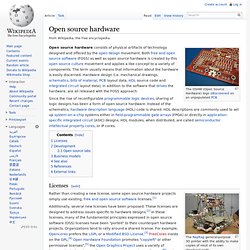
Both free and open source software (FOSS) as well as open source hardware is created by this open source culture movement and applies a like concept to a variety of components. The term usually means that information about the hardware is easily discerned. Hardware design (i.e. mechanical drawings, schematics, bills of material, PCB layout data, HDL source code and integrated circuit layout data), in addition to the software that drives the hardware, are all released with the FOSS approach. Open design. RepRap general-purpose 3D printer that not only could be used to make structures and functional components for open-design projects but is an open-source project itself.
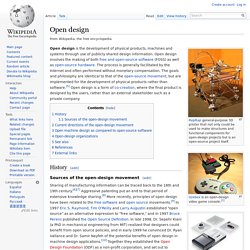
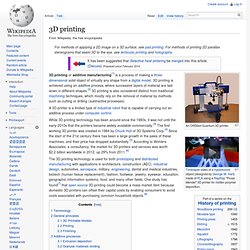
Uzebox is an open-design video game console.[1] 3D printing. An ORDbot Quantum 3D printer. 3D printing or additive manufacturing[1] is a process of making a three-dimensional solid object of virtually any shape from a digital model. 3D printing is achieved using an additive process, where successive layers of material are laid down in different shapes.[2] 3D printing is also considered distinct from traditional machining techniques, which mostly rely on the removal of material by methods such as cutting or drilling (subtractive processes).
Hackerspace. Activities[edit] Many hackerspaces participate in the use and development of free software, open hardware, and alternative media. They are often physically located in infoshops, social centers, adult education centers, public schools, public libraries or on university campuses, but may relocate to industrial or warehouse space when they need more room. Hackerspaces with open membership became common within Germany in the 90s in the orbit of the German Chaos Computer Club, with the C-base being probably the most impressive example. The concept however was limited to less than a dozen of spaces within Germany, and did not spread beyond borders at first. Most likely this was because initial founding costs were prohibitive for small groups without the support of a large organization like the CCC.
In 2006, Paul Bohm came up with a fundraising strategy based on the Street Performer Protocol to build Metalab in Vienna, Austria, and became its founding director.