
Roubini Slams Trichet For Making The Biggest Mistake In ECB History. Will Europe trigger another global economic crisis? Please support our site by enabling javascript to view ads.

The euro zone debt crisis took another dramatic turn Tuesday as thousands of Italians hit the streets in a general strike, protesting a new round of austerity measures. Europe's woes continue to rile global investors. The Swiss National Bank surprised the markets by setting an exchange rate cap on the soaring franc, which investors have been flocking to as a safe-haven currency. European stock markets, meanwhile, hit their lowest point in two years Tuesday. While Europeans take their August vacations and leaders prevaricate, investors are growing increasingly concerned that the continent’s common currency could collapse, and that one or more countries could default on their debt, leading to another global economic crisis.
More from GlobalPost: German court rejects challenge to eurozone rescue deals For insights on the current state of the crisis, GlobalPost turned to economist Yannis M. He’s right. Compare that to the U.S. Yes. Eurozone threat looms over IMF meeting. The eurozone's failure to resolve its own problems adds to tension in run-up to IMF annual meeting.
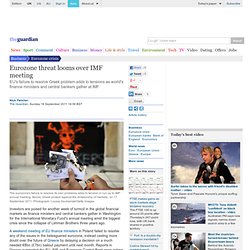
Above, Greek protest 'against the dictatorship of markets', on 17 September 2011. Photograph: Louisa Gouliamaki/Getty Images Investors are poised for another week of turmoil in the global financial markets as finance ministers and central bankers gather in Washington for the International Monetary Fund's annual meeting amid the biggest crisis since the collapse of Lehman Brothers three years ago. A weekend meeting of EU finance ministers in Poland failed to resolve any of the issues in the beleaguered eurozone, instead casting more doubt over the future of Greece by delaying a decision on a much needed €8bn (£7bn) bailout payment until next month. Reports in Greece suggested the EU, IMF and European Central Bank were asking for further austerity measures, including 100,000 public sector job cuts, in an attempt to resolve Greece's budget deficit and avoid a default.
Australian banks pull funds out of troubled euro zone. AUSTRALIAN banks have been cutting back their exposure to Europe's troubled economies, pulling billions in funds from Spain and reducing lending to France.
However, the latest figures that cover public and private debt from the Swiss-based Bank For International Settlements show Australian lenders are still prepared to do business with Italy, even as it battles serious debt strains. The figures from the so-called ''central bankers' bank'' emerged amid concerns the sovereign debt crisis was spreading rapidly from the periphery to the core of the euro area. Greece faces an October deadline to qualify for an €8 billion ($10.6 billion) European aid package. Without this, it is expected to default on its debt. European finance ministers had warned at the weekend that the failure of Greece to meet tough savings targets would put the release of the package at risk.
“Multi-Trillion” Euro Bank Bailout Prepped. British newspapers are often sensational and sometimes wrong on big issues, so take this with a grain of salt.
But the Telegraph reports that European leaders are constructing a “multi-trillion” euro plan to deal with the banking crisis that has gripped the continent. I very pointedly say “banking crisis” because we should wean ourselves off calling this a sovereign debt crisis. The sovereigns are the pass-throughs to European banks which made bad bets and still never resolved them from the financial crisis of 2008. That’s the problem being solved here: OK, so the first step of this plan is to shovel “many tens of billions” of euros to the banking sector, either directly through the stronger countries or through a bailout fund. Here Are The Key Things Trichet Just Said At His Last ECB Press Conference. Outgoing European Central Bank President Jean-Claude Trichet gave his final press conference after a rate decision today.

This marks the end of his incumbency at the helm of the ECB, and he's not exactly receiving high fives on his way out the door. The ECB left rates unchanged today, but instituted a bank refinancing program and restarted a covered bond purchase program in order to provide stability to shaky markets. Consensus among investors and the financial news media is that the ECB should have hiked rates today, and will probably do so once Mario Draghi takes over in November. Pour Noël, la BCE ne veut pas faire de cadeaux aux Etats. Non.

No. Nein. Tenez-vous le pour dit, la Banque centrale européenne ne volera pas aux secours des pays en difficultés sur les marchés. C'est le message que martèlent, en stéréo, son président Mario Draghi et le président de la Bundesbank allemande Jens Weidmann, dans deux entretiens publiés respectivement par le Financial Times et Les Echos, aujourd'hui. La BCE offre son premier prêt sur trois ans aux banques de la zone euro. La Banque centrale européenne (BCE), inquiète de voir les banques de la zone euro à court de liquidités, doit lancer mercredi sa première opération de prêt sur trois ans à leur intention.
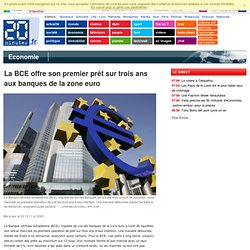
Une manière détournée d'aider les Etats à se refinancer, analysent aussi certains. Pour la BCE, ces prêts à long terme -jusqu'ici elle accordait des prêts au maximum sur 13 mois, d'un montant illimité et bon marché avec un taux d'intérêt de 1%, sont destinés à les aider dans un contexte tendu, où les marchés ne leur font pas confiance, afin qu'à leur tour elles prêtent aux entreprises et aux ménages pour soutenir la croissance. L'annonce de cette mesure n'en a pas moins suscité l'idée que l'institution monétaire de Francfort (ouest), qui se refuse à être le prêteur en dernier ressort des pays de la région comme on le lui réclame depuis des mois, tentait de les aider de manière détournée. «Chaque Etat pourra se tourner vers ses banques» Mais ce raisonnement a ses limites.
ECB Overnight Deposits Reach New High. Deposits at ECB Hit High.