
Www.thirdmillenniumfarming.com/01. Online Files/03. 3MF Research Brochure.pdf. Www.aimsmeeting.org/wp-content/uploads/2012/09/Doris_Taylor_Nature_Medicine_2008.pdf. En 2050 : nous mangerons des insectes. Sites entomovores. Entomphagy Videos. Other uses for insects. Entomophagy Projects. Featured Creatures. Eating Insects. Insectes en tant qu'aliments (entomophagie) Articles reports and research. Costa Rica Entomophagy. Insect species. Insect proteins. Articles. Insectes. Vidéo. Marcel Dicke: Why not eat insects? Insectes en tant qu'aliments (entomophagie) Scientists 'grow' edible insects in Costa Rica - Health News, Health & Families. Entomologist Manuel Zumbado's research into this alternative food source is inspired by practices in Africa, where insects have long been part of people's diet.
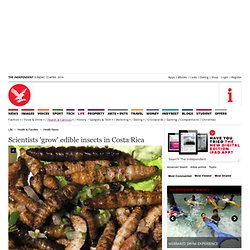
With its rainforests playing host to countless insect species, including thousands that have yet to be identified, Costa Rica is a perfect breeding ground for the work. From leaf-cutting ants to rhinoceros beetles and a dizzying flurry of butterflies, the Central American nation is also a haven of ecotourism. But is it the next hotbed of mouth-watering bugs? The food diversification program at the National Biodiversity Institute in Santo Domingo de Heredia, a small city close to the capital San Jose, looks into indigenous insect species.
But it also examines mushrooms, inspired by their importance in diets from the Himalayan kingdom of Bhutan. At the institute, Costa Rican scientists mingle with Bhutan mycology expert Ugyen Yangchen and Elisabeth Zannou, an entomologist from Benin. "It's worth the effort to taste them," he added. Eating Insects.
Raising farming insects. Insect farming patents. Can Insect Farming Solve World Hunger? How many ways can you spell YUMMY!
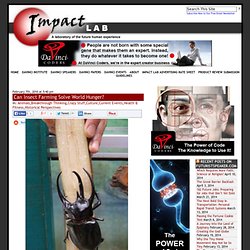
The day when restaurants will serve garlic grasshoppers or beetle larva skewers is getting closer in Costa Rica, where scientists are “growing” insects for human consumption. Entomologist Manuel Zumbado’s research into this alternative food source is inspired by practices in Africa, where insects have long been part of people’s diet. With its rainforests playing host to countless insect species, including thousands that have yet to be identified, Costa Rica is a perfect breeding ground for the work. From leaf-cutting ants to rhinoceros beetles and a dizzying flurry of butterflies, the Central American nation is also a haven of ecotourism. But is it the next hotbed of mouth-watering bugs? The food diversification program at the National Biodiversity Institute in Santo Domingo de Heredia, a small city close to the capital San Jose, looks into indigenous insect species. Replace cattle? Edible insects produce smaller quantities of greenhouse gases.
(PhysOrg.com) -- Insects produce much smaller quantities of greenhouse gases per kilogram of meat than cattle and pigs.
This is the conclusion of Dutch team of scientists at Wageningen University, who have joined forces with government and industry to investigate whether the rearing of insects could contribute to more sustainable protein production. Insect meat could therefore form an alternative to more conventional types of meat. Cattle farming worldwide is a major producer of greenhouse gases. Humanity Needs to Start Farming Bugs for Food, Says United Nations Policy Paper. The raising of livestock consumes two-thirds of the planet's farmland, and is a major source of greenhouse gases.
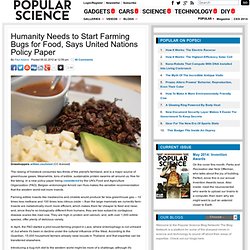
Meanwhile, tons of edible, sustainable protein swarms all around us, free for the taking. In a new policy paper being considered by the UN's Food and Agriculture Organization (FAO), Belgian entomologist Arnold van Huis makes the sensible recommendation that the western world eat more insects. Farming edible insects like mealworms and crickets would produce far less greenhouse gas -- 10 times less methane and 100 times less nitrous oxide -- than the large mammals we currently farm.
A List of Edible Insects. Crickets are often thought of as annoying pests by many people, especially farmers who know that crickets can be damaging to crops.
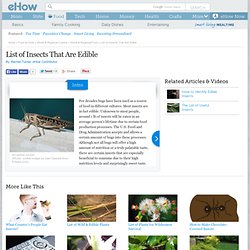
Crickets are packed with protein and can be eaten in a variety of ways.
Insect Recipes. Insects - Cooking - Entomophagy. Insect recipes. Harvesting of insects in South Africa and Japan- Indigenous Knowledge in the Classroom. Department of Biology. We’ve had a couple of concerned inquiries resulting from some unexpected, 6 legged, dinner time garnishes.
It happens, at least once in your life your cereal was ruined by the crunch of something in your mouth that you are pretty sure was not a raisin. Not to fear, most insects are percfectly edible! It has been estimated that the average North American inadvertently ingests 1 to 2 pounds of insects each year. Eco-Friendly Protein: Edible Bugs. (images via Bill Hail, Kent Wang, $ensai) In certain cultures around the world, creatures like beetles, stink bugs, and grubs are not seen as pests, but as food items.
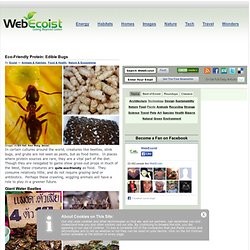
In places where protein sources are rare, they are a vital part of the diet. Though they are relegated to game show gross-out props in much of the West, these creatures are quite eco-friendly as food. They consume relatively little, and do not require grazing land or antibiotics. Perhaps these crawling, wiggling animals will have a role to play in a greener future. Giant Water Beetles. Www.ethnobiomed.com/content/pdf/1746-4269-2-51.pdf. Eating Insects. Insects as Food, by Gene DeFoliart; Home Page. Edible insects around the world.
FINL Vol. 9, No. 1 Mealworms: Raising Mealworms for Food. The Food Insects Newsletter Raising MealwormsMarch 1996.
Volume 9, Issue #1. (This article is adapted from a leaflet prepared by the Insectarium of Montreal for the public. The leaflet contains several illustrations and photos and is available free in French and English. Meat producers should replace cattle with insects, scientists say. Scientists in the Netherlands have discovered that insects produce significantly less greenhouse gas per kilogram of meat than cattle or pigs.
Their study, published in the online journal PLoS One, suggests that a move towards insect farming could result in a more sustainable - and affordable - form of meat production. The rearing of cattle and pigs for meat production results in an estimated 18 percent of global greenhouse gas emissions. With worldwide consumption of beef and pork expected to double by 2020, alternatives are being investigated. Entomophagy. Entomophagy (/ˌɛntəˈmɒfədʒi/, from Greek ἔντομον éntomon, "insect", and φᾰγεῖν phagein, "to eat") is the human use of insects as food.
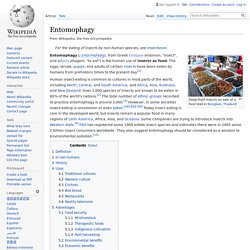
The eggs, larvae, pupae, and adults of certain insects have been eaten by humans from prehistoric times to the present day.[1] Human insect-eating is common to cultures in most parts of the world, including North, Central, and South America; and Africa, Asia, Australia, and New Zealand. Over 1,000 species of insects are known to be eaten in 80% of the world's nations.[2] The total number of ethnic groups recorded to practice entomophagy is around 3,000.[3] However, in some societies insect-eating is uncommon or even taboo.[4][5][6][7][8] Today insect eating is rare in the developed world, but insects remain a popular food in many regions of Latin America, Africa, Asia, and Oceania.
Definition[edit] Mealworms presented in a bowl for human consumption. For Most People, Eating Bugs Is Only Natural. July 15, 2004 If you think eating insects is gross, you may be in the cultural minority. Throughout history, people have relished insects as food. Today, many cultures still do. Ten thousand years ago hunters and gatherers ate bugs to survive. Entomophagy: using insects as a food source. Www.cosis.net/abstracts/COSPAR2006/00134/COSPAR2006-A-00134-1.pdf?
TLC Cooking "How Freeze-Drying Works" Les Insectes Comestibles d'Afrique de L'Ouest et Centrale sur Internet. Lincaocnet. The purpose of the LINCAOCNET project (2009-2010) is to collect and disseminate as much information about the edible insect s of French speaking West and Central Africa as possible.
A website has been set up for this purpose ( ) and contains a database of insect s which are consumed in 10 African countries. This information source serves as a basis for better scientific knowledge and for the improved use of insect s as a foodstuff. Importance of the project The project is of importance both for the general public and for the world of science. It promotes on the one hand entomofagy (the consumption of insect s) by providing information which is accessible to everyone, and on the other hand, the management and conservation of edible insect s.
How Entomophagy Works" In the 1973 children's book "How to Eat Fried Worms," Billy, the young protagonist, downs 15 worms in 15 days for 50 bucks. On the American game show "Fear Factor," contestants wolfed down larvae, cockroaches and other insects by the handful for a shot at $50,000. It seems that in Western culture, the only time anyone eats an insect is on a bet or a dare.
This isn't true in much of the rest of the world.