
Labor Unions During the Great Depression and New Deal - For Teachers. In the early 1930s, as the nation slid toward the depths of depression, the future of organized labor seemed bleak.
In 1933, the number of labor union members was around 3 million, compared to 5 million a decade before. Franklin D. Roosevelt. Assuming the Presidency at the depth of the Great Depression, Franklin D.
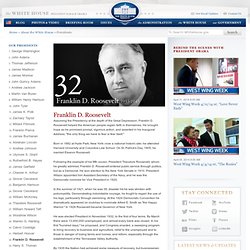
Roosevelt helped the American people regain faith in themselves. He brought hope as he promised prompt, vigorous action, and asserted in his Inaugural Address, "the only thing we have to fear is fear itself. " Born in 1882 at Hyde Park, New York--now a national historic site--he attended Harvard University and Columbia Law School. On St. Patrick's Day, 1905, he married Eleanor Roosevelt. Franklin D. Roosevelt - President of the United States (POTUS)
Links immediately following the image of the American Flag ( ) are links to other POTUS sites.
All other links lead to sites elsewhere on the Web. Jump to: Presidential Election Results | Cabinet Members | Notable Events | Internet Biographies | Historical Documents | Media Resources | Other Internet Resources | Points of Interest Father: James Roosevelt Mother: Sara Delano Roosevelt Married: Anna Eleanor Roosevelt (1884-1962), on March 17, 1905 Children: Anna Eleanor Roosevelt (1906-75); James Roosevelt (1907-91); Elliott Roosevelt (1910-90); Franklin Delano Roosevelt, Jr. (1914-88); John Aspinwall Roosevelt (1916-81) Religion: Episcopalian Education: Graduated from Harvard College (1903); Attended Columbia Law School Occupation: Public official, lawyer Political Party: Democrat Other Government Positions: Member of New York State Legislature, 1911-13 Assistant Secretary of the Navy, 1913-20 Governor of New York, 1929-33.
Presidency of franklin d. roosevelt - Google Search. Herbert Hoover. Son of a Quaker blacksmith, Herbert Clark Hoover brought to the Presidency an unparalleled reputation for public service as an engineer, administrator, and humanitarian.
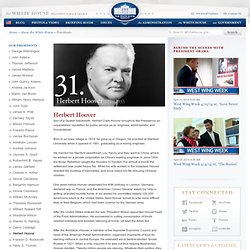
Born in an Iowa village in 1874, he grew up in Oregon. He enrolled at Stanford University when it opened in 1891, graduating as a mining engineer. He married his Stanford sweetheart, Lou Henry, and they went to China, where he worked for a private corporation as China's leading engineer. The Presidency of Herbert Hoover. The purpose of this essay is to analyze the presidency of Herbert Hoover using various political models and to determine whether his ranking in presidential history is fair or not.
President Herbert Hoover was elected by one of the largest margins in American history in 1928 and lost reelection to Franklin Roosevelt by one of the largest margins for a sitting president in American history in 1932. “The transformation of the national government from Hoover's brand of ‘rugged individualism; to Roosevelt's ‘New Deal’ changed American politics forever.” [i] This paper will look at his presidency to determine what exactly happened over his four years in office to change the minds of the people who first elected him. One of the first names that come to the mind of the average person when asked who the worst president was is Herbert Hoover, whether this assumption is true or not will be looked at. Department of Justice’s criminal focus, and prison reform. Radio's America: The Great Depression and the Rise of Modern Mass Culture by Bruce Lenthall, an excerpt. An excerpt from.
Works Progress Administration News. The Works Progress Administration, launched by President Franklin Roosevelt in his third year in office, was the largest jobs initiative the United States has ever seen.
It was the signature program of the New Deal -- and the most attacked and reviled by conservatives. In its eight years, from 1935 to 1943, it spent $10.5 billion employing eight and a half million Americans who previously had been jobless, rescuing them -- and the country -- from the straits of the Depression. Unemployment had been 24.9 percent when Roosevelt took office two years earlier, in 1933. The Depression in the U.S. The Depression in the United States--An Overview The Great Depression In October 1929 the stock market crashed, wiping out 40 percent of the paper values of common stock.
Even after the stock market collapse, however, politicians and industry leaders continued to issue optimistic predictions for the nation's economy. But the Depression deepened, confidence evaporated and many lost their life savings. Top 10 New Deal Programs. Myrna Loy. The Early Years When David Franklin Williams was travelling by train in early 1905, he went through a small station called 'Myrna'.
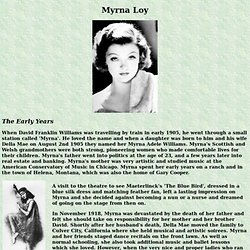
He loved the name and when a daughter was born to him and his wife Della Mae on August 2nd 1905 they named her Myrna Adele Williams. Myrna's Scottish and Welsh grandmothers were both strong, pioneering women who made comfortable lives for their children. Myrna's father went into politics at the age of 23, and a few years later into real estate and banking. Myrna Loy Pictures - Myrna Loy Photo Gallery - 2011. Pretty Boy Floyd. Pretty Boy Floyd Words and Music by Woody Guthrie If you'll gather 'round me, children, A story I will tell 'Bout Pretty Boy Floyd, an outlaw, Oklahoma knew him well.
Charles Arthur 'Pretty Boy' Floyd. Charles Arthur 'Pretty Boy' Floyd About North Georgia Overview Georgia native "Pretty Boy" Floyd grew famous in the Midwest as one of a cadre of 1930's badmen who used the lack of federal laws and strong local friendships to elude capture and prosecution. Biographical Born in rural Bartow CountyCharles Arthur Floyd was born on February 3, 1904, Bartow County, GA. Early years Charles Floyd earned money as a young boy picking cotton in Georgia for nearby growers.
Henry Starr apparently captured Charles' attention as word of his exploits reached the young boy. Early crimes In 1922 Charles Floyd was caught following a bungled attempt to rob a post office. St. Three and a half years later "Pretty Boy" emerged to a different world. Floyd in Kansas Kansas City was one such haven, known as a wild town controlled by Tom Prendergast, who was not above consorting with criminals and using mob muscle to enforce his rule. First trip to Ohio Returmn to Kansas Floyd and Richetti Kansas City Massacre. Pretty boy floyd. The Mother Road: Historic Route 66.