
Pure Taurine Powder Supplement - Energy Drink Ingredients. Reliable and relatively consistent scientific data showing a substantial health benefit.Contradictory, insufficient, or preliminary studies suggesting a health benefit or minimal health benefit.For an herb, supported by traditional use but minimal or no scientific evidence.

For a supplement, little scientific support. Our proprietary “Star-Rating” system was developed to help you easily understand the amount of scientific support behind each supplement in relation to a specific health condition. While there is no way to predict whether a vitamin, mineral, or herb will successfully treat or prevent associated health conditions, our unique ratings tell you how well these supplements are understood by the medical community, and whether studies have found them to be effective for other people. For over a decade, our team has combed through thousands of research articles published in reputable journals. Taurina. La taurina es un ácido orgánico que interviene en la formación de la bilis, que se encuentra naturalmente en pequeñas cantidades en los tejidos de muchos seres vivos (incluyendo a los humanos)[1] [2] y por lo tanto en varios alimentos.
Es un derivado del aminoácido cisteína que contiene el grupo tiol; y es el único ácido sulfónico natural conocido.[3] Su nombre deriva del latín taurus (que significa toro) porque fue aislada por primera vez de la bilis del toro en 1827 por los científicos alemanes Friedrich Tiedemann y Leopold Gmelin. Guarana. Guarana (/ˌɡwɑrəˈnɑː/, from the Portuguese guaraná [ɡwaɾɐˈna]), Paullinia cupana, syn.
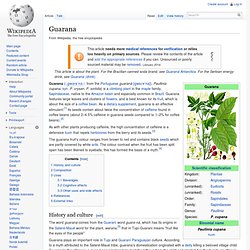
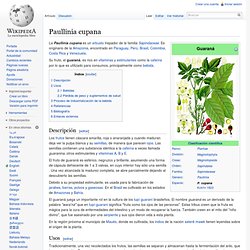
P. crysan, P. sorbilis) is a climbing plant in the maple family, Sapindaceae, native to the Amazon basin and especially common in Brazil. Guarana features large leaves and clusters of flowers, and is best known for its fruit, which is about the size of a coffee bean. As a dietary supplement, guarana is an effective stimulant:[1] its seeds contain about twice the concentration of caffeine found in coffee beans (about 2–4.5% caffeine in guarana seeds compared to 1–2% for coffee beans).[2] As with other plants producing caffeine, the high concentration of caffeine is a defensive toxin that repels herbivores from the berry and its seeds.[3] The guarana fruit's colour ranges from brown to red and contains black seeds which are partly covered by white arils. Paullinia cupana. La Paullinia cupana es un arbusto trepador de la familia Sapindaceae.
Yerba maté. Yerba mate (from Spanish [ˈʝeɾβa ˈmate]; Portuguese: erva-mate [ˈɛɾvɐ ˈmatʃe]) is a species of the holly (family Aquifoliaceae), with the binomial name of Ilex paraguariensis.
Guarana extract powder - buy online in NZ. Guarana (Paullinia cupana) Natural Extract 50 Capsules Guaranteed Potency!
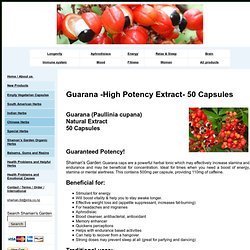
Shaman's Garden Guarana caps are a powerful herbal tonic which may effectively increase stamina and endurance and may be beneficial for concentration. Ideal for times when you need a boost of energy, stamina or mental alertness.
What is MSM (methylsulfonylmethane) and why do we need it. Unknown to most of us, sulfur is one of the five basic elements of life.
Sulfur is an indispensable component in human nutrition. It's found in every cell in the body, and is structurally and functionally important to 150 compounds, including hormones, enzymes, antibodies and antioxidants. Sulfur itself is held mainly in the muscles, skin, bones, nails and hair. MSM provides the essential sulfur necessary for a number of body compounds. MSM Fast Facts - The Facts of MSM - Methylsulfonylmethane. Is MSM a Cure for Arthritis?
: MSM (methylsulfonylmethane) has been hyped as a cure for arthritis, based on testimonials but little valid scientific data. Stanley Jacob, M.D. who developed MSM maintains that the supplement does not cure arthritis, but he believes it offers many benefits. What Are the Benefits of Taking MSM? : MSM. Quite simply, MSM is probably the most significant discovery since Vitamin C.
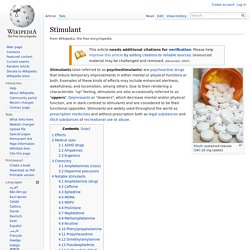
It's pretty much a miracle in a pill. (Since we don't eat raw food, fresh picked, we need to get it in a pill, just like Vitamin C.) It's good for preventing muscle aches and sprains, general health, and a whole lot more: It's a sulfur compound isolated from food, so it's more of a food that a supplement. It is apparently the only form of sulpfur the body can assimilate. Msm information. Stimulant. Ritalin sustained-release (SR) 20 mg tablets Effects[edit] Medical uses[edit] Stimulants are used both individually and clinically for therapeutic purposes in the treatment of a number of indications, including the following: To counteract lethargy and fatigue throughout the day while at work or while doing other activitiesTo reduce sleepiness and to keep the person awake when necessary, as well as to treat narcolepsyTo decrease appetite and promote weight loss, as well as to treat obesityTo improve concentration and focus, and reduce restlessness and hyperactivity, especially for those with attentional disorders such as ADHDOccasionally, used off-label to treat clinical depression, in particular, non-typical depression and treatment-resistant depressionTo relieve nasal congestion and to treat orthostatic hypotension and postural orthostatic tachycardia syndrome.To aid in smoking cessation.
ADHD drugs[edit] Stimulants are the most commonly prescribed medications for ADHD. Stimulant compounds in energy drinks. Caffeine Caffeine is found in the leaves, seeds or fruits of more than 60 plants. The Best Natural Stimulants For Increased Energy and Weight Loss. We strongly recommend caution against the use of stimulants for those with unresolved heart problems or high blood pressure. Use caution when combining stimulants. For people of reasonably good health and common sense, stimulants can be like a God-send; especially for those who have slowed metabolisms. Of course, we recommend dealing appropriately with whatever underlying issues might be causing a slowed metabolism, but sometimes a multi-pronged attack is prudent. Appropriately used stimulants can help a person to get into better shape, while providing the necessary energy to do so, at the same time.
Again, common sense and responsible usage are prudent to ensure that more good is done than harm. Our official recommendation is that people start slowly discovering how these various stimulants effect them independently. Stimulants, Energy Pills, More Daily Energy, Happy Pills, Pep, Natural Energy Boost. Glucuronolactona. La Glucuronolactona es un carbohidrato derivado de la glucosa mediante su metabolismo en el hígado el cual se presenta naturalmente y es un importante componente estructural de casi todos los tejidos conectivos. La glucuronolactona también se encuentra en la savia de muchas plantas. Propiedades físicas y químicas[editar] La glucuronolactona es un compuesto blanco sólido inodoro, soluble en agua caliente o fría.
Vitamina B5. Ácido pantoténico. Creatine. Chemical compound Creatine ( or )[1] is an organic compound with the nominal formula (H2N)(HN)CN(CH3)CH2CO2H. This species exists in various modifications (tautomers) in solution. Creatine is found in vertebrates where it facilitates recycling of adenosine triphosphate (ATP), the energy currency of the cell, primarily in muscle and brain tissue.
Recycling is achieved by converting adenosine diphosphate (ADP) back to ATP via donation of phosphate groups. Carnitine. Carnitine is a quaternary ammonium compound biosynthesized from the amino acids lysine and methionine.[1] In living cells, it is required for the transport of fatty acids from the intermembraneous space in the mitochondria, into the mitochondrial matrix during the breakdown of lipids (fats) for the generation of metabolic energy.[2] It is widely available as a nutritional supplement.
Maltodextrin. Maltodextrin is a polysaccharide that is used as a food additive. It is produced from starch by partial hydrolysis and is usually found as a white hygroscopic spray-dried powder.[1] Maltodextrin is easily digestible, being absorbed as rapidly as glucose, and might be either moderately sweet or almost flavorless. It is commonly used for the production of sodas and candy. It can also be found as an ingredient in a variety of other processed foods. Structure[edit] Maltodextrin consists of D-glucose units connected in chains of variable length.
Maltodextrins are classified by DE (dextrose equivalent) and have a DE between 3 to 20.