
Organic Electronics. Oldest light bulb still burning after 110 years. Posted by Anonymous on June 15, 2011 The four watt bulb, installed in a fire station in Livermore, California, has been declared the oldest known working light bulb by the Guinness Book of World Records.The bulb was a gift from a businessman in 1901 and with the exception of a brief period in 1903, a week in 1937 and some power outages between then and 1976, the light has remained on.Lynn Owens, the chairman of the town’s light bulb centennial committee, said that the light’s longevity has baffled scientists.He said: “Nobody knows how it’s possible.

It is a 60 watt bulb and it’s only turned on for about four watts but nobody knows why it keeps burning. “We’ve had scientists from all over the country look at this light bulb. Of course nobody has ever been able to touch this it,” he added.The bulb has become a major tourist draw for Livermore and a celebrity in its own right. Like this:
Arduino. Recycling. Sound Devices. Lighting. LED. Lasers. Electrical engineering toolbox. Electronics Demonstrations. Open Source. Circuit Simulation. Electronics supply. Electricity and magnetism. DIY HOW TO. Security. Cell phones. World's largest Rail Gun. Virtual Library: CAD. CAD software is commonly used for drafting architectural and engineering drawings and for making technical illustrations of any kind.

If you are a professional associated with design or drafting or would just like to widen your knowledge about CAD applications, then you will find this section of informative and useful. CAD enables you to prepare fast and accurate drawings. It provides flexibility to change drawings with minimal effort. In recent years, many professionals have switched to CAD to enjoy the benefits of this precise and creative tool. Today, many educational institutions include CAD as part of their academic curriculum. This section of Virtual Library is devoted to CAD education. Join online AutoCAD Training - Learn more... Techshop. Electricity and Magnetism.
Spark Fun Electronics. Sensors Use Building's Electrical Wiring as Antenna. Wireless sensors scattered throughout a building can monitor everything from humidity and temperature to air quality and light levels.

This seems like a good idea–until you consider the hassle and cost of replacing the sensors’ batteries every couple of years. The problem is that most wireless sensors transmit data in a way that drains battery power. Researchers at the University of Washington have come up with a way to reduce the amount of power a sensor uses to transmit data by leveraging the electrical wiring in a building’s walls as an antenna that propagates the signal. The approach extends a wireless sensor’s range, and it means that its battery can last up to five times longer than existing sensors, say the researchers.
“The powerline has an amplification effect,” says Patel. “Most academic research on in-building sensor nodes has looked at building infrastructure as a problem,” says Matt Reynolds, professor of electrical and computer engineering at Duke University. Eddy current brake. An eddy current brake of a German ICE 3 in action.
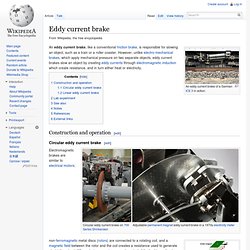
An eddy current brake, like a conventional friction brake, is responsible for slowing an object, such as a train or a roller coaster. However, unlike electro-mechanical brakes, which apply mechanical pressure on two separate objects, eddy current brakes slow an object by creating eddy currents through electromagnetic induction which create resistance, and in turn either heat or electricity. Construction and operation[edit] Circular eddy current brake[edit] Principle of the linear eddy current brake Japanese Shinkansen trains had employed circular eddy current brake system on trailer cars since 100 Series Shinkansen. Linear eddy current brake[edit] The principle of the linear eddy current brake has been described by the French physicist Foucault, hence in French the eddy current brake is called the "frein à courants de Foucault".
The braking energy of the vehicle is converted in eddy current losses which lead to a warming of the rail. K.D. Bug Labs: Products.