The draft constitution: Some controversial stipulations. After long hours of article-by-article voting on the Egyptian constitution by the Constituent Assembly, the draft was passed on early Friday.

The current draft has been submitted to President Mohamed Morsy, who in turn will put it up for a referendum, the conditions of which remain unknown in the wake of a recent crisis between the president and the judiciary. However, the draft follows a tumultuous and unresolved writing process, with many non-Islamist members of the assembly quitting in objection to the non-representative nature of the document. More than 22 members of the 100-strong assembly withdrew, including church representatives, liberal and left-leaning party figures and others. Several of the articles passed have been a matter of contention. Egypt Independent attempts to identify articles that raised concerns amongst experts in the corresponding fields. An Overview of the Egyptian Legal System and Legal Research. By Dr.
Mohamed S. E. Abdel Wahab Dr. Mohamed S.
The "hareem" of the new Egyptian Constitution. On my way to the 8 March women’s march scheduled to take off from the Press Syndicate downtown, I overheard an animated conversation between two young men walking beside me near Ramses Street.

One was almost shouting at the other, telling him, “Over my dead body would I take money from a woman; why would I do that?! Curse the day when that would happen; in fact, curse all the women in the world if that ever happens!” Coming from the opposite direction was an elderly lady dressed in the traditional black galabeya who stopped short in her tracks at hearing this curse. She chastised the young man for being so ungrateful and rude to the women who took care of him all his life at which point he sheepishly replied, “Not all harem are like you, my mother.”
She looked him straight in the eye and shouted, “I’m not a horma, I’m a dakar,’” turned and walked on her way. Egypt’s military given power to detain civilians days before presidential vote. CAIRO — The Egyptian government announced Wednesday that military police and intelligence officers have been given the right to detain civilians, a move that appears to reflect concern about the prospect of mass protests linked to the upcoming presidential election.
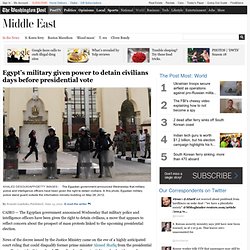
News of the decree issued by the Justice Ministry came on the eve of a highly anticipated court ruling that could disqualify former prime minister Ahmed Shafiq from the presidential runoff vote set for this weekend. The ruling has the potential to unleash widespread anger, particularly if Shafiq is not ruled ineligible under a law that bars senior officials who served under President Hosni Mubarak from political life for 10 years.
Egypt's Supreme Constitutional Court. An instant analysis of Egypt's new constitution. Nathan Brown — a professor at GWU and Carnegie Scholar whose fantastic writings on Egypt’s transition you can find at Foreign Policy and Carnegie among other places — has hastily jotted down some very quick observations on the supplementary constitutional declaration just issued by SCAF (here's a scan of the constitution [PDF] Update: English text.).

Here they are: Egypt's Transition Imbroglio - By Nathan J. Brown. The phrase "Egyptian transition process" has become tragicomically oxymoronic in light of the dizzying series of developments over the past month.

More metaphorically, events have driven entire herds of elephants stampeding through every legal and constitutional loophole in Egypt's makeshift interim political system. There are, to be sure, some rules. In the seven weeks following former President Hosni Mubarak's forced departure last year, a series of policy statements by the Supreme Council of the Armed Forces (SCAF), a set of constitutional amendments developed by an ad hoc committee appointed by the SCAF and approved in a referendum, and a "constitutional declaration" drafted secretly and proclaimed by the SCAF collectively laid out a set of procedures for rebuilding the Egyptian political order. Those procedures have largely been followed. But they have led Egypt into a state of complete confusion. Yes, there are rules. Perhaps "landmines" is the wrong explosive metaphor.
Egypt After Mubarak: Liberalism, Islam, and Democracy in the Arab World. Bruce K.

Rutherford Reviewed by David Faris, Ph.D. candidate, University of Pennsylvania Princeton University Press, 2008. 292 pages. $35.00. In Egypt after Mubarak, Bruce K. Rutherford outlines the legal, judicial and constitutional philosophies of Egypt’s major political forces. Rutherford’s work is an exemplary piece of single-case scholarship that nevertheless enhances our understanding of both Egyptian and Arab politics. Rutherford’s analysis is grounded in the historical-institutional perspective. The Struggle for Constitutional Power. For nearly three decades, scholars and policymakers have placed considerable stock in judicial reform as a panacea for the political and economic turmoil plaguing developing countries.

Courts are charged with spurring economic development, safeguarding human rights, and even facilitating transitions to democracy. How realistic are these expectations, and in what political contexts can judicial reforms deliver their expected benefits? Histories Online : The liberal age, 1923–1952. Constitutions and the rule of law in the Middle East. Johansen - The Jurisprudence of Egypt's Supreme Constitutional Court.