
Brush Up On Your EdTech Vocabulary With This Cheat Sheet. Web 2.0. Technology in Elementary School.
Top 12 Ways Technology Changed Learning. In the 21st century, technology has changed the ways in which we communicate and go about our lives.

Very few educators would disagree with the notion that technology has dramatically changed the teaching and learning process. With the help of some fellow teachers, here is a short list of the top 12 ways how technology has changed education: Communication Evolution. Learning 2.0. Resources. Aplanetwebquest [licensed for non-commercial use only] / FrontPage. Welcome to the aPLaNet (Autonomous 'Personal Learning Networks' for Language Teachers) Self-Access Piloting Webquest About aPLaNet In the first year, the aPLaNet team produced guides and resources for language teachers to help them become autonomous users of social networks.
![aplanetwebquest [licensed for non-commercial use only] / FrontPage](http://cdn.pearltrees.com/s/pic/th/aplanetwebquest-commercial-30842648)
The language teachers who are willing to build their Personal Learning Networks (PLNs) are invited to use these resources and help us test the effectiveness of them. The piloting will start on 16 January 2011 and finish on 9 March 2012 and the analysis of the piloting results will help us improve our system and resources. Update: The piloting has been extended until 30.05.2012.
Parenting & Social Media Part 2 — What Every Parent Should Know about Facebook, Twitter, YouTube, and More. As a parent, do you ever feel like your teen or young adult children are speaking a completely different language when they start talking about Facebook or Twitter?
Have you any idea what they are “blogging” about? As if text message abbreviations aren’t bad enough, now there’s even more on the internet for your kids to get into. Your Nonprofit Tech Checklist. At the end of the Social Media for Social Good: A How-To Guide for Nonprofits is a nine-page “Nonprofit Tech Checklist” which I have copied and pasted below.
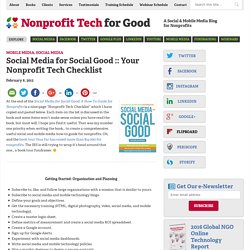
Each item on the list is discussed in the book and some items won’t make sense unless you have read the book, but most will. I hope you find it useful. That was my number one priority when writing the book… to create a comprehensive, useful social and mobile media how-to guide for nonprofits. Oh, and the book tour thus far has raised more than $14,000 for nonprofits. The IRS is still trying to wrap it’s head around that one… a book tour fundraiser. Getting Started: Organization and Planning. 45 Interesting Ways To Use Wordle In The Classroom.
Four reasons for blogging. Even though blogging is becoming more and more popular among scientists and researchers, I still notice some doubts and hesitation among my peers when it comes to blogging. Cristina Costa outlines uses of Social Media in Education. Mr. Kremer's Blog. Staffroom HQ. Why you don’t have to miss the ICT in Education articles even if you’re too busy to read them. If you’re too busy to read the articles on the ICT in Education website, you can listen to them instead.
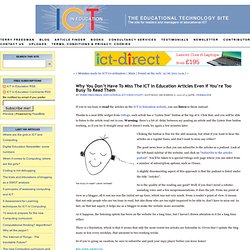
Thanks to a neat little widget from Odiogo, each article has a “Listen Now” button at the top of it.
Interactives; Virtual Tours; Virtual Labs. Internet Safety. Around The Web In ESL/EFL/ELL. Apps To Help You Deal With Too Many Apps. When you see as many apps as we do at RWW, you begin to feel like it's all been done.
So many of the everyday jobs for apps to do can already be done by at least one app (if not dozens). How many ways can you share photos with your friends? How many social networks and check-ins and restaurant-discovery services do we need? Lately, we've started to see a new class of app emerge just for managing these tasks across their various apps. The idea of apps for our apps sounds ridiculous, but some of them are neat, and some are downright lifesavers. Viewing Photos A photo app called Pixable exists just to pull the photos from your Facebook and Twitter feeds into one attractive place.
Hopefully the creators will roll Instagram, Google+ and a few other services into this app. Videos For viewing all the videos in your various social networks, Showyou is amazing. Showyou is available for iOS devices and the Kindle Fire. Files. This Week In Web 2.0. 9 Free Tools to Create Educational Cartoons. 30 Ways to use Social Media to Work Smarter. Social Learning in Practice: Separating Truth from Myth. Reality from Hype : Online Forums Archive. Research Library Guild Research delivers four specific types of research reports whose single goal is helping you make sense of the depth of our field.
Web 2.0. Web2.0. The Best Web 2.0 Applications For Education In 2012 — So Far. WebSearchEducation. Web2.0. Web2.0. Web 2.0. Web2.0 Links. Android Apps - Essential Android App Reviews & News from Recombu Apps. 6 days ago | POSTED IN Android The Olympics may be over but the 2012 summer sporting season is only just getting started. Come 3 o’clock tomorrow from Upton Park to Emirates football stadiums across the country will be brimming ... last week | POSTED IN Android Gamers the world over who’ve spent any time in front of a mouse and keyboard over a console controller should be familiar with the Steam brand. Built by game developers Valve, Steam for PC and ... 2 weeks ago | POSTED IN Android As movie franchises go, you can't get much bigger than Batman. 3 weeks ago | POSTED IN Android The Olympic games are finally here. 1 month ago | POSTED IN Android With the Olympic Games finally here, London is bracing themselves for the slew of tourists and athletes expected to engulf the city for the duration of the event.
Mobile Learning. Digital teaching sites. Education using Technology.