
Alpha: Computational Knowledge Engine. Abstract Algebra - Free Harvard Courses. Algebra Problem Solver. The Beauty of Roots. I feel like talking about some pure math, just for fun on a Sunday afternooon.

Back in 2006, Dan Christensen did something rather simple and got a surprisingly complex and interesting result. He took a whole bunch of polynomials with integer coefficients and drew their roots as points on the complex plane. The patterns were astounding! Then Sam Derbyshire joined in the game. After experimenting a bit, he decided that his favorite were polynomials whose coefficients were all 1 or -1. He then plotted all the roots using some Java programs, and created this amazing image: You really need to click on it and see a bigger version, to understand how nice it is. Here’s a closeup of the hole at 1: Note the line along the real axis! Next, here’s the hole at. Nerd Paradise : Divisibility Rules for Arbitrary Divisors. It's rather obvious when a number is divisible by 2 or 5, and some of you probably know how to tell if a number is divisible by 3, but it is possible to figure out the division 'rule' for any number.
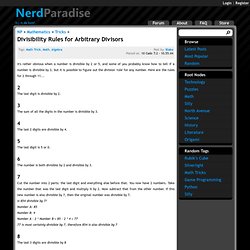
Here are the rules for 2 through 11... The last digit is divisible by 2. The sum of all the digits in the number is divisible by 3. The last 2 digits are divisible by 4. The last digit is 5 or 0. The number is both divisible by 2 and divisible by 3. Cut the number into 2 parts: the last digit and everything else before that. The last 3 digits are divisible by 8 The sum of all the digits in the number is divisible by 9. The last digit is a 0. Break the number into two parts (like you did for the division by 7 rule). Also there is a quick way for determining divisibility by 11 for 3-digit numbers: If the inner digit is larger than the two outer digits, then it is divisible by 11 if the inner digit is the sum of the two outer digits. Rules for all divisors ending in 1... User Comments: 9. Wolfram MathWorld: The Web's Most Extensive Mathematics Resource. Speed Mathematics. People who excel at mathematics use better strategies than the rest of us, they don't necessarily have better brains.
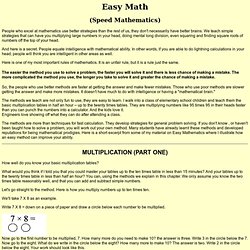
We teach simple strategies that can have you multiplying large numbers in your head, doing mental long division, even squaring and finding square roots of numbers off the top of your head. And here is a secret. People equate intelligence with mathematical ability. In other words, if you are able to do lightning calculations in your head, people will think you are intelligent in other areas as well. Here is one of my most important rules of mathematics. The easier the method you use to solve a problem, the faster you will solve it and there is less chance of making a mistake. So, the people who use better methods are faster at getting the answer and make fewer mistakes. The methods we teach are not only fun to use, they are easy to learn.
The methods are more than techniques for fast calculation. How well do you know your basic multiplication tables? Mathématique du deuxième cycle au secondaire par Sylvain Lacroix (Mathématique secondaire 3,4, 5) Technico-Sciences du cinquième secondaire. Mathématiques : cours et exercices de mathématiques, forums... Apprendre les mathématiques-cours de mathématiques gratuits.