
28 Student-Centered Instructional Strategies. 28 Student-Centered Instructional Strategies by TeachThought Staff For in-person professional development from TeachThought on effective instructional strategies or any other topic your school or district might need, contact us today.
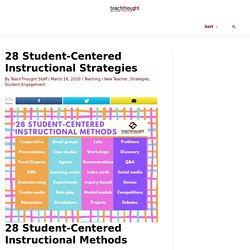
Student-centered teaching is teaching designed for the student. This means that planning often begins with the student in mind as opposed to a school policy or curriculum artifact, for example. Done well, it can disarm some of the more intimidating parts of academia, while also shortening the distance between the student and understanding. Put another way, student-centered teaching is teaching that is ‘aware’ of students and their needs above and beyond anything else.
A Secret For Learning: Don’t Take Notes With Your Laptop. Remember when being in a classroom entailed your teacher’s lesson plan being scratched onto a chalkboard?

Or watching as he or she rolled a projector into the room and brought forth the lesson onto a white screen? Why Readers, Scientifically, Are The Best People To Fall In Love With. Ever finished a book?
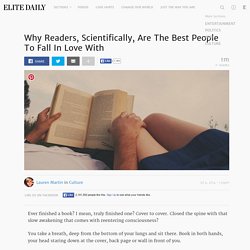
I mean, truly finished one? Cover to cover. Stressful Competitions Can Hinder Performance. Top Dog, a new book by Po Bronson and Ashley Merryman about “the science of winning and losing” is in large part a celebration of competition.

The authors of the bestselling NurtureShock explore the benefits of what they call “competitive fire” — stories of Olympic swimmers, champion chess players, and upstart political candidates who reached the top by racing someone else. But just as interesting are the cases in which we do better without the element of competition. Sometimes, it turns out, competing against others can actually make our performance worse. Secrets of the Most Successful College Students. How to Raise a Group's IQ. What makes a group intelligent?
That is: What enables a team of people to effectively solve problems and produce solutions? You might think a group’s IQ would be simply the average intelligence of the group’s members, or perhaps the intelligence of the team’s smartest participant. But researchers who study groups have found that this isn’t so. Annie Murphy Paul: Can Mindfulness Technique Help Us Focus? Fixed vs. Growth: The Two Basic Mindsets That Shape Our Lives.
“If you imagine less, less will be what you undoubtedly deserve,” Debbie Millman counseled in one of the best commencement speeches ever given, urging: “Do what you love, and don’t stop until you get what you love. Work as hard as you can, imagine immensities…” Far from Pollyanna platitude, this advice actually reflects what modern psychology knows about how belief systems about our own abilities and potential fuel our behavior and predict our success. The Trouble With Bright Girls. Five Reasons to Stop Saying "Good Job!" (**) - Alfie Kohn.
September 2001 By Alfie Kohn NOTE: An abridged version of this article was published in Parents magazine in May 2000 with the title “Hooked on Praise.”
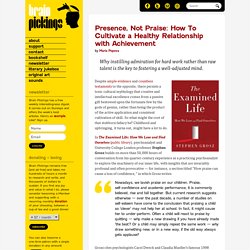
Presence, Not Praise: How To Cultivate a Healthy Relationship with Achievement. By Maria Popova Why instilling admiration for hard work rather than raw talent is the key to fostering a well-adjusted mind.
More evidence corroborating Professor Krashen and exposing the contrived skills and STEM crises. Developing Future Workskills Through Content Curation. July 27, 2012.
Susan Ohanian's Testing Outrages. The Chicago Public Schools Turnaround Model by Susan Ohanian Chicago Public School CEO Arne Duncan introduced the School Turnaround Model in 2006. You may remember that Duncan literally gutted the William T. Sherman Elementary School of staff: principals, teachers, even custodians were replaced. A year after the turnaround, the Chicago parent advocacy group Parents United for Responsible Education (PURE) researched Sherman's data and found, "during its first turnaround year, Sherman had a 20 percent drop in enrollment, a 10 percent drop in the number of low-income children, a 17 percent increase in the mobility rate, a lower parent involvement rate and lower science test scores.
" That didn't stop Duncan from touting Sherman and the turnaround model as central to his education reform plan once he was named U. Please note: The above text is copyrighted by the Chicago Public Schools-- Office of School Improvement. GlobalEd Collaborative News. The Powers Tweet Daily. 8 Wastes of Time That Can Actually Make You Smart. Intelligence Study Links Low I.Q To Prejudice, Racism, Conservatism. Are racists dumb?
Do conservatives tend to be less intelligent than liberals? A provocative new study from Brock University in Ontario suggests the answer to both questions may be a qualified yes. The study, published in Psychological Science, showed that people who score low on I.Q. tests in childhood are more likely to develop prejudiced beliefs and socially conservative politics in adulthood. I.Q., or intelligence quotient, is a score determined by standardized tests, but whether the tests truly reveal intelligence remains a topic of hot debate among psychologists. Dr. Can Schools Create a Culture of Learning By Doing? - Education. What if we had a culture of "do" instead of a culture of "know" in our schools?
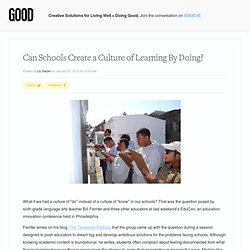
That was the question posed by sixth-grade language arts teacher Bill Ferriter and three other educators at last weekend’s EduCon, an education innovation conference held in Philadelphia. Ferriter writes on his blog, The Tempered Radical, that the group came up with the question during a session designed to push educators to dream big and develop ambitious solutions for the problems facing schools. Make online flashcards & notes. Study anywhere, anytime. New Teacher Academy: Delivery of Instruction.
Welcome to week three of Edutopia's New Teacher Academy blog series! I'm excited to be here with you sharing my passion to support and mentor new teachers. I hope that you will stay with us as we continue to look at five key topics designed to provide resources for new teachers in five key areas. To collaborate in more detail on these and other topics, I invite you to join my weekly New Teacher chat on Twitter, and also to visit my blog Teaching with Soul.
Please view this video as I share a few words on our focus for this week. Your Learning Style Profile. The table below represents some of the ways our learning skills, styles, and preferences may be categorized. Why We Need a 4th R: Reading, wRiting, aRithmetic, algoRithms. When Frederick J.