
Lawmaker slams Bank for withholding minutes of 2007 talks. LONDON Mon Oct 31, 2011 12:04am GMT LONDON (Reuters) - A senior legislator has attacked the Bank of England's supervisory body for its refusal to provide details to parliament about talks held over the collapse of bank Northern Rock in 2007.
The complaint by Andrew Tyrie, who chairs the House of Commons' Treasury Committee, highlights parliamentarians' concerns about the Bank's lack of accountability at a time when it is about to be handed far-reaching new powers in the government's overhaul of Britain's financial regulation. The Bank's Court, which oversees the Bank's conduct but does not influence policy, refused to provide Tyrie's committee with detailed minutes of talks relating to the financial crisis. Tous les articles : FrancisLefebvre. Monetary aggregates. Monetary aggregates comprise monetary liabilities of MFIs and central government (post office, treasury, etc.) vis-à-vis non-MFI euro area residents excluding central government.
M1 is the sum of currency in circulation and overnight deposits; M2 is the sum of M1, deposits with an agreed maturity of up to two years and deposits redeemable at notice of up to three months; and M3 is the sum of M2, repurchase agreements, money market fund shares/units and debt securities with a maturity of up to two years. L'IFI réclame une pause dans la régulation bancaire. LONDRES, 2 novembre (Reuters) - Il faudra marquer une pause dans le renforcement de la régulation du secteur bancaire sous peine de provoquer une contraction du crédit en Europe et dans les principales économies avec les risques que cela comporte pour la croissance et l'emploi, a estimé mercredi l'Institut de la finance internationale (IFI).
Selon l'IFI, qui regroupe les principales institutions financières mondiales, les exigences plus élevées en matière de fonds propres pourraient faire baisser d'au-moins 5% les crédits aux entreprises de la zone euro. "Les responsables politiques doivent marquer une pause dans l'introduction de nouvelles mesures de régulation, tandis que les éléments clés de la réforme, comme la hausse de la base de fonds propres (...) sont mises en place", a déclaré Charles Dallara, directeur général de l'IFI.
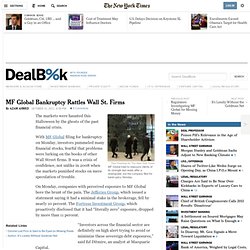
MF Global Bankruptcy Rattles Wall St. Firms. Tina Fineberg for The New York TimesMF Global tried to reassure clients of its strength last week after a downgrade, but the company filed for bankruptcy Monday.
The markets were haunted this Halloween by the ghosts of the past financial crisis. With MF Global filing for bankruptcy on Monday, investors pummeled many financial stocks, fearful that problems were lurking on the books of other Wall Street firms. It was a crisis of confidence, not unlike in 2008 when the markets punished stocks on mere speculation of trouble.
On Monday, companies with perceived exposure to MF Global bore the brunt of the pain. The Jefferies Group, which issued a statement saying it had a minimal stake in the brokerage, fell by nearly 10 percent. “Investors across the financial sector are definitely on high alert trying to avoid or minimize these sovereign debt exposures,” said Ed Ditmire, an analyst at Macquarie Capital. MF Global made a risky bet in a tumultuous market. Encore une affaire mettant en cause les pratiques des huissiers de justice, (officiers ministériels assermentés nommés par le Ministère de la Justice). Un nouveau dossier vient de tomber, comme chaque jour maintenant.

Il met en cause un huissier, mais par n’importe lequel, celui officiant pour les services fiscaux du XVème arrondissement. Les faits : Une Société civile immobilière doit environ 460 euros aux impôts. La dette est reconnue et seule des difficultés financières empêchent le représentant de cette société de s’en acquitter. L’huissier intervient comme il se doit. Il décide une saisie arrêt sur une des deux pensions du gérant de la Société. Cette saisie arrêt est de 154 euros début juillet, début août et début septembre 2011. Le 3 septembre, le gérant vient régler la totalité. Le trésor public confirme la mainlevée auprès de l’organisme de pension n° 1. Jusqu’à présent, tout est normal, c’est une scène de la vie quotidienne. Did You Hear the One About the Bankers?