
Waving or Drowning: Developing Countries After The Financial Crisis. Yilmaz Akyuz More than five years since the outbreak of the global financial crisis, the world economy shows little sign of stabilizing and moving towards strong and sustained growth.

Because of policy shortcomings in removing the debt overhang and providing strong fiscal stimulus to make up for private sector retrenchment, the crisis in the US and Europe has been taking too long to resolve. While deleveraging continues to stifle private demand, economic activity is further restrained by fiscal drag in these two epicentres of the crisis as governments have turned to fiscal orthodoxy after an initial reflation. Developing countries (DCs) are not decoupled from AEs, contrary to what was widely believed during their unprecedented growth in the run-up to the global crisis. With continued instability and downturn in AEs, the structural weaknesses in DCs are exposed. Such a return to business-as-usual could be disastrous for the world economy, not just for the US. ShareThis. Pettis, M.: The Great Rebalancing: Trade, Conflict, and the Perilous Road Ahead for the World Economy.
China's economic growth is sputtering, the Euro is under threat, and the United States is combating serious trade disadvantages.
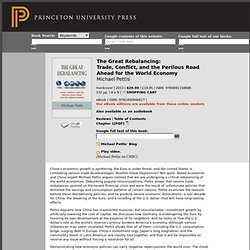
Another Great Depression? Not quite. Noted economist and China expert Michael Pettis argues instead that we are undergoing a critical rebalancing of the world economies. Debunking popular misconceptions, Pettis shows that severe trade imbalances spurred on the recent financial crisis and were the result of unfortunate policies that distorted the savings and consumption patterns of certain nations. Pettis examines the reasons behind these destabilizing policies, and he predicts severe economic dislocations--a lost decade for China, the breaking of the Euro, and a receding of the U.S. dollar--that will have long-lasting effects.
Pettis explains how China has maintained massive--but unsustainable--investment growth by artificially lowering the cost of capital. Review: "[Michael Pettis is] a brilliant economic thinker. " "Insightful. . . . More reviews Subject Areas: Evergreen-college-talkdiscussion-14-feb-2013. Guest post: The Crisis as a repercussion of global imbalances, by Peter Dorman. ShiftingWealth: MGG Public Lecture (30 July 2012, at GDI/DIE) Shifting wealth: rising powers and the new world order (in 16 paragraphs) 1.

How has the global development scene changed by the rising powers, or as we at the OECD Development Centre call them, the convergers? It has diversified the pool of actors, aid instruments, capital, trade and tax revenues to low-income countries; it has allowed low-income countries to switch to the growth engine that works; and it has loosened up the policy and paradigm monopole once solidly occupied by the old donor cartel around Bretton Woods institutions and the DAC. While overall it has been good news for poor countries, it has been rather bad news for aid bureaucracies, for compliance with global soft law, and for donor (& NGO) rethoric and posture. 2. 3. 4. 5. 6. 7. 8. 9. 10. 11. 12. 13. 14.
The OECD and other international organisations have developed mechanisms to raise the compliance with soft law, the major instrument being the peer review.