
Ha-Joon Chang, "Kicking Away the Ladder" Www.paecon.net Post-Autistic Economics Review Kicking Away the Ladder: How the Economic and Intellectual Histories of Capitalism Have Been Re-Written to Justify Neo-Liberal Capitalism Ha-Joon Chang () There is currently great pressure on developing countries to adopt a set of “good policies” and “good institutions” – such as liberalisation of trade and investment and strong patent law – to foster their economic development.
When some developing countries show reluctance in adopting them, the proponents of this recipe often find it difficult to understand these countries’ stupidity in not accepting such a tried and tested recipe for development. Naturally, there have been heated debates on whether these recommended policies and institutions are appropriate for developing countries. Almost all of today’s rich countries used tariff protection and subsidies to develop their industries. List was not alone in seeing the matter in this light. What can be done to change this? Historical School of Economics. Historical school of economics. The historical school of economics was an approach to academic economics and to public administration that emerged in the 19th century in Germany, and held sway there until well into the 20th century.
Tenets[edit] The historical school held that history was the key source of knowledge about human actions and economic matters, since economics was culture-specific, and hence not generalizable over space and time. The school rejected the universal validity of economic theorems. They saw economics as resulting from careful empirical and historical analysis instead of from logic and mathematics.
The school also preferred reality, historical, political, and social, as well as economic, to mathematical modelling. Most members of the school were also Sozialpolitiker (social policy advocats), i.e. concerned with social reform and improved conditions for the common man during a period of heavy industrialization. The historical school can be divided into three tendencies:[1] English school[edit]
Friedrich List. Georg Friedrich List (August 6, 1789 – November 30, 1846) was a leading 19th-century German-American[2] economist who developed the "National System" or what some[3] would call today the National System of Innovation.
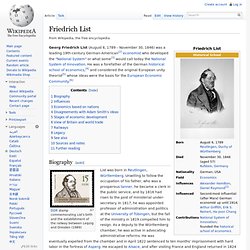
He was a forefather of the German historical school of economics,[4] and considered the original European unity theorist[5] whose ideas were the basis for the European Economic Community.[6] Biography[edit] DDR stamp commemorating List's birth and the establishment of the railway between Leipzig and Dresden (1989) List was born in Reutlingen, Württemberg. Unwilling to follow the occupation of his father, who was a prosperous tanner, he became a clerk in the public service, and by 1816 had risen to the post of ministerial under-secretary. In 1830, he was appointed United States consul at Hamburg, but on his arrival in Europe in he found that the Senate had failed to confirm his appointment.[8] After residing for some time in Paris, he returned to Pennsylvania. Railways[edit] Gustav von Schmoller.
Gustav von Schmoller (German: [ˈʃmɔlɐ] ( ); 24 June 1838 – 27 June 1917) was the leader of the "younger" German historical school of economics.
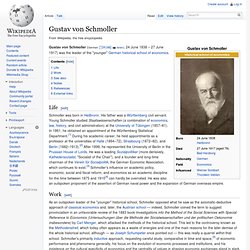
Life[edit] Schmoller was born in Heilbronn. His father was a Württemberg civil servant. Young Schmoller studied Staatswissenschaften (a combination of economics, law, history, and civil administration) at the University of Tübingen (1857–61). Work[edit] As an outspoken leader of the "younger" historical school, Schmoller opposed what he saw as the axiomatic-deductive approach of classical economics and, later, the Austrian school — indeed, Schmoller coined the term to suggest provincialism in an unfavorable review of the 1883 book Investigations into the Method of the Social Sciences with Special Reference to Economics (Untersuchungen über die Methode der Socialwissenschaften und der politischen Oekonomie insbesondere) by Carl Menger, which attacked the methods of the historical school.
Works by Schmoller His magnum opus is See also[edit] Notes[edit]