
Did Securitization Lead to Riskier Corporate Lending? João Santos There’s ample evidence that securitization led mortgage lenders to take more risk, thereby contributing to a large increase in mortgage delinquencies during the financial crisis.
In this post, I discuss evidence from a recent research study I undertook with Vitaly Bord suggesting that securitization also led to riskier corporate lending. We show that during the boom years of securitization, corporate loans that banks securitized at loan origination underperformed similar, unsecuritized loans originated by the same banks. Additionally, we report evidence suggesting that the performance gap reflects looser underwriting standards applied by banks to loans they securitize.
Historically, banks kept on their books the loans they originated. Corporate loan securitization appealed to banks because it gave them an opportunity to sell loans off their balance sheets—particularly riskier loans, which have been traditionally more difficult to syndicate. A Demon of Our Own Design: Markets, Hedge Funds, and the Perils of Financial Innovation. "A risk-management maven who's been on Wall Street for decades…Bookstaber's book shows us some complex strategies that very smart people followed to seemingly reduce risk—but that led to huge losses.
" (Newsweek) "Mr. Bookstaber is one of Wall Street's 'rocket scientists'--mathematicians lured from academia to help create both complex financial instruments and new computer models for making investing decisions. Financialization and the World Economy. A Demon of Our Own Design: Markets, Hedge Funds, and the Perils of Financial Innovation. "A risk-management maven who's been on Wall Street for decades…Bookstaber's book shows us some complex strategies that very smart people followed to seemingly reduce risk—but that led to huge losses.
" (Newsweek) "Mr. Bookstaber is one of Wall Street's 'rocket scientists'--mathematicians lured from academia to help create both complex financial instruments and new computer models for making investing decisions.
Finance capitalism - curators... Broken Markets: How High Frequency Trading and Predatory Practices on Wall Street are Destroying Investor Confidence and Your Portfolio. Financial engineering as a career: Part 1. The other day the new MSFE students showed up at Columbia for orientation and I had to welcome them. These are some notes from what I said. Part 1Background Several years ago, my son, who did a PhD thesis on the reception history of Max Weber, the founding father of sociology, introduced me to two influential essays by Weber, entitled respectively Science as a Vocation and Politics as a Vocation.
In them Weber discusses what problems you have to face, and what personality and character you have to own, if you decide to make these fields your calling, and he’s surprisingly thoughtful and yet practical about it.I thought it would be interesting to begin to think about the same questions with respect to entering the field of Quantitative Finance, particularly from a practitioner’s point of view. Financial “Engineering“?! So what is financial engineering? But what exactly is financial science? Structured Finance / Derviatives / Securitization. Ongoing Research - Market Events and Phenomena.
Mike Konczal: '13 Bankers,' Financialization and the Real Economy. How has financialization changed the real economy?
James and Simon do an excellent job tracing the history of the conflict between the financial sector and the government in their book "13 Bankers. " They do this history in two dimensions: first as a history of the United States' complicated relationship with the financial sector and large, concentrated banks, and second as a cross-section of the world in the late 1990s and early 21st century. From Andrew Jackson to recent problems in South Korea, they tell a narrative that connects ways in which the financial sector, when too big and too connected, is capable of capturing their regulators. The financialisation of commodities. Crude oil, copper, cotton, soybeans, and live cattle – a seemingly unrelated set of commodities – went through a synchronised boom and bust cycle between 2006 and 2008 (see Figure 1).
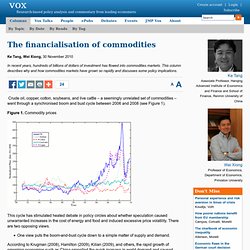
Figure 1. Commodity prices. Jungle Ethics Financialism vs. Free Market Capitalism. The ‘Financialization’ of Commodities - Real Time Economics - WS. Crapshoot Investing: How Tech-Savvy Traders and Clueless Regulators Turned the Stock Market into a Casino. In Crapshoot Investing: How Tech-Savvy Traders and Clueless Regulators Turned the Stock Market into a Casino, James McTague, Barron’s Washington Editor, chronicles the effects of High Frequency Trading (HFT) from the crash of October 1987 to last year’s Flash Crash.
McTague say that equity markets are now “high-speed casinos rigged against individual investors.” In the book, he traces the development of HFT, explains why the Flash Crash happened, and why the odds strongly favor a major re-occurrence again. Derivative Concentration Threaten Global Economy. Derivatives Ownership Even More Concentrated Than Ever As I noted in 2009, 5 banks held 80% of America’s derivatives risk.
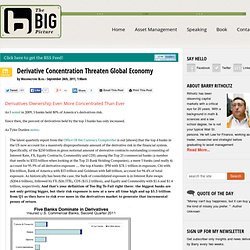
Since then, the percent of derivatives held by the top 5 banks has only increased. As Tyler Durden notes: The latest quarterly report from the Office Of the Currency Comptroller is out [shows] that the top 4 banks in the US now account for a massively disproportionate amount of the derivative risk in the financial system. Specifically, of the $250 trillion in gross notional amount of derivative contracts outstanding (consisting of Interest Rate, FX, Equity Contracts, Commodity and CDS) among the Top 25 commercial banks (a number that swells to $333 trillion when looking at the Top 25 Bank Holding Companies), a mere 5 banks (and really 4) account for 95.9% of all derivative exposure …. the top 4 banks: JPM with $78.1 trillion in exposure, Citi with $56 trillion, Bank of America with $53 trillion and Goldman with $48 trillion, account for 94.4% of total exposure.