
Inforegio: EU Regional Policy - Project examples - Policy Learning Database. Idw - Meerwasserentsalzung mit neuartigen Solarkollektoren. Fraunhofer-Institut erschließt neue Anwendungsfelder für Sonnenenergie:Meerwasserentsalzung mit neuartigen Solarkollektoren Wußten Sie, daß etwa 2% des weltweit aus Meerwasser gewonnenen Süßwassers auf den Kanarischen Inseln erzeugt und verbraucht wird?
Das Fraunhofer-Institut für Solare Energiesysteme ISE stellt jetzt ein von der Europäischen Gemeinschaft gefördertes Projekt vor: Ziel ist die Entwicklung von Kollektoren mit korrosionsfesten Kunststoffabsorbern, die in einer Demonstrationsanlage zur Meerwasserentsalzung eingesetzt werden. Mit von der Partie sind das Centro de Investigacion en Energia y Agua CIEA aus Gran Canaria, die Agricultural University of Athens, das Zentrum für Angewandte Energieforschung ZAE, München und die Firma Thermisch Angetriebene Systeme TAS, München.
Thermische Wasseraufbereitungsanlagen sind bisher meist dieselbetrieben. Kernstück sind 50m2 der neuen Kollektoren mit Kunststoffabsorbern. Membrandestillation. Bei der Membrandestillation handelt es sich um ein thermisch getriebenes Separationsverfahren, bei dem die Separation aufgrund eines Phasenwechsels erfolgt.
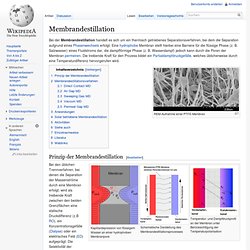
Eine hydrophobe Membran stellt hierbei eine Barriere für die flüssige Phase (z. B. Salzwasser) eines Fluidstroms dar, die dampfförmige Phase (z. B. Wasserdampf) jedoch kann durch die Poren der Membran permeiren. Meerwasser-Entsalzung: Eine neuartige Technik nutzt die Sonne und ist gegen Korrosion unempfindlich - Gesundheit - Welt. 25.06.2000 00:00 Uhr Die jüngst auf Gran Canaria in Betrieb genommene Demonstrationsanlage zur Meerwasser-Entsalzung eignet sich gerade für Gegenden der Erde, die eine schlechte Infrastruktur besitzen.

Matthias Rommel, Physiker vom Fraunhofer Institut für solare Energiesysteme (ISE) in Freiburg betonte, dies liege vorrangig an der neuartigen Technik. In den Kollektoren wird das Wasser direkt durch die Sonnenenergie erhitzt. "Bislang konnten dafür nur Rohrsysteme aus Kupfer, Stahl oder anderen Metallen verwendet werden", sagte Rommel. Diese Rohre halten allerdings den chemischen und physikalischen Belastungen durch heißes Meerwasser nicht lange stand. Dezentrale Wasseraufbereitung. Solarspring: Home. Redox-flow batteries - ISEA - Institut für Stromrichtertechnik und Elektrische Antriebe. Flow battery.
Projektziele. Im Mittelpunkt des Projektes steht die effektive Verwertung von Rest- und Abfallstoffen im Botanischen Garten Berlin.
Als Rest- und Abfallstoffe zählen im Botanischen Garten u.a. Laub, Rasen-, Baum- und Strauchschnitt. Ziel dabei ist es, einen wesentlichen Beitrag zum nachhaltigen Bodenmanagement im Bereich des Urban farming auch unter dem Blickwinkel der Vermeidung von Kohlenstoff- und Nährstoffverlusten und der Anpassung an die Folgen der Klimaveränderungsprozesse zu leisten. Ausgangslage Im Botanischen Garten Berlin fallen jährlich etwa 750 m3 Grünschnitt, 350 m3 Gehölzschnitt, 230 m3 Langgrasschnitt und 150 m3 Stammholz an.
Die Terra Preta nova Technologie Entsprechen die Qualitäten der Rohsubstrate, die im BGBM produziert werden, den Erfordernissen für die Herstellung der anthropogenen Schwarzerden, Terra Preta nova (TPn), kann der Stoffkreislauf innerhalb des BGBM geschlossen werden. Home - PYREG Pflanzenkohle. BBC Two - Jimmy's Global Harvest, Australia. Doubling yield by restricting irrigated water supply - soc.culture.indian. Amazing second progrnam where Jimmy visits an Australian farmwhere they irrigate with holes in the pipes , laid on opposite side ofgrape vines.
They turn off water supply to one side of the plants so theplant thinks there is a drought and shuts down the stomata whichevaporter water and oxygen . The other side is watered which gets tothe growing grapes. Yields have gone up and water requirements cut. Another item was a calcium solution which replaces salt in thesoil and allows water to penetrate deeper into it giving healthierplants. Hövding - Den osynliga cykelhjälmen. Biotechnik gegen Klimakiller: Algen sollen Treibhausgas fressen. Wissen Donnerstag, 22.
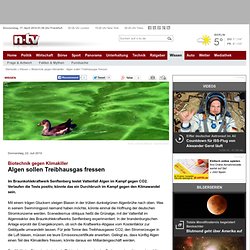
Juli 2010 Im Braunkohlekraftwerk Senftenberg testet Vattenfall Algen im Kampf gegen CO2. Verlaufen die Tests positiv, könnte das ein Durchbruch im Kampf gegen den Klimawandel sein. Mit einem trägen Gluckern steigen Blasen in der trüben dunkelgrünen Algenbrühe nach oben. Die 28-jährige Biotechnologin Janin Thiele nimmt gerade eine Probe aus dem Algenreaktor. Gesetze der Photosynthese Ihr Job ist es, in einem zunächst eineinhalbjährigen Pilotprojekt zu ergründen, ob die Algen mit den ungefilterten Kraftwerks-Abgasen zurechtkommen, die neben dem Klimakiller etwa auch Schwefel oder Schwermetalle enthält. Der Algenreaktor nutzt die seit langem bekannten Gesetze der Photosynthese: Pflanzen nehmen Kohlendioxid auf und wandeln sie mit Hilfe von Licht zu Biomasse.
Bioreaktoren in der Zukunft? Für Janin Thiele schließt sich mit der grünen Mission zugunsten der Braunkohle ein Kreis. EE-Gas. Als Power-to-Gas (kurz PtG oder P2G, deutsch etwa: „Elektrische Energie zu Gas“) wird ein chemischer Prozess bezeichnet, in dem mittels Wasserelektrolyse mit teilweise nachgeschalteter Methanisierung unter dem Einsatz von Strom aus erneuerbaren Energien (EE) ein Brenngas hergestellt wird.[1] Das so erzeugte Gas wird auch als EE-Gas bezeichnet.
Je nach Art der eingesetzten erneuerbaren Energie wird das Gas auch Windgas, Solargas oder ähnlich genannt, je nach chemischer Zusammensetzung des Gases wird statt des Begriffes „Gas“ auch „Methan“ oder „Wasserstoff“ verwendet. Power-to-Gas-Konzept[Bearbeiten] Schematische Darstellung eines Wind-to-Gas-Hybridkraftwerkes (integrierte elektrolytische Wasserstoffherstellung ohne nachfolgende Methanisierung) Eine mögliche Definition von Power to Gas lautet:
Dye-sensitized solar cell. GmbH - About us. TECNARO GmbH develops, produces and markets ARBOFORM® (lat.: arbor — the tree), a sustainable thermoplastic material, with a capacity of 5,000t annual output at present, which can be increased easily.
ARBOFORM® is made from 100% renewable raw materials and, because of its origin and composition, is mainly used for injection moulded wood applications. ARBOFORM® brings two industries together. Bioplastic. Bioplastics are plastics derived from renewable biomass sources, such as vegetable fats and oils, corn starch, pea starch[1] or microbiota.[2] Common plastics, such as fossil-fuel plastics, are derived from petroleum; these plastics rely more on fossil fuels and produce more greenhouse gas.
Some, but not all, bioplastics are designed to biodegrade. Biodegradable bioplastics can break down in either anaerobic or aerobic environments, depending on how they are manufactured. There is a variety of materials that bioplastics can be composed of, including: starches, cellulose, or other biopolymers. Some common applications of bioplastics are packaging materials, dining utensils, food packaging, and insulation.[3] Kunststoffe aus Orangenschalen — FMF - Freiburger Materialforschungszentrum.
Die Kunststoffindustrie sucht heute nach alternativen Rohstoffquellen, um in Zukunft vom knapper und teurer werdenden Erdöl unabhängig zu sein.
Darüber hinaus ist es für sie von Interesse, das klimaschädliche Kohlenstoffdioxid chemisch zu fixieren. Prof. Dr. Rolf Mülhaupt, Freiburger Materialforschungszentrum (FMF) und Institut für Makromolekulare Chemie der Universität Freiburg, hat zusammen mit seinem Mitarbeiter Moritz Bähr aus dem Naturstoff Limonen und den in der Luft vorkommenden Gasen Sauerstoff und Kohlenstoffdioxid den Zugang zu neuen bio-basierten Kunststoffen eröffnet. Den Forscherinnen und Forschern ist es erstmals gelungen, in einem Verfahren Limonenoxid mit Kohlendioxid umzusetzen, ohne dabei Lösungsmittel einzusetzen. Die Wissenschaftler setzten als Aminhärter erstmals die in Freiburg maßgeschneiderten Zitronensäureamidoamine ein, die ebenfalls aus Zitrusfrüchten gewonnen werden.
Das Freiburger Verfahren basiert auf der grünen Chemie. Cyclic limonene dicarbonate as a new monomer for non-isocyanate oligo- and polyurethanes (NIPU) based upon terpenes - Green Chemistry. Biodegradable plastic from polystyrene - Pseudomonas putida CA-3. Worldwide, more than 14 million metric tons of polystyrene are produced annually and it is so durable that it takes thousands of years to decompose. With 70% of polystyrene ending up in landfill within a year of manufacture and 99% of all polystyrene ultimately ending up in dumps, the long term problem created by this versatile plastic is causing major anxiety among local and national governments throughout the world.
Greentech Media.