
background preloader

Gardening

Facebook Twitter

Plant Spacing - My Square Foot Garden. Here is a chart of plants and how many to plant per square. See below for explanations on how to calculate and sample pictures. To calculate how many plants per square, look on the back of the seed packet–ignore the row spacing, just look at the plant spacing: 3″ plant spacing = 16 per square 4″ plant spacing = 9 per square 6″ plant spacing = 4 per square 12″ plant spacing = 1 per square 3″ plant spacing with trellis = 8 per square Some plants require more than one square. 18″ plant spacing = 4 in 9 squares 24″ plant spacing with trellis = 2 squares 24″ plant spacing with cage = 4 squares. Planting Guide | Your Garden Solution. Planting Guide (Based on USDA 2012 Hardiness zones of between 6b and 7a) Below is a helpful planting guide for use in square foot gardens. Note that the number beside the vegetable indicates the # that can be planted in one square foot.


Remember, in a 4×4 square foot garden, there are 16 designated squares, outlined by the grid on top of your garden. Please note, as you begin planting, think about how many days each vegetable will take to reach harvest. You will want to plant those vegetable plants that have the shortest harvest period on the outside squares of the SFG.

This way, you will not need to reach in as far and, in turn, it is easier to harvest! Early Spring Plant March 20-April 15 Sugar Peas-9 per square foot Kale-4 Onions-16 (small) or 9 (medium) Radishes-16 Lettuce-4 Carrots-16 Red Beets-large (9 per square) small (16 per square) Early Cabbage-1 Broccoli-1 Brussel Sprouts-1 Cauliflower-1 Garden Peas-9 Spinach-9 Swiss Chard-4 Strawberries-4 Chive-16 Mint-1 Mid-Spring Plant April 15- April 30. Willis Orchard Company | Buy Fruit Trees | Berry Plants | Grape Vines | Nut Trees | Shade Trees. Scythe Supply - Quick Start Manual. Articles: Quick Start Manual Oh, we know how excited you are to begin mowing with your new scythe.

We've been there, too. But, please take a few minutes and review this “Quick Start” information. It will save you some frustration and possible damage to your scythe. Jumping into mowing, swinging it hard like you're trying to drive a home run over the left field fence will only tire you out and likely break the snath, dent, bend or break the blade. Take a look at that blade. You have spent good money, and we have put in a fair amount of time making sure this scythe is made from sound material, is in good shape, sharp (if you requested it) and sized to fit you.

There is an art to mowing with a scythe. Scything is a gentle art. At the beginning of the stroke engage only the first third of the blade in the grass. Practice the motion in a cleared space then begin mowing grass by taking small bites, moving the blade in a short arc in front of you. Here are the secrets to mowing with a scythe. Farm fresh, in the city: Urban farming in Newark. MITSU YASUKAWA/THE STAR-LEDGERJohn Taylor waters plants at Brick City Urban Farms' garden near Lincoln Park in Newark.
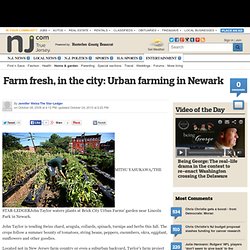
John Taylor is tending Swiss chard, arugula, collards, spinach, turnips and herbs this fall. The crops follow a summer bounty of tomatoes, string beans, peppers, cucumbers, okra, eggplant, sunflowers and other goodies. Located not in New Jersey farm country or even a suburban backyard, Taylor's farm project is brightening a fenced-in half-acre in downtown Newark. It's a neatly arranged quarter-acre garden that uses some principles of small plot intensive, or "Spin" farming, a concept Canadian farmer Wally Satzewich turned into a company after his experiment in downsizing proved fruitful.

Taylor's experiment, Brick City Urban Farms, aims to bring fresh produce to Newark residents and restaurants, and has already given it -- and some measure of excitement -- to passers-by. The agency plans to build a four-story apartment building on the site next year. Spin farming. Rodale Institute :: Organic Pioneers since 1947. World Naked Gardening Day (WNGD) - First Saturday of May! Would You Like to be the Owner of a Profitable Plant Growing Business - Growing For Market? Coalition of Austin Community Gardens. American Community Gardening Association. The Guerrilla Gardening Home Page. Growing Mushrooms: Video Series. How you will go about growing mushrooms will vary depending on what you want to do with those mushrooms when everything is said and done.
Learn about growing mushrooms with help from experienced mushroom professionals in this free video series. How to Grow Mushrooms to Eat Growing mushrooms to eat requires a few key changes to the process you would go through if you were just growing mushrooms under normal circumstances. Grow mushrooms to eat with help from experienced mushroom professionals in this free video clip. How to Grow a Mushroom Plant Growing mushroom plants is something you can do using a very specifically designed kit. How to Grow Mushrooms in the Dark Just because you have an area without a lot of sunlight doesn't mean you can't still grow mushrooms.

Sauteed Mushrooms in Red Wine Over Steak There are few delicacies more delectable than sauteed mushrooms in red wine over steak. Mushroom Fennel Salad Mushroom fennel salad is a delicious treat that the whole family will love. Central Texas Gardening Database. Click on the plants from the list to see its facts and description: (Although no plants made this list unless they are good ones for Central Texas, the plants with an * are the very best you can get for a successful Texas Garden.) After several requests from my readers, I have added a warning sign to those plants that are considered invasive. You will have to decide whether or not to plant these. They are good for your yard, but certainly not for our wildlife and natural plants. Althea: This is a small tree with hibiscus-like flowers in the summertime. Deciduous, 10'--15' feet. Apple: Plant apple trees in full sun and enjoy their spring blooms and a harvest of crisp, fresh apples. Catalpa: Large, deciduous tree with showy flowers in the spring and big, pretty leaves.
Carolina Buckthorn: A nice deciduous tree for sun to shade, with a height of 15 to 30 feet. Chinese Photinia: One of my favorite trees. Crape Myrtle: These come in two sizes, this one is a tree, the other a shrub.

Pests

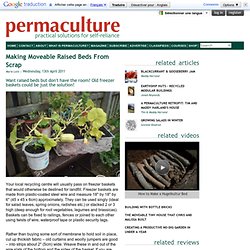
Making Moveable Raised Beds From Scrap. Your local recycling centre will usually pass on freezer baskets that would otherwise be destined for landfill. Freezer baskets are made from plastic-coated steel wire and measure 18" by 18" by 6" (45 x 45 x 6cm) approximately. They can be used singly (ideal for salad leaves, spring onions, radishes etc.) or stacked 2 or 3 high (deep enough for root vegetables, legumes and brassicas). Baskets can be fixed to railings, fences or joined to each other using twists of wire, waterproof tape or plastic security tags. Rather than buying some sort of membrane to hold soil in place, cut up thickish fabric – old curtains and woolly jumpers are good – into strips about 2" (5cm) wide. Fill with a soil and compost mixture and start planting and remember that strawberries, nasturtiums and herbs can be grown from the sides rather than take up room on the top. Maria Lalic, www.coblynes.co.uk.
Hugelkulture

DIY Vertical Garden | How To Start | Gardening Tips ‘n Ideas. A DIY Vertical Garden Example Ever since coming across Patrick Blanc’s vertical garden I’ve been interested to observe how this technology might transform the home gardening scene. I mean, it’s only a matter of time before we begin running out room for gardens to grow on a horizontal plane. Yet vertical – that’s another dimension altogether. For most home gardeners the concept isn’t a new one. We’ve been staking tomato plants, espaliering fruit trees and training creepers to grow over undesirable fences for aeons. The reason: Whereas all our other vertical gardening exploits centred around plants being grounded in the soil, the vertical garden has absolutely no dependency on the ground. But for most home gardeners, Patrick Blanc and his artworks are far beyond the comprehension and resources available to them.

However, as we have already experienced with increasing gas prices our conservative views of the world may need to change. So, here’s a challenge for us all – myself included. Gardening in Central Texas.

Wildcrafting

Plant Hardiness Zone Map. Composting. Biophile Magazine -- » Circle Gardens: a discovery par excellence! FILED IN: Green Gardening · Issue 15 · Soil For Life Save water and increase production with a new way of gardening. I first read about ‘ecocircles’ (‘circles of cultivation’) in a Land magazine dating back to 1998. The article was written by Anthony Trowbridge of Applied Natural Sciences at Technikon SA.

In a recent telephone conversation with him he enthusiastically endorsed this way of growing as a means not only to save on labour, but also to provide a unique and simple way of growing large amounts of food in small spaces using very little water. Not only can the method be effectively used by the home gardener, but it can also be used on a commercial scale, where its low-tech requirements reduce capital costs. There are many benefits of growing in this way: • You can grow lots of food in small spaces.

In our Resource Centre garden we have been in awe of how much food comes out of one circle. . • Raised beds give an increased depth for establishing healthy root systems. Go on. Do it today.

Food Forest

Hot and Humid. Hot and Humid: The Southeast This warm band extends from east Texas through the coastal Carolinas. This region corresponds with USDA Zones 8–9 and Sunset Zones 26–28 and 31. Perennial in all of the Hot and Humid zone: Allium ampeloprasum perennial sweet leek Allium cepa aggregatum shallot Allium cepa aggregatum potato onion Allium cepa proliferum walking onion Allium fistulosum Welsh onion Allium tuberosum garlic chives Apios americana groundnut Aralia cordata udo Arundinaria gigantean canebrake bamboo Asparagus officinalis asparagus Asphodeline lutea yellow asphodel Atriplex halimus saltbush Bambusa spp. clumping bamboos Brassica oleracea acephala tropical tree kale Bunias orientalis Turkish rocket Camassia scillioides wild hyacinth Canna edulis achira Cedrella sinensis fragrant spring tree Cnidoscolus spp. bull nettles Colocasia esculenta ‘Celery Stem’ taro Colocasia esculenta taro, cocoyam, eddo, dasheen Cynara cardunculus cardoon Cynara scolymus ‘Purple Sicilian’ globe artichoke Dioscorea japonica jinenjo.