
Hana Lima 'Ia 'Ukulele Construction Manual. How to bind or route the edges of your ukulele. WaverlyStreet Design Ukulele Site. We have available detailed, full-size 24" x 36" shop drawings of both soprano and concert scale ukuleles, suitable for someone "handy" to use to make their own. $14.00 US each including postage.
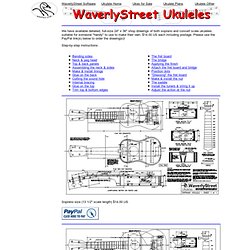
Please use the PayPal link(s) below to order the drawing(s)! Step-by-step instructions: Cigar Box Dimensions. Home - Pete Howlett Ukulele. Ukulele Building / Luthier's Lounge. Images/pdf files/How to Make a Cigar Box Ukulele.pdf. The Ukulele Hut - Build, Make, Tune, Learn to Play your Ukulele. Ukeuncle's Channel. Dimensions of Ukulele Sizes and Scaling Dimensions.
Www.ukulelebooks.com/images/excerpts.pdf. Building a Ukulele. Ukulele Sizes – Soprano, Concert, Tenor, Baritone. Many people seem to think that ‘ukulele size determines how you play.

While you do alter your stance and approach to accommodate different sizes, you don’t have to change your knowledge or learn anything new. There is no “how do I play a tenor vs. how do I play a soprano?” The only size that might take some different thinking would be the baritone, because it is tuned differently. Here is a rundown of the main ‘ukulele sizes from smallest to biggest. The scale length is the distance of the ringing string – from the nut to the saddle.
Soprano (or Standard) ‘Ukulele Scale length: 13-14 in. The smallest size in the ‘ukulele family, the soprano has the recognizable plinky sound that everyone associates with the instrument. Concert ‘Ukulele Scale length: 15-16 in. The concert sized ‘ukulele spans the gap between the “plinky” soprano sound and the fuller tenor sound. Tenor ‘Ukulele Scale length: 17-18 in. Baritone ‘Ukulele Scale length: 19-20 in. LUTHERIE.HTM. By Al McWhorter - Member, Guild of American Luthiers All Text and Photos Copyright © 2002 by Al McWhorter Lutherie is something that I've wanted to try for many years and, finally, in the second half of my life, I am able to devote the time to its pursuit.
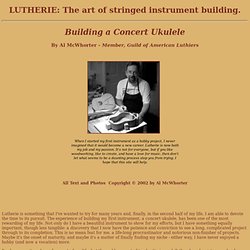
The experience of building my first instrument, a concert ukulele, has been one of the most rewarding of my life. Not only do I have a beautiful instrument to show for my efforts, but I have something equally important, though less tangible: a discovery that I now have the patience and conviction to see a long, complicated project through to its completion. This is no mean feat for me, a life-long procrastinator and notorious non-finisher of projects. I've been a guitar player for most of my life, but the sudden onset of tendonitis in my left thumb and wrist a couple of years ago made it difficult to chord a guitar. After searching the internet for ukulele building supplies, I settled on a basic. Soprano_ukulele.jpg (1024×768) Www.stewmac.com/freeinfo/i-5347/i-5347.pdf.