
Everything I know - Everything I Know - Simple interaction plus great content = winning emotional experience. I got a sneaky look at the Oxfam Curiosity Shop in Selfridges yesterday.
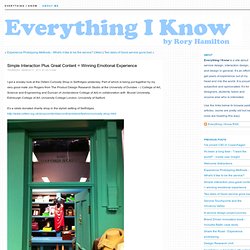
Part of which is being put together by my very good mate Jon Rogers from The Product Design Research Studio at the University of Dundee – ( College of Art, Science and Engineering and Duncan of Jordanstone College of Art) in collaboration with Brunel University, Edinburgh College of Art, University College London, University of Salford. It’s a celeb donated charity shop in the stylish setting of Selfridges. What I wanted to mention was the interactive piece Jon and co. have been working on:It’s very simple: donated items are tagged with an paper label and RFID tag. When the scanner is passed over the tag it prompts a video to play.
It’s pretty simple and we’ve seen things like this before. We scanned Annie Lennox’s dress and saw the video of her holding it and saying where she wore it and how much she liked it etc. Customer Experience Matters. Designer Myopia: How To Stop Designing For Ourselves. Quick summary ↬ Have you ever looked at a bizarre building design and wondered, “What were the architects thinking?”

Or have you simply felt frustrated by a building that made you uncomfortable, or felt anger when a beautiful old building was razed and replaced with a contemporary eyesore? You might be forgiven for thinking “these architects must be blind!” New research shows that in a real sense, you might actually be right. Taking A Customer From Like To Love: The UX Of Long-Term Relationships. Advertisement What do you mean “improve”?
IEOR 170 Design Process. Models / Frameworks. Thursday August 22, 2013 / 2 Comments When I created the Mental Notes card deck, I shied away from creating a framework for using the cards.
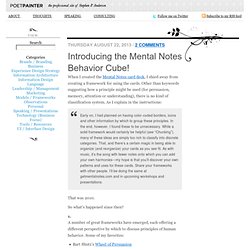
Other than keywords suggesting how a principle might be used (for persuasion, memory, attention or understanding), there is no kind of classification system. As I explain in the instructions: Nuovi elementi dello user experience design - Alberto Mucignat. Fino ad ora il diagramma che meglio rappresentava il lavoro di progettazione della user-experience era quello di Garrett: È sicuramente un’immagine “operativa” che rappresenta efficacemente il processo in maniera lineare (o waterfall, se preferisci), dall’astratto al concreto.
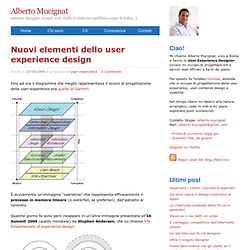
Qualche giorno fa sono però incappato in un’altra immagine presentata all’IA Summit 2009 (quello mondiale) da Stephen Anderson, che lui chiama The fundamentals of experience design: È una visione un po’ più “alta” e meno operativa, ma è utile per rappresentare quello che l’immagine operativa di Garrett non riesce a trasmettere: Activities can be anything you do, and aren’t necessarily task-focused (this is a problem I have with many of the UCD and Agile discussions). Consider passive experiences like reading The Onion, or entertainment experiences like iSteam.
Questo è sicuramente uno dei punti chiave. Interessante anche la suddivisione nei due piani, quello più concreto (“chi sei?” Human-Centered Design Toolkit. For years, businesses have used human-centered design to develop innovative solutions.

Why not apply the same approach to overcome challenges in the nonprofit world? This project, funded by International Development Enterprise (IDE) as part of a grant from the Bill & Melinda Gates Foundation, sought to provide NGOs and social enterprises with the tools to do just that. IDEO, in collaboration with nonprofit groups ICRW and Heifer International, developed the HCD Toolkit to help international staff and volunteers understand a community’s needs in new ways, find innovative solutions to meet those needs, and deliver solutions with financial sustainability in mind. The HCD Toolkit was designed specifically for NGOs and social enterprises that work with impoverished communities in Africa, Asia, and Latin America. The HCD toolkit has been used by organizations throughout the developing world, including Acumen Fund, AyurVAID, Heifer International, ICRW, IDE, Micro Drip, and VisionSpring.
User Centred Design - Infographic Poster by Pascal Raabe. What’s this all about?
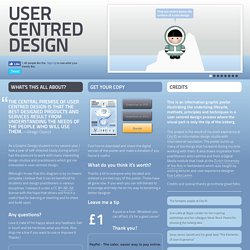
The central premise of user centred design is that the best designed products and services result from understanding the needs of the people who will use them. User Experience Design. June 21, 2004 I've been practicing information architecture since 1994, and from Gopher to Google have seen dramatic changes in the landscape of organization, search and retrieval.
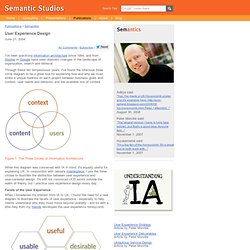
Through these ten tempestuous years, I've found the infamous three circle diagram to be a great tool for explaining how and why we must strike a unique balance on each project between business goals and context, user needs and behavior, and the available mix of content. Figure 1. The Three Circles of Information Architecture While this diagram was conceived with IA in mind, it's equally useful for explaining UX.
Facets of the User Experience When I broadened my interest from IA to UX, I found the need for a new diagram to illustrate the facets of user experience - especially to help clients understand why they must move beyond usability - and so with a little help from my friends developed the user experience honeycomb. Figure 2. Here's how I explain each facet or quality of the user experience: Useful.