
The human brain can create structures in up to 11 dimensions. Memory capacity of brain is 10 times more than previously thought. In a computational reconstruction of brain tissue in the hippocampus, Salk and UT-Austin scientists found the unusual occurrence of two synapses from the axon of one neuron (translucent black strip) forming onto two spines on the same dendrite of a second neuron (yellow).
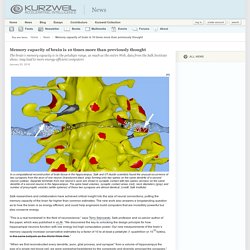
Separate terminals from one neuron’s axon are shown in synaptic contact with two spines (arrows) on the same dendrite of a second neuron in the hippocampus. The spine head volumes, synaptic contact areas (red), neck diameters (gray) and number of presynaptic vesicles (white spheres) of these two synapses are almost identical. (credit: Salk Institute)
Is it time to move past the idea that our brain is like a computer? Is it time to move past the idea that analogies are perfect?
No, it's not. Because nobody except insufferable pedants treat analogies like they're somehow either perfect or irredeemably broken. The brain is like a computer in many ways. It's not exactly like a computer, but it is like one. It processes inputs and produces outputs in a way that nothing we have now except a computer system even comes close to. There are ways that computers and brains are different. Magnetic Mind Control. How Does the Brain Work?
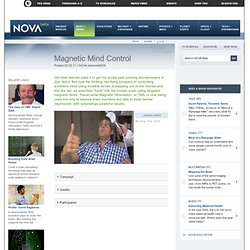
PBS Airdate: September 14, 2011 NEIL DEGRASSE TYSON: Hi, I'm Neil deGrasse Tyson, your host for NOVA scienceNOW, where this season, we're asking six big questions. On this episode: How Does the Brain Work? To find out, I head to Las Vegas, where brain researchers are placing their bets on magic. MAC KING (Magician): That's a dang real fish. NEIL DEGRASSE TYSON: Some of the world's top magicians... PENN JILLETTE (Magician): Place the ball... NEIL DEGRASSE TYSON: ...are making the mysteries behind our most powerful organ disappear... I saw it go over! The illusionists reveal their secrets That motion will draw the eye ...giving us new insight into how our brain pays attention.
STEPHEN MACKNIK (Barrow Neurological Institute): This would be a major contribution to science from the magicians. NEIL DEGRASSE TYSON: Also, a magnetic wand ... MO ROCCA (Correspondent): Oh! SQUID Magnetometry. Flip of a single molecular switch makes an old mouse brain young. The flip of a single molecular switch helps create the mature neuronal connections that allow the brain to bridge the gap between adolescent impressionability and adult stability.
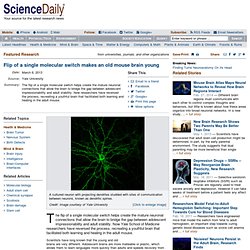
Now Yale School of Medicine researchers have reversed the process, recreating a youthful brain that facilitated both learning and healing in the adult mouse. Scientists have long known that the young and old brains are very different. Adolescent brains are more malleable or plastic, which allows them to learn languages more quickly than adults and speeds recovery from brain injuries. Chapter 9: Limbic System. The limbic system is a convenient way of describing several functionally and anatomically interconnected nuclei and cortical structures that are located in the telencephalon and diencephalon.
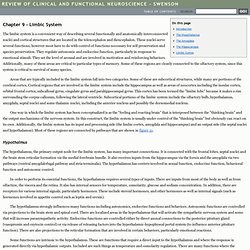
These nuclei serve several functions, however most have to do with control of functions necessary for self preservation and species preservation. They regulate autonomic and endocrine function, particularly in response to emotional stimuli. They set the level of arousal and are involved in motivation and reinforcing behaviors. Additionally, many of these areas are critical to particular types of memory. Some of these regions are closely connected to the olfactory system, since this system is critical to survival of many species. Untitled. John R.
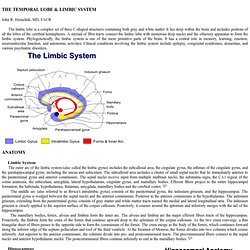
Hesselink, MD, FACR The limbic lobe is a complex set of three C-shaped structures containing both gray and white matter. Science & Nature - Human Body and Mind - Body - Brain Map. The New Map Of The Brain. Trying to map the brain has always been cartography for fools.
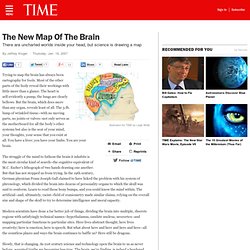
Most of the other parts of the body reveal their workings with little more than a glance. The heart is self-evidently a pump; the lungs are clearly bellows. But the brain, which does more than any organ, reveals least of all. The 3-lb. lump of wrinkled tissue--with no moving parts, no joints or valves--not only serves as the motherboard for all the body's other systems but also is the seat of your mind, your thoughts, your sense that you exist at all. You have a liver; you have your limbs.
Allan Jones: A map of the brain. Allen Brain Atlas - Welcome. Rainbow Brain Map Reveals Grid-Like Pattern. By Greg Miller, ScienceNOW To the unaided eye, the most striking feature of the human brain is its squiggly pattern of bumps and grooves.
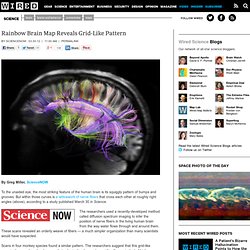
But within those curves is a latticework of nerve fibers that cross each other at roughly right angles (above), according to a study published March 30 in Science. The researchers used a recently-developed method called diffusion spectrum imaging to infer the position of nerve fibers in the living human brain from the way water flows through and around them. These scans revealed an orderly weave of fibers — a much simpler organization than many scientists would have suspected.
Scans in four monkey species found a similar pattern. This story provided by ScienceNOW, the daily online news service of the journal Science. Image: M. New Discoveries in Brain Structure and Connectivity.
Brainwaves and Entrainment.