
Facebook et ses 80 milliards de photos - Social Media, Community Management, Social CRM, e-Reputation par Cédric Deniaud. Lorsque l'on donne des chiffres sur Facebook (et Dieu sait que l'on n'en donne trop !!)
, on s'arrête trop souvent au chiffres des inscrits (400 millions d'inscrits) et des connexions (près de 50% de connexions quotidiennes)... et on omet trop souvent les chiffres de participations ou liés aux contenus. Or ce sont ceux là les pertinents. En effet, si je fais un parallèle avec Twitter, donner seulement les chiffres du nombre de comptes créés, ca serait passer a côté des chiffres les plus pertinents qui permettent véritablement de mesurer l'adoption de l'outil : nombre de tweets en moyenne par utilisateur, taux de connexion, nombre de comptes abandonnées (sans aucun tweet à partir de XX jours).
Facebook est la 1ere plateforme d'hébergement et de partage de photos au monde, et ce loin devant FlickR. Protagonize: collaborative story & creative fiction writing community. Licences Creative Commons. SoundCloud Announces Deeper Creative Commons Integration. SoundCloud , the fast-growing online audio service, today announces a raft of new features that will enable users to find, create and promote their music within its community of over one million music makers and throughout the entire web.
Underpinning this is a deeper integration and partnership with Creative Commons that allows their users the freedom and choice to share and reuse content. Visitors to SoundCloud will now be able to uncover popular Creative Commons-licensed tracks via a dedicated homepage and search for free-to-use samples and audio via the advanced search features and tag browsing. Creators who choose to provide their original work with these free and easy-to-use licenses will now have new channels to expose their tracks with the freedom they want them to carry for sharing and reuse. Read more at this location . Wikipedia + CC BY-SA = Free Culture Win! Facebook. Identi.ca. TweetCC Lets You CC License Your Twitter Feed. Google Books adds Creative Commons license options - Creative Co. Eric Steuer, August 13th, 2009 Some very exciting news for authors, publishers, and readers: Today, Google launched a program to enable rightsholders to make their Creative Commons-licensed books available for the public to download, use, remix, and share via Google Books.
Slideshare. Lulu. Our fall campaign is in full swing and superheroes are giving at all levels – as such, it’s a great time to shine the spotlight on some of our most significant donors.
Lulu, the fantastic open publishing platform, is one such organization. Beyond offering creators of all types the means to publish their own work, Lulu offers a CC-licensing option for authors when they are creating their books. Over a million creators have used the service to date with approximately 20,000 titles to Lulu’s catalog each month. We caught up with founder and CEO Bob Young to talk about Lulu generally, why they’ve chosen to support CC, and how our licenses have helped Lulu grow in the past decade. Bob Young by Lulu / CC BY Can you give our readers some background on Lulu? Lulu’s mission is nothing less than to accelerate the transfer of knowledge from one generation of humans to the next. As Founder and CEO I get much more credit for the success of Lulu to date than I deserve.
YouTube adopte (enfin) les Creative Commons ! Vimeo introduit les licences Creative Commons pour ses vidéos. Et YouTube ? Ces dernières années, les licences Creative Commons ont pris une place de tout premier plan dans la façon dont sont gérés certains droits d'une œuvre.
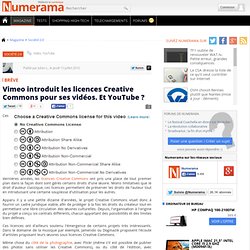
Moins limitatives que le droit d'auteur classique, ces licences permettent de préserver les droits de l'auteur tout en introduisant une certaine souplesse d'utilisation pour les autres. Apparu il y a une petite dizaine d'années, le projet Creative Commons visait donc à fournir un cadre juridique viable, afin de protéger à la fois les droits du créateur tout en permettant une libre circulation des œuvres culturelles. Depuis, l'organisation à l'origine du projet a conçu six contrats différents, chacun apportant des possibilités et des limites bien définies.
Flickr/Creative Commons. Many Flickr users have chosen to offer their work under a Creative Commons license, and you can browse or search through content under each type of license.
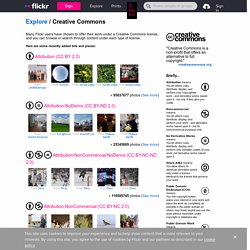
Here are some recently added bits and pieces: Attribution License. FlickrCC. Flickr - 5 Milliards de photos stockées. DeviantArt. Shockingly, we have yet to post anything on uber-online artist community deviantArt, who not only act as a creative outlet for over 7 million users but do so with CC licensing built into their UI.
Our bad. Hopefully we can make up for lost blogging through an interview with Richard Hartley, Director of Community Development at deviantArt (and sometimes clown in disguise). Read on to learn more about the incredibly rich deviantArt community, how CC licences play a roll in user submissions, and future plans that include nothing short of global domination (seriously). Can you give us some background on deviantArt? When and why did it start up? DeviantART began on August 7th of 2000, primarily as a site to provide a space to allow deviants to upload various application skins for programs like Sonique, WInamp, WindowBlinds and so on.
If you have a good 50 or 60 hours we can get into that one! The one common ground they all have though is that they all love dA. It helps in many aspects.