
Documents < CloudComputing < TWiki. NIST publications, work-in-process, and working group products that may be helpful to US government agencies and others in making decisions regarding the effective and secure implementation of cloud computing.
To actively participate on this wiki collaboration site and NIST Cloud Computing mailing list, please register through NIST Cloud Computing website. DRAFT NIST Special Publication 500-293: US Government Cloud Computing Technology Roadmap (Release 1.0) Volume I & II: Volume I - High-Priority Requirements to Further USG Agency Cloud Computing Adoption and Volume II - Useful Information for Cloud Adopters (To appear) Working Draft of Volume III: Technical Considerations for USG Cloud Computing Deployment Decisions Volume III was initiated in parallel, but is logically dependent on the technical work contained in Volume II, and will necessarily be completed and presented as part of the roadmap special publication in a subsequent release. Business Use Case Working Group Forum Agenda. Cloud Computing. Cloud computing is a model for enabling convenient, on-demand network access to a shared pool of configurable computing resources (e.g., networks, servers, storage, applications, and services) that can be rapidly provisioned and released with minimal management effort or service provider interaction.
This cloud model promotes availability and is composed of five essential characteristics (On-demand self-service, Broad network access, Resource pooling, Rapid elasticity, Measured Service); three service models (Cloud Software as a Service (SaaS), Cloud Platform as a Service (PaaS), Cloud Infrastructure as a Service (IaaS)); and, four deployment models (Private cloud, Community cloud, Public cloud, Hybrid cloud).
Key enabling technologies include: (1) fast wide-area networks, (2) powerful, inexpensive server computers, and (3) high-performance virtualization for commodity hardware. The Cloud Computing model offers the promise of massive cost savings combined with increased IT agility. Cloud Computing Use Cases group. Cloud. I have been working very hard trying to identify just what cloud computing is.
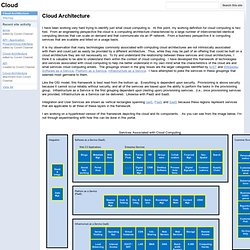
At this point, my working definition for cloud computing is two fold. From an engineering perspecitve the cloud is a computing architecture characterized by a large number of interconnected identical computing devices that can scale on demand and that communicate via an IP network. From a business perspective it is computing services that are scalable and billed on a usage basis.
It is my observation that many technologies commonly associated with computing cloud architectures are not intrinsically associated with them and could just as easily be provided by a different architecture. Thus, while they may be part of an offering that could be built on a cloud architecture they are not necessarily so. Like the OSI model, this framework is best read from the bottom up. I am working on a hyperlinked version of this framework depicting the cloud and its components. It's not complete, but it's getting there. SA - P2302 - Standard for Intercloud Interoperability and Federation (SIIF) This standard creates an economy amongst cloud providers that is transparent to users and applications, which provides for a dynamic infrastructure that can support evolving business models.

In addition to the technical issues, appropriate infrastructure for economic audit and settlement must exist.This standard defines topology, functions, and governance for cloud-to-cloud interoperability and federation. Topological elements include clouds, roots, exchanges (which mediate governance between clouds), and gateways (which mediate data exchange between clouds). Functional elements include name spaces, presence, messaging, resource ontologies (including standardized units of measurement), and trust infrastructure. Governance elements include registration, geo-independence, trust anchor, and potentially compliance and audit. Contact the IEEE-SA Liaison Simply click here to voice your interest.Joan Woolery. Cloud Computing at NIST: Two New Draft Documents and a Wiki. The National Institute of Standards and Technology (NIST) has issued two new draft documents on cloud computing for public comment, including the first set of guidelines for managing security and privacy issues in cloud computing.
The agency also has set up a new NIST Cloud Computing Collaboration site on the Web to enable two-way communication among the cloud community and NIST cloud research working groups. United States Chief Information Officer Vivek Kundra asked NIST to accelerate the federal government's secure adoption of cloud computing by leading efforts to develop standards and guidelines in collaboration with standards bodies, the private sector and other stakeholders. These new draft documents and the collaboration site are part of NIST's work to fulfill that mission.