
Cloud Computing: Why Businesses Are Embracing It. Le cloud computing expliqué aux nuls. Le phénomène du "cloud computing" prend de plus en plus d'ampleur dans les entreprises et le grand public commence à le connaître sous la forme de services de stockage à distance, ou encore de musique en streaming.
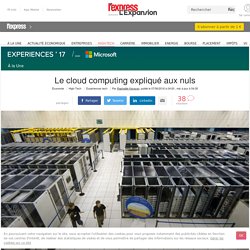
Le cloud est sur toutes les lèvres. Bernard Ourghanlian est directeur technique et sécurité de Microsoft France. Pour L'Express, il explique ce qu'est le cloud, et à quoi ça sert. Comment définissez-vous le cloud computing ? Le grand public utilise depuis longtemps le cloud computing sans le savoir. Peut-on dire que le cloud computing est une révolution pour l'informatique ? C'est une révolution économique, mais pas technologique. Quel est l'intérêt du cloud computing ? Il est surtout économique. Que nous permet de faire le cloud, que l'on ne pouvait pas faire avant ? Par exemple, préserver le contexte quand on change de terminal. Où se trouvent ces ressources informatiques, qui ne sont plus en local ? Les grands acteurs du cloud sont en effet peu nombreux.
Pas vraiment. Cloud Computing. Definitions. Cloud computing metaphor: For a user, the network elements representing the provider-rendered services are invisible, as if obscured by a cloud.

Cloud computing is a computing term or metaphor that evolved in the late 1990s, based on utility and consumption of computer resources. Cloud computing involves application systems which are executed within the cloud and operated through internet enabled devices. Purely cloud computing does not rely on the use of cloud storage as it will be removed upon users download action. Clouds can be classified as public, private and hybrid.[1][2] Overview[edit] Cloud computing[3] relies on sharing of resources to achieve coherence and economies of scale, similar to a utility (like the electricity grid) over a network.[2] At the foundation of cloud computing is the broader concept of converged infrastructure and shared services.
Cloud computing, or in simpler shorthand just "the cloud", also focuses on maximizing the effectiveness of the shared resources. Understanding flavors of Cloud. Confusion Continues With Cloud Computing And SaaS Definitions Coincidence or just brilliance must be in the air as three esteemed industry colleagues, Phil Wainewright, Michael Cote, and James Governor, have both decided to clarify definitions on SaaS and Cloud within a few days of each other.
In fact, this couldn’t be more timely as SaaS and Cloud enter into mainstream discussion with next gen CIO’s evaluating their apps strategies. A few common misconceptions often include: “That hosting thing is like SaaS”“Cloud, SaaS, all the same, we don’t own anything”“OnDemand is Cloud Computing”“ASP, Hosting, SaaS seems all the same”“It all costs the same so what does it matter to me?” “Why should I care if its multi-tenant or not? Cloud Computing Represents The New Delivery Model For Internet Based IT services Traditional and Cloud based delivery models share 4 key parts (see Figure 1): As the über category, Cloud Computing comprises of Figure 1.
Single Instance – (a.k.a. Figure 2. Above the Clouds. Above_the_clouds. Above the Clouds: A Berkeley View of Cloud Computing. Michael Armbrust, Armando Fox, Rean Griffith, Anthony D.
Joseph, Randy H. Katz, Andrew Konwinski, Gunho Lee, David A. Patterson, Ariel Rabkin, Ion Stoica and Matei Zaharia EECS Department University of California, Berkeley Technical Report No. UCB/EECS-2009-28 February 10, 2009 Provided certain obstacles are overcome, we believe Cloud Computing has the potential to transform a large part of the IT industry, making software even more attractive as a service and shaping the way IT hardware is designed and purchased. BibTeX citation: EndNote citation: %0 Report %A Armbrust, Michael %A Fox, Armando %A Griffith, Rean %A Joseph, Anthony D.
Myths.