
Category:Knowledge representation. Schéma de classification. Un article de Wikipédia, l'encyclopédie libre.

Dans certains domaines informatiques et en particulier dans la norme de registre de métadonnées, ISO/IEC 11179, un schéma de classification correspond à « l'information descriptive d'une organisation ou d'une division d'objets en groupes basés sur des caractéristiques communes des objets[1] ». Figurative system of human knowledge. ENC_SYSTEME_FIGURE.jpeg (Image JPEG, 1071x1407 pixels) Classification systems. Knowledge representation and reasoning. Knowledge representation and reasoning (KR) is the field of artificial intelligence (AI) devoted to representing information about the world in a form that a computer system can utilize to solve complex tasks such as diagnosing a medical condition or having a dialog in a natural language.

Knowledge representation incorporates findings from psychology about how humans solve problems and represent knowledge in order to design formalisms that will make complex systems easier to design and build. Simple Knowledge Organization System. Little Alchemy. Taxonomie de Bloom. Un article de Wikipédia, l'encyclopédie libre.
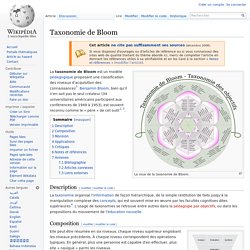
La roue de la taxonomie de Bloom. Bloom's Taxonomy. Bloom's Digital Taxonomy. Approche didactique sur la taxonomie des objectifs et des compétences - Didawiki. De Didawiki.
Depuis la publication de la première taxonomie de Bloom et de ses collaborateurs (1956), de nombreuses taxonomies d'objectifs de l'éducation ont vu le jour. La plupart des taxonomies sont spécifiques et concernent un domaine particulier. D’autres taxonomies ont un spectre plus large, certaines combinent les taxonomies précédentes, d’autres intègrent des dimensions socio-constructiviste, les plus fines sont adaptés aux compétences et réfèrent à la didactique de chaque discipline :
L'analyse par classement. Connaître, penser, c'est classer.

Georges Clémenceau [L]'esprit humain sembl[e] tendre naturellement à la classification et à la hiérarchisation (ou à l'anarchie, ce qui revient au même) [...]G. Girard, R. Ouellet et C. Les effets de la catégorisation. Les effets de la catégorisation Ce sujet sera abordé de deux façons complémentaires : - un film bref relatant une expérimentation concernant la catégorisation.- un exposé qui analyse cette expérimentation, présente d'autres expérimentations sur le même thème et apporte des notions théoriques sur les effets de la catégorisation.
Catégorie:Espace Catégorie. "Information Architecture" What Are Topic Maps. September 11, 2002 Many years ago, I started looking into SGML and XML as a way to make information more manageable and findable, which was something I had been working on for a long time.

It took me several years to discover that, although SGML and XML helped, they did not actually solve the problem. Ontopia home page. Trees to Network.... Portal:Contents/Categories. Reference: Libraries: Library and Information Science: Technical Services: Cataloguing: Classification. Taxonomy. Taxonomie de van Hiele. Un article de Wikipédia, l'encyclopédie libre.

La taxonomie de van Hiele, développée par les Hollandais Dieke van Hiele-Geldof et Pierre Marie van Hiele, est un modèle surtout utile en pédagogie de la géométrie. Metadata? Thesauri? Taxonomies? Topic Maps! Making sense of it all.
Humansv2.jpg (Image JPEG, 3200x3200 pixels) Taxonomy Warehouse: Software, Consultants, Events, Blogs & Books All About Taxonomies. Taxonomy Watch. Carte heuristique. Carte heuristique dessinée pendant un exposé.
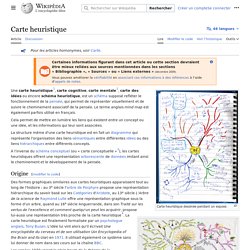
Une carte heuristique[1], carte cognitive, carte mentale[2], carte des idées ou encore schéma heuristique, est un schéma, supposé refléter le fonctionnement de la pensée, qui permet de représenter visuellement et de suivre le cheminement associatif de la pensée. Le terme anglais mind map est également parfois utilisé en français. Cela permet de mettre en lumière les liens qui existent entre un concept ou une idée, et les informations qui leur sont associées. Cartographies des connaissances scientifiques. Comment cartographier les sciences? De la "Métaphysique" d'Aristote à la classification de Dewey, le classement des savoirs est un enjeu philosophique majeur.
Knowledge tags. The use of keywords as part of an identification and classification system long predates computers. Paper data storage devices, notably edge-notched cards, that permitted classification and sorting by multiple criteria were already in use prior to the twentieth century, and faceted classification has been used by libraries since the 1930s. Online databases and early websites deployed keyword tags as a way for publishers to help users find content. Knowledge organization. The term knowledge organization (KO) (or "organization of knowledge", "organization of information" or "information organization") designates a field of study related to Library and Information Science (LIS). In this meaning, KO is about activities such as document description, indexing and classification performed in libraries, databases, archives etc. These activities are done by librarians, archivists, subject specialists as well as by computer algorithms. Tag (metadata)
The use of keywords as part of an identification and classification system long predates computers. Paper data storage devices, notably edge-notched cards, that permitted classification and sorting by multiple criteria were already in use prior to the twentieth century, and faceted classification has been used by libraries since the 1930s. Folksonomy.
An empirical analysis of the complex dynamics of tagging systems, published in 2007,[8] has shown that consensus around stable distributions and shared vocabularies does emerge, even in the absence of a central controlled vocabulary. For content to be searchable, it should be categorized and grouped. Portal:Contents/Glossaries. Lexical and Classification Resources. BV- Lexiques et vocabulaires de l'Office québécois de la langue française.
Lexicon. 7. Lexiques Realiter - Realiter. Realiter català Español français galego. Thésaurus. Un article de Wikipédia, l'encyclopédie libre. C'est un langage contrôlé utilisé pour l'indexation de documents et la recherche de ressources documentaires dans des applications informatiques spécialisées. Les thésaurus sont donc une catégorie de langages documentaires parmi d'autres. Vocabulaire de la documentation. Le vocabulaire de la documentation auquel vous avez accès ici correspond à l'édition papier, coordonnée par Arlette Boulogne et publiée par l'ADBS en 2004. Il propose un vocabulaire technique du domaine de l'information-documentation. A ce jour, il ne couvre pas tous les besoins de l'exercice professionnel, en particulier on n'y trouvera pas tous les les termes liés à l'usage des technologies de l'information et d'Internet.
Il est accessible par domaines ou par l'intermédiaire d'un formulaire de recherche. Proposer une nouvelle entrée. WebRef.org. Ressources en ligne - Accueil. Tous les glossaires. Terminologie. Un article de Wikipédia, l'encyclopédie libre. La terminologie est l'ensemble des termes, rigoureusement définis, qui sont spécifiques d'une science, d'une technique, d'un domaine particulier de l'activité humaine. C'est une discipline qui a pour objet l'étude théorique des dénominations des objets ou des concepts utilisés par tel ou tel domaine du savoir, le fonctionnement dans la langue des unités terminologiques, ainsi que les problèmes de traduction, de classement et de documentation qui se posent à leur sujet[1]. La norme ISO 1087 définit la terminologie comme « l'étude scientifique des notions et des termes en usage dans les langues de spécialité ».
Beyond Bookmarks: Schemes for Organizing the Web. Essaiphilosophiesciences_1.pdf (Objet application/pdf) Ampère philosophe. 1 Cette correspondance a été publiée et enrichie de nombreux compléments par Alexandre Robinet, Corr (...) « Pourquoi suis-je tourmenté du désir de connaître la nature de mon intelligence et de ma volonté, de remonter à l’origine des connaissances que j’ai ou que je crois avoir, au principe des déterminations par lesquelles j’agis ? (...) Banque de terminologie. Terminobanque du Service de la langue française (Communauté française de Belgique) Terminologie.net - Tout sur la terminologie, la traduction, la terminotique et la terminographie. Ontology (information science) Ontologie (informatique) Ontology Explorer.
Categorization. Catégorisation. Category:Subfields by academic discipline. Commonsense knowledge base. Caractéristique universelle. Characteristica universalis. Alphabet of human thought. Universal language.