
Chemistry. Periodic table.
Periodic stable. Practical chem. CHEMISTRY. Williamwakefield. Mol4D Web Organic Chemistry. Organic Chemistry Animations ChemTube3D. VirtualText of Organic Chemistry. Organic Chemistry Links. Polymers & Liquid Crystals Main Page. Biochemistry. Organic Chemistry Portal. Water structure and science: Contents. Chemical Engineering. Kent's Chemical Demonstrations. The ChemCollective. Elementylogy and elements multidict. Elements. The Periodic Table of Videos. Dynamic Periodic Table. Periodic table (detailed) Biochemical Periodic Table. Chemsoc - for everyone into chemistry. We want everyone to experience the excitement and value of the chemical sciences.
Our members and supporters reach out to connect people - from schoolchildren to scientists to political leaders - with chemistry. Whether you want to attend or run an event, set up a meeting or spend a few minutes writing an email, find out in this section how to get involved. Also in Campaigning & outreach: CampaigningFind out about our current campaigns and see how you can get involved in a way that suits you. PolicySee how we help to shape policy debates by providing expert information and leading the development of policy in key areas. OutreachFind out what we are doing to bring the chemical sciences to a wide range of different audiences, and how you can get involved.
Tackling global challengesChemistry can help us avoid dangerous climate change, generate energy sustainably, feed the world, and tackle disease and illness. Useful Chemistry. Chromatography Solutions Blog (thermo scientific) Synthetic Remarks. A Chemist's Selection of Science News and Resources. Chemistry Central blog. We are pleased to announce that Professor Liang-Nian He, a Professor of Chemistry at the State Key Laboratory of Elemento-Organic Chemistry, Nankai University, China has joined the Editorial Board for Sustainable Chemical Processes.
His research interests include: green synthetic chemistry; synthesis and application of task-specific ionic liquids; catalysis in green solvents such as ionic liquids, PEG and water; CO2 chemistry; biomass conversion, particularly chemical transformations of CO2 into fuels, chemicals and materials; and CO2 capture and utilization. Associate Professor Michael Oelgemöller from James Cook University, Australia also joins us on the Editorial Board. His research activities include synthetic organic photochemistry, solar photochemistry, microflow photochemistry, the development of new photochemical synthesis tools and photochemical water treatment.
He is a leading expert in … Read more Following the congress, a selection … Chem-bla-ics. UNC Chemistry Fundamentals. An Interactive Educational Exercise Because of special formatting tags needed to display exponents, this site is best viewed with Netscape 3.0 or higher.
If needed, use the link under Useful Materials to download Netscape. Hyle - journal for philosophy of chemistry. Wiki Chemistry. Topics - Agfa Didac. Basic chemistry concepts. The Chemogenesis Webbook. Unlike chemistry textbooks printed on paper, this webbook contains dynamic Synthlet and Database pages that explore and make predictions about aspects of chemical structure & reactivity and have embedded reaction chemistry YouTube Videos.
Thanks go to the authors of web sites linked to from these pages, to members of the International Society for the Philosophy of Chemistry (ISPC) and to the members of the ChemEd internet discussion list who have answered my many questions and synthesized such interesting postings. This web book is being continually updated. Please send comments, link suggestions, factual errors, browser problems, bug & broken link reports, etc., to the author: Chemistry - Biographies. Josiah Willard Gibbs. In 1863, Yale awarded Gibbs the first American doctorate in engineering.
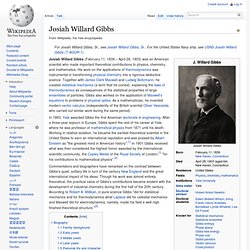
After a three-year sojourn in Europe, Gibbs spent the rest of his career at Yale, where he was professor of mathematical physics from 1871 until his death. Working in relative isolation, he became the earliest theoretical scientist in the United States to earn an international reputation and was praised by Albert Einstein as "the greatest mind in American history".[1] In 1901 Gibbs received what was then considered the highest honor awarded by the international scientific community, the Copley Medal of the Royal Society of London,[1] "for his contributions to mathematical physics".[2]
Chemical heritage - history by people. The story of chemistry is a human adventure of both mind and action.
From very early times, chemists have sought to expand our understanding of matter, from the atomic to the galactic. Meanwhile, they have contributed to the modern world as we know it, through new materials, medicines, and technologies, as well as environmental problems and solutions. Look for an expanding set of themes under which chemists have pursued their investigations over time. Early Chemistry and Gases › The Chemical Revolution of the late 18th century was based in large part on Antoine-Laurent Lavoisier's new understanding of the chemical role of a gas—oxygen. Linus Pauling and The Nature of the Chemical Bond: A Documentary History. Revised and Expanded Utilizing over 2,500 manuscript pages, nearly 100 photographs, and more than four hours of audio and video, this website tells the story of a cornerstone achievement of twentieth century science.
In 1926 Linus Pauling, then a promising young doctoral candidate, set sail for Europe to study quantum mechanics with an eye toward applying this new physics to problems in structural chemistry. Pauling's ensuing program of research would result in a remarkable series of landmark publications that revolutionized the scientific world's conception of how atoms join together to form molecules. In 1939 Pauling's ideas were bundled into a book that was uniformly recognized as an instant classic. Chemistry resources (C2k) Welcome to ChemWeb.
News briefing on EU REACH regulation and supply chain chemical risks. Chemical Industry News & Intelligence. Technology and Business Development in Chemicals and Materials. Reference Electrodes Topics. Reference Electrode Potentials. Potentials of some common reference electrodes. A calculator for converting between reference electrodes. Which Reference Electrode should I use? Calomel Electrode Potential Temperature Dependence: A Calculator! <br />(Uses Javascript!) The Ag/AgCl Reference Electrode. Caveman Chemistry : Hands-on Projects in Chemical Technology. Chemalone – The Chemical Engineering eResources portal. Chemists Without Borders. Society of Chemical Industry - Home. The International Council of Chemical Associations Home. Royal Society of Chemistry. American Chemical Society - The world's largest scientific society. Links for Chemists / Virtual Library Chemistry Section.
Megalomania's Link Section. Nano, Quantum & Statistical Mechanics & Thermodynamics Educational Sites. Quantum aspects of the world. Molecular orbital. Complete acetylene (H–C≡C–H) molecular orbital set.
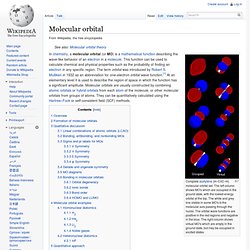
The left column shows MO's which are occupied in the ground state, with the lowest-energy orbital at the top. The white and grey line visible in some MO's is the molecular axis passing through the nuclei. The orbital wave functions are positive in the red regions and negative in the blue. The right column shows virtual MO's which are empty in the ground state, but may be occupied in excited states. Overview[edit] A molecular orbital (MO) can be used to represent the regions in a molecule where an electron occupying that orbital is likely to be found. Center for Molecular Modeling. Chemistry. Most of the services are free for academic researchers in Finland, but require a user account (also in Finnish) at CSC.
Overview: Quick introduction to services useful for chemists. CCL Home. Welcome to VIPEr ;) Electrochemistry Encyclopedia. This site contains popular-science style articles describing many aspects of electrochemistry, electroanalytical chemistry, electrochemical engineering, and electrochemical technology, written by international experts in the field.
It is crosslinked with the ELECTROCHEMISTRY DICTIONARY for definitions. New articles are added at irregular intervals, and all articles are periodically updated as recent developments occur in the field. ( The Encyclopedia is hosted by the Ernest B. Visit also ELECTROCHEMICAL SCIENCE AND TECHNOLOGY INFORMATION RESOURCE (ESTIR) a listing of electrochemistry related websites, books, proceedings, reviews, graduate schools, societies, journals, meetings, etc, etc. Go to the Table of Contents below or search the whole Encyclopedia. Two kinds of links are provided in the articles. Most figures in the articles are backed up by a larger figure. Table of Contents Go to: Top – Search.