CCSS Sample Math Tasks (Illinois) Quality Mathematics Tasks. Teaching is the Core. Teaching is the Core: Successful Common Core Implementation Across New York State Across New York State, district administrators, principals, teachers, and BOCES are working hard to implement Common Core standards and instruction into their classrooms and schools.
Their hard work is paying off and positively impacting all students. Download this videoRight-click on the link above and select "save link as" or "save target as" and save the video as an .mp4 file. Embed this videoUse the code below to embed the video on your website:
Resources to Guide Common Core Implementation. Jay McTighe - CCSS Website suggestions. DrSuz - home. Common Core Curriculum Maps. Over 300 LiveBinders on Common Core. Parents' Guide to the CCSS. Currently, each state has a separate set of education standards, lists of skills that students are expected to do by the time they graduate each grade.
However, in response to concerns about American student achievement and just how prepared students are for college and careers, education leaders in 48 states, along with the National Governors Association and the Council of Chief State School Officers (CCSSO), have written a set of standards for student across the U.S. The common core state standards were released in 2010. Now, 44 states are working to implement them by 2013-2014. What High School Parents Should Know About Common Core - High School Notes. The Common Core standards require high school students to collaborate to solve problems. When the Common Core State Standards take full effect in 2014, they will impact more than 42 million K-12 students.
While some schools and districts are holding information sessions to educate parents on the new standards, most still know very little about what the Common Core entails. Only 7 percent of adults say they know "a lot" about the standards, and 60 percent say they know "nothing" about the standards, according to a July report by Achieve, an education nonprofit. The following cheat sheet can help parents of high school students move closer to joining that 7 percent. 1. Aligning the academic bar across state lines means students should receive the same level of instruction if their family moves from one state to another—an important factor for parents who have to relocate their families for work, says Randi Brill, founder of Quarasan, which develops content for education publishers. 2. 3. 4. Tips for Communicating With Parents About the Common Core. K-8 PARENT HANDBOOK (California)
Parent Roadmaps to Common Core Standards / Parent Roadmaps- Mathematics. ParentGuide_Math_1. ParentGuide_Math_3. ParentGuide_Math_k_v2r2. Next Generation Science Standards. Common Core. ORG. Achievethecore.org. EduCore - Tools for Teaching the Common Core - ASCD.
50 Important Links for Common Core Educators. Educators across the nation are working hard this summer to begin developing updated curricula that will fit into the new Common Core State Standards, which will be fully applied in 45 U.S. states (Texas, Alaska, Nebraska, Virginia, and Minnesota have opted out of statewide participation) by 2015.
9 Ways the CC Will Change Classroom Practice Harvard Education Letter. Volume 28, Number 4July/August 2012 By ROBERT ROTHMAN Nine Ways the Common Core Will Change Classroom Practice, continued Nine Ways the Common Core Will Change Classroom Practice In a recent survey, William Schmidt, a University Distinguished Professor of education at Michigan State University, found some good news and bad news for supporters of the Common Core State Standards.
The good news was that the vast majority of teachers have read the Standards and nearly all like them. Those teachers might want to take a closer look. In Mathematics 1. Shifts in Instruction. Resources for Understanding the Common Core State Standards. CC Links to many of the best state resources. NC: K-12 Curriculum and Instruction. The primary purpose of the K-12 Standards, Curriculum, and Instruction Division is to serve as the authoritative source for the review, revision, and support for implementation of state content standards in the North Carolina Standard Course of Study in the areas of Arts Education (Dance, Music, Theatre Arts, and Visual Arts), English Language Arts, English Language Development, Guidance, Healthful Living (Health and Physical Education), Mathematics, Science, Social Studies, and World Languages.
The North Carolina Department of Public Instruction (NCDPI)'s supplemental google sites are intended to be a resource for educators, administrators, institutions of higher education, and other interested parties. MO Learning Standards. Webinars: Key Shifts ELA and Math from Achieve the Core. Common Core Works (CGCS) iTunes U Courses: CCSS for Teachers.
Discussions: Shifting Students from Passive Observers to Active Participants. “During discussion learners are not passive recipients of information that is transmitted from a teacher.
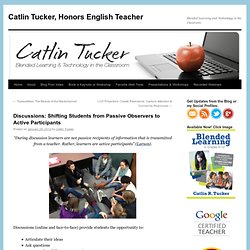
Rather, learners are active participants” (Larson). Discussions (online and face-to-face) provide students the opportunity to: Articulate their ideasAsk questionsBe exposed to different perspectivesMake connectionsLearn to “play” and fearlessly interact with new information The act of telling or explaining what they know cements students’ understanding of concepts.