
Blog:fisherfaces [ Some time ago I have written a post on Linear Discriminant Analysis, a statistical method often used for dimensionality reduction and classification.

It was invented by the great statistician Sir R. A. Fisher, who successfully used it for classifying flowers in his 1936 paper "The use of multiple measurements in taxonomic problems" (The famous Iris Data Set is still available at the UCI Machine Learning Repository.). But why do we need another dimensionality reduction method, if the Principal Component Analysis (PCA) did such a good job? Well, the PCA finds a linear combination of features that maximizes the total variance in data. This was also recognized by Belhumeur, Hespanha and Kriegman and so they applied a Discriminant Analysis to fae recognition in their paper "Eigenfaces vs.
You seldomly see something explained with code and examples, so I thought I'll change that. I've put all the code under a BSD License, so feel free to use it for your projects. Covariance matrix. Assessment | Biopsychology | Comparative | Cognitive | Developmental | Language | Individual differences | Personality | Philosophy | Social |Methods | Statistics | Clinical | Educational | Industrial | Professional items | World psychology | Statistics:Scientific method · Research methods · Experimental design · Undergraduate statistics courses · Statistical tests · Game theory · Decision theory Definition Edit If entries in the column vector are random variables, each with finite variance, then the covariance matrix Σ is the matrix whose (i, j) entry is the covariance where is the expected value of the ith entry in the vector X.
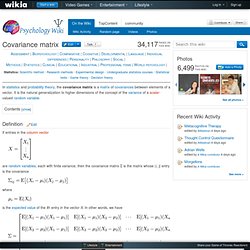
As a generalization of the variance Edit The definition above is equivalent to the matrix equality This form can be seen as a generalization of the scalar-valued variance to higher dimensions. The matrix is also often called the variance-covariance matrix since the diagonal terms are in fact variances. Conflicting nomenclatures and notations Nomenclatures differ. . Eigenface. Assessment | Biopsychology | Comparative | Cognitive | Developmental | Language | Individual differences | Personality | Philosophy | Social |Methods | Statistics | Clinical | Educational | Industrial | Professional items | World psychology | Other fields of psychology:AI · Computer · Consulting · Consumer · Engineering · Environmental · Forensic · Military · Sport · Transpersonal · Index Eigenfaces are a set of eigenvectors used in the computer vision problem of human face recognition.
The approach of using eigenfaces for recognition was developed by Matthew Turk and Alex Pentland beginning in 1987, and is considered the first successful example of facial recognition technology. [How to reference and link to summary or text] These eigenvectors are derived from the covariance matrix of the probability distribution of the high-dimensional vector space of possible faces of human beings. Eigenface generation Edit Prepare a training set. Use in facial recognition See also References D. Implementing Eigenface. Last month's article explained how the face recognition method called eigenface works.

This month's article concludes both the OpenCV series and the eigenface topic with a detailed look at a complete program for implementing eigenface with OpenCV. A Brief Review Here's a brief recap of last month's article explaining how eigenface works. Eigenface consists of two phases: learning and recognition. In the learning phase, you give eigenface one or more face images for each person you want it to recognize. Eigenface uses the training images to "learn" a face model. The lower dimensionality representation that eigenface finds during the learning phase is called a subspace. Setting up for Eigenface In use, you'll probably want to combine eigenface with the face detection method presented in Part 2 of this series. For the examples in this article, I've used a free, publicly available face database, the Olivetti Research Lab's (ORL) Face Database, which you can download here. eigenface train.