
Why Gandalf Never Married. I want to talk about magic, how magic is portrayed in fantasy, how fantasy literature has in fact contributed to a very distinct image of magic, and perhaps most importantly how the Western world in general has come to accept a very precise and extremely suspect image of magic users.
I'd better say at the start that I don't actually believe in magic any more than I believe in astrology, because I'm a Taurean and we don't go in for all that weirdo occult stuff. But a couple of years ago I wrote a book called The Colour of Magic. It had some boffo laughs. 10 sci-fi books written by women of color to add to your reading list.
Obviously, science fiction books by and about women of color exist.

But all too often, we don't get to see them. Awards for literature overwhelmingly go to male authors who write about men or boys. Female writers of color face additional barriers in the literary world, especially in sci-fi, which tends to be dominated by male authors. But at a ceremony earlier this week, something cool happened: The winners of the Hugo Awards, some of the most prestigious awards in science fiction, were announced, and the top four fiction awards were awarded to four women.
Three of those winners were female writers of color. 21 Feminist Books Every Girl Should Read In Her Lifetime. The 15 best comedy books of all time. ‘Gone Girl’ and the Rise of Crime Novels by Women. Once upon a time, in the smoky, violent neverland of crime fiction, there were seductive creatures we called femmes fatales, hard women who lured sad men to their doom.
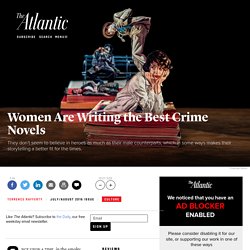
Now there are girls. It started, of course, with Gillian Flynn, whose 2012 suburban thriller, Gone Girl, told a cruel tale of marriage and murder and sold a zillion copies. The most striking thing about Flynn’s cool, clever mystery is the childishness of its main characters, Nick and Amy Dunne, the sheer pettiness of the deadly games they play with each other. And the prize for winning is something like a gold star from the teacher: Gone Girl takes place in a world in which grown-up girls—and boys—will kill for no better reason than self-validation. This is not a world Raymond Chandler would have recognized.
I miss those tough guys, with their cigarettes and their hats, but I’ve learned to do without them. That’s not to say the guys are gone, or even going away anytime soon. 12 bookstores every reader should visit in their lifetime. Facebook.com/BrattleBookShopOutside of Boston's Brattle Book Shop.
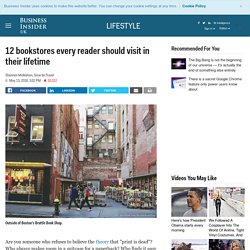
Are you someone who refuses to believe the theory that "print is dead"? Who always makes room in a suitcase for a paperback? Who finds it easy to spend more time at a charmingly ramshackle bookstore than a crowded tourist attraction? You're not alone. How to Read a Book a Week. Executive Summary Reading gives us access to great ideas, allows us peek into the minds of the smartest people, and gives us fuel to be valuable contributors in conversations.
But who really has time to read every book that would help us as business leaders? Everyone, according to the author, because the key to reading is not taking in every word, but understanding the concepts that the author presents. Following his advice, you have the potential to read at least one nonfiction book a week. Plan & share your travel to Japan - Odigo. Librarians in uproar after borrowing record of Haruki Murakami is leaked.
Librarians in Japan have ditched their traditional regard for silence to accuse a newspaper of violating the privacy of Haruki Murakami, Japan’s best-known contemporary writer, after it revealed his teenage reading habits.
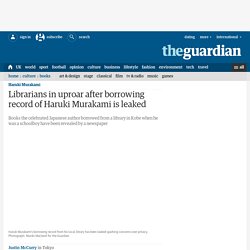
As a schoolboy in the western port city of Kobe, Murakami delved into the three-volume complete works of the French writer Joseph Kessel, according to library cards leaked to the Kobe Shimbun newspaper. It is not clear, however, if the then student at Kobe high school read Belle De Jour, Kessel’s 1928 novel about a woman who works as a prostitute by day and reverts to her life as a housewife in the evening. The novel was turned into a film in 1967, starring Catherine Deneuve. The Kobe Shimbun revealed Murakami’s reading habits of half a century ago after obtaining the cards from the school’s library that carried borrower entries under the author’s name, Japanese media reported. “He is known to have profound knowledge of British and American literature.
33 books everyone should read before turning 30. Haruki Murakami's music. The Shrinking World of Ideas. By Arthur Krystal We have shifted our focus from the meaning of ideas to the means by which they’re produced.
When professors began using critical theory to teach literature they were, in effect, committing suicide by theory. When, in 1942, Lionel Trilling remarked, "What gods were to the ancients at war, ideas are to us," he suggested a great deal in a dozen words. Barnes and noble leatherbound: Books.
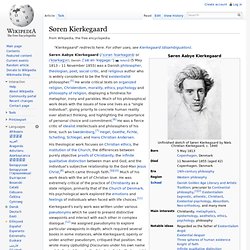
Read Online. Søren Kierkegaard. Søren Aabye Kierkegaard (/ˈsɔrən ˈkɪərkəɡɑrd/ or /ˈkɪərkəɡɔr/; Danish: [ˈsɶːɐn ˈkiɐ̯ɡəɡɒːˀ] ( )) (5 May 1813 – 11 November 1855) was a Danish philosopher, theologian, poet, social critic, and religious author who is widely considered to be the first existentialist philosopher.[5] He wrote critical texts on organized religion, Christendom, morality, ethics, psychology and philosophy of religion, displaying a fondness for metaphor, irony and parables.
Chinese author Mo Yan wins Nobel Prize for Literature. Chinese author Mo Yan has been awarded the 2012 Nobel Prize for literature.

A prolific author, Mo has published dozens of short stories, with his first work published in 1981. The Swedish Academy praised his work which "with hallucinatory realism merges folk tales, history and the contemporary". The 57-year-old is the first Chinese resident to win the prize. Chinese-born Gao Xingjian was honoured in 2000, but is a French citizen. Mo is the 109th recipient of the prestigious prize, won last year by Swedish poet Tomas Transtroemer.
Presented by the Nobel Foundation, the award - only given to living writers - is worth 8 million kronor (£741,000). "He has such a unique way of writing. BookMooch: trade your books with other people. Welcome to World of Books.com. Beatnik. Coming Soon: Building Stories by Chris Ware « Knopf Doubleday - Graphic Novels. Buy the Book: Amazon | Barnes & Noble | Books-a-Million | IndieBound | Powell’s | Random House After years of sporadic work on other books and projects and following the almost complete loss of his virility, it’s here: a new graphic novel by Chris Ware.
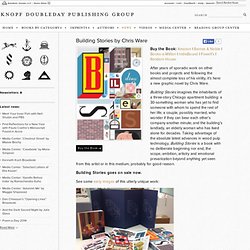
Building Stories imagines the inhabitants of a three-story Chicago apartment building: a 30-something woman who has yet to find someone with whom to spend the rest of her life; a couple, possibly married, who wonder if they can bear each other’s company another minute; and the building’s landlady, an elderly woman who has lived alone for decades. Richard's Poor Almanac.
Richard Thompson's Richard's Poor Almanac: "Make the Pie Higher" (January 2001). To see this image at full resolution, go to Cul de Sac. Make the Pie Higher[edit] The Richard's Poor Almanac cartoon published the week of George W. Bush's first inauguration was Thompson's mock inaugural poem, "Make the Pie Higher," composed of some of Bush's more incoherent quotations. When "Make the Pie Higher" was leaked onto the Internet, it spread rapidly and was eventually dissected and analyzed on Snopes, which did a lengthy review of its origins. Wainscot : Dictionary / Wörterbuch. All is Song: Amazon.co.uk: Samantha Harvey: 9780224096324. Harvey's debut, The Wilderness, received some impressive critical responses when published, the general consensus being that it didn't read like a debut at all but the work of a far more established writer. I haven't read it, but after reading her new novel I don't feel like I need to in order to proclaim her a writer every bit as promising as that debut suggested.
All Is Song is a novel of great intelligence and understanding, the kind of book in which very little actually happens and yet which grips from first page to last with its philosophical, spiritual and emotional explorations. In this way Harvey is the natural heir to Iris Murdoch who I was reminded of when reading this book. Human and humane in its examination of personal responsibility, a small cast of characters become incredibly close to the reader so that it becomes a very moving reading experience. It's so good in fact that settling down to write this review I wonder which of its many strands I should write about. The 100 greatest non-fiction books. Art The Shock of the New by Robert Hughes (1980)Hughes charts the story of modern art, from cubism to the avant garde The Story of Art by Ernst Gombrich (1950)The most popular art book in history.
Gombrich examines the technical and aesthetic problems confronted by artists since the dawn of time Ways of Seeing by John Berger (1972)A study of the ways in which we look at art, which changed the terms of a generation's engagement with visual culture. A Room with a View. The Modern Library ranked A Room with a View 79th on its list of the 100 best English-language novels of the 20th century (1998). Plot summary[edit] Part one[edit] The Book Bench: Six Shorts to Read During a Hurricane. Tower of the Hand ~ An Encyclopedia of Ice and Fire. Colorless Tsukuru Tazaki and His Years of Pilgrimage. Word has leaked that Haruki Murakami’s trusted translator Philip Gabriel is aiming to finish translating Haruki Murakami’s latest novel by the end of this year.
That means that the English version of “Colorless Tsukuru Tazaki and His Years of Pilgrimage” will probably hit bookstores in the first half of 2014. For those who don’t want to twiddle their thumbs for 8 – 12 more months, take intensive Japanese lessons or reread “Norweigian Wood,” I’ve put together a preparation guide to help you begin to immerse yourself in Murakami’s latest world, ahead of its English release.
Children's.