
Persistence- The Key to Successful Classroom Blogging. I've been fortunate to have been invited to speak about blogging at a number of schools and conferences.
One of the points that I always try to make in my talks about blogging is "keep blogging even if only your mother is reading your blog. " Teachers (and many others) often give up on blogging because they think that no one is reading their blog posts. It takes persistence to make a blog work if you're the only author. Keep writing even if only one person is reading it. That one person may tell another about your work and then you'll have doubled your readership.
Why Are You Blogging? [Guest Post] You hear that all teachers should blog.
![Why Are You Blogging? [Guest Post]](http://cdn.pearltrees.com/s/pic/th/blogging-guest-post-edublogger-49933003)
You follow the tutorials and set up a blog. Now what? It’s easy to get overwhelmed with the idea of blogging, especially if you are unclear about the purpose of the blog. Is the blog for you or for students and parents? Will it be written as a medium for reflection, a newsletter, or a source of advice for other educators? This post highlights the most prevalent types of education blogs and includes links to blogs that exemplify each of the types. A Blog is Not Just a Blog A single classroom blog may exist for many reasons.
Personal reflection on teaching and learningcommunication between you, parents, students, and the worldexhibition of student workrecommendation of resources to other teachers Student blogs also vary. Step 1 – Create A Class Blog. The next Student Blogging Challenge starts in March September, 2010 and this time we’ve decided there are tasks that need to be done BEFORE your class actually takes part in the challenge.
Internet Catalogue. Classroom Blogging Step Ladder. 20+ Classroom Blogs to Enjoy. I spent today working with staff at Christ Church Primary School in Brixton, South London – and we were predominantly talking about the use of classroom blogging to support learning.
During the day I was tweeting to ask people to share their own class blogs as I was working with different year groups and it was lovely to look back this evening and find so many all across the world that people sent me – so a big thanks to those of you in this list. I have gathered them up and indictaed where the cass blogs are from and thought I would share in a post for everyone to benefit from.
Blue 3 Blog | This is yours to present to the – Leeds, UKMrs Elrick’s class blog – Taiipei, TaiwanYear Two – Toulouse, FranceMrs Soltau-Heller 2011-2012 – CanadaMrs Soltau-Heller’s Class – CanadaPLC Year 2 – PLC Sydney Year 2 Class Blog – Sydeny, AustraliaClass 5’s Blog | Come and see what we’ve been up to! Please share your class blog in the comments below Other articles you might enjoy. Educational-Blogging - home.
10 Reasons you should get your class blogging. Kids Love it! This has to be the number one reason. I have spoken to dozens of teachers who have recently started blogging with their classes and the big take home message is that the kids love it. So blogging seems to be an activity that when handled well is a great way of getting students motivated, engaged and on task. It’s great for improving literacy skills Once you get your class blog going you’ll find that your kids just can’t wait to get writing, and the more they write, the more their written skills will improve. You can easily showcase pupils work Your pupils will try extra hard on projects in class once they know that the best ones will be showcased on the blog for the whole world to see.
It can help you embrace the wider community Blogging with your class is an easy and effective way of interacting with the wider community. Parents can get involved with the class It teaches independence. Parents in the Loop Via the Class Blog. When my kids were in school the proverbial answer to “What did you learn today?”
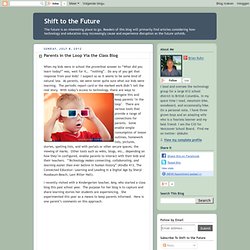
Was, wait for it… “nothing”. Do any of you get that response from your kids? I suspect so as it seems to be some kind of natural law. As parents, we were never quite sure what our kids were learning. The periodic report card or the marked work didn’t tell the real story. Mitigate this and keep parents ‘in the loop’. I recently visited with a Kindergarten teacher, Amy, who started a class blog this past school year. Ofelia, a parent of a Kindergarten child, stays in the loop via class blog Ofelia appreciates that the blog “makes learning visible”. Amy, a Kindergarten teacher, talks about starting and using a class blog Amy chose to create her blog on the District private site to protect her students’ privacy. Lori, a parent of a Kindergarten child, talks about the impact of a class blog There was a lot of interest in the post I wrote recently about student’s blogging.
An audience. IdeasforClassroomBlogs.