
Freelance 3D Artist. Blender-Keyframing & Animation. Blender 3D Channel on freemovies.co.uk. Introduction to Scripting with Python in Blender. 3D scatter plots with Blender - Mathieu Gibert. Here is a little python script to import a set of points into blender.
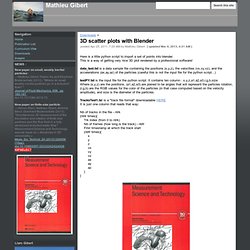
This is a way of getting very nice 3D plot rendered by a professional software! Data_test.txt is a data sample file containing the positions (x,y,z), the velocities (vx,vy,vz), and the accelerations (ax,ay,az) of the particles (careful this is not the input file for the python script...) testPY.txt is the input file for the python script. It contains ten column : x,y,z,a1,a2,a3,r,g,b,size Where (x,y,z) are the positions, (a1,a2,a3) are planed to be angles that will represent the particles rotation, (r,g,b) are the RGB values for the color of the particles (in that case computed based on the velocity amplitude), and size is the diameter of the particles. TracksTest1.txt is a "track file format" downloadable HERE It is just one column that reads that way:
Mapping, still mapping. Blender 3D Tutorials - Free Blender 3D Tutorial at Tutorial Hero. Blender Artists Community. Blender for Architecture. From Blender for Architecture Blender is quite suitable for Architecture work.
Nevertheless, it still lacks a lot of features to to make it user friendly. The aim of this website is to bring together most content related to Architectural design with Blender to help and improve workflow. All content on this website use Free licenses. Feel free to add new content yourself ! You can follow the news about the website at the Café. If you have found a file which shouldn't be here because of licensing or other reasons please Report it. Note : This website is designed to be used through the English interface of Mediawiki Modified special pages are not translated and translations may contain grammatical errors. Blender 3D as a CAD tool: Using the ProCAD script. One of the oldest wishes of artists that uses Blender 3D for architectural visualization is the addition of CAD tools in Blender, to make the modeling of architectural elements easier and with better precision options.

A big improvement was made with the addition of new snapping tools in the Apricot project, but we could use a little more options to make Blender get even closer to a CAD tool. Even without native tools that turn Blender into a CAD tool, we have a few scripts that really help and add some great features, available in most CAD tools that can make the difference for the modeling stage of architectural visualization projects. One of these scripts is the ProCAD from Paolo Provenda, which can add incredible and useful options to Blender. If you want to download the script and install it in Blender, visit this link.
Well, most of the script is in Italian and were partially translated to English. Let`s get started? The Complete Architecture Series using Blender. With July now behind us, the architecture tutorial series is now complete!
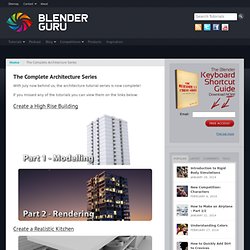
If you missed any of the tutorials you can view them on the links below: Create a High Rise Building Create a Realistic Kitchen I hope you enjoyed the series! Next month’s topic will be announced at the start of next week. Blender 3D Architect. The Durian Open Movie Project » Blog Archive » Modeling Sprint – A Stellar Success! On February 21st, 2010, by Colin Levy Will you just look at the number of models posted the past couple days on BlendSwap!

Check it out! Holy smokes, you guys. I came in Saturday afternoon surprised to find that nearly every single item on the wiki with a name next to it and nearly 200 people logged into IRC! And things were just getting started! Free rendering by the people for the people. Blender Tutorials Downloads Videos & Education – Blender Cookie. Modelling a character from scratch through to animation. BlenderArt Magazine. BlenderNation. 3D, Maya, Blender and more tutorials from beginner to advanced. Blender Newbies 3D Video Tutorials (Learn to Create 3D Graphics with Blender!) Manual/Textures/Maps/Bump and Normal Maps.
From BlenderWiki Mode: All Modes Panel: Shading/Texture Context → Image Hotkey: F6 Description Normal Maps and Bump Maps both serve the same purpose: they simulate the impression of a detailed 3D surface, by modifying the shading as if the surface had lots of small angles, rather than being completely flat.

Both bump maps and normal maps work by modifying the normal angle (the direction pointing perpendicular from a face), which influences how a pixel is shaded. Bump maps These are textures that store an intensity, the relative height of pixels from the viewpoint of the camera. Normal maps These are images that store a direction, the direction of normals directly in the RGB values of an image. Normal maps in Blender store a normal as follows: Red maps from (0-255) to X (-1.0 - 1.0) Green maps from (0-255) to Y (-1.0 - 1.0) Blue maps from (0-255) to Z (0.0 - 1.0) Since normals all point towards a viewer, negative Z-values are not stored (they would be invisible anyway). Workflow Examples. Come swap some blends with friends.