
4002050596_0c2b6c4dd2_o.jpg (JPEG Image, 3861 × 1706 pixels) - Scaled (37%) Dark alien planet discovered by NASA. Lores.jpg (JPEG Image, 1159 × 1159 pixels) - Scaled (64%) An Abundance of Exoplanets Changes our Universe. Earth-sized planets near and far (NASA/Ames/JPL-Caltech) Planets in habitable zones, planets orbiting twin suns, miniature solar systems, rogue planets, planets, planets, planets.

If there is one single piece of information you should take away from the recent flood of incredible exoplanetary discoveries it is this: Our universe makes planets with extraordinary efficiency – if planets can form somewhere, they will. We’ve been sidling up on this fact for some time now, but it’s still a remarkable thing to acknowledge. Ten to fifteen years ago, as the first exoplanet detections began to come in, we understood that what we were seeing was potentially just the tip of the iceberg. Earth's Inconstant Magnetic Field. Earth's Inconstant Magnetic Field Our planet's magnetic field is in a constant state of change, say researchers who are beginning to understand how it behaves and why.
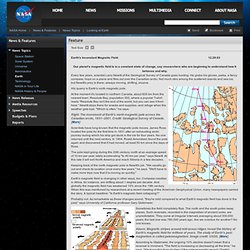
Every few years, scientist Larry Newitt of the Geological Survey of Canada goes hunting. He grabs his gloves, parka, a fancy compass, hops on a plane and flies out over the Canadian arctic. Not much stirs among the scattered islands and sea ice, but Newitt's prey is there--always moving, shifting, elusive. His quarry is Earth's north magnetic pole. All About Black Holes: Formation & Discovery. Black holes are some of the strangest and most fascinating objects found in outer space.

They are objects of extreme density, with such strong gravitational attraction that even light cannot escape from their grasp if it comes near enough. Albert Einstein first predicted black holes in 1916 with his general theory of relativity. The term "black hole" was coined in 1967 by American astronomer John Wheeler, and the first one was discovered in 1971. There are three types: stellar black holes, supermassive black holes and intermediate black holes. Asteroid Threat Becomes A Promise: New Space Venture Launches. Strange Magnetic Bubbles at the Edge of the Solar System Video. Diamond planet discovered by astronomers. If a diamond truly is a girl's best friend, then astronomers working from Swinburne University of Technology in Melbourne, Australia, may have just discovered the supreme BFF: a planet made of solid diamond, according to a report by New Scientist.

The planet is orbiting a pulsar about 4,000 light-years away, and it represents some serious bling. Astronomers estimate that the planet is barely under 60,000 kilometers in diameter and has a mass roughly equal to that of Jupiter. Although the planet is too far away to be seen through a conventional telescope, astronomers were able to infer its existence by observing periodic flickers in the pulsar it is orbiting. Video: Must-See Solar Flare Explodes From Sun's Surface. An incredibly stunning solar flare erupted from the sun’s surface, throwing charged particles and searing plasma millions of miles out into space on Apr. 16.

NASA’s Solar Dynamics Observatory captured data from the flare — a medium-sized M-class event — which was turned into a movie by Steele Hill, media specialist at the Goddard Space Flight Center. The blast was not directed at the Earth and is unlikely to hit any of the planets in our solar system. The video above follows a trail of plasma hotter than 143,000 degrees Fahrenheit, which is actually quite cool for the sun. A rose made of galaxies. Cosmic Purple. Life on Mars found but destroyed by mistake - Sci/Tech. Bungling NASA scientists are believed to have found tiny live microbes on Mars - but mistakenly killed them by boiling them alive, a media report said.

Bungling NASA scientists are believed to have found tiny live microbes on Mars - but mistakenly killed them by boiling them alive, a media report said Saturday. Two spacecraft that landed on the Red Planet in 1976 are now thought to have detected microbes in Martian soil. But scientists at the time failed to spot the signs of life - and cooked the bugs at 160 degrees Centigrade during experiments, The Sun reported. Rocket Scientist: Making space pay and having fun doing it.
Astronaut Photographs Banks Peninsula From Space. Garik Israelian: How spectroscopy could reveal alien life. NASA Science. The Most Important Image Ever Taken. Earth's magnetic field provides vital protection. A chance alignment of planets during a passing gust of the solar wind has allowed scientists to compare the protective effects of Earth’s magnetic field with that of Mars’ naked atmosphere.

The result is clear: Earth’s magnetic field is vital for keeping our atmosphere in place. The alignment took place January 6, 2008. Using the European Space Agency’s (ESA) Cluster and Mars Express missions to provide data from Earth and Mars, respectively, scientists compared the loss of oxygen from the two planets’ atmospheres as the same stream of solar wind hit them.
Astronomer finds evidence for record-breaking nine planet system. A study by Mikko Tuomi, an astronomer at the University of Hertfordshire, has revealed that the planetary system around the star named HD 10180 may have more planets in its orbits than our own Solar system.

Dr Tuomi carried out his analysis as part of the EU research network RoPACS, being led in Hertfordshire. Originally reported to be orbited by seven planets in 2010, re-analysed data from the HARPS (High Accuracy Radial Velocity Planet Searcher) now indicates that the star has nine planets. This discovery is significant as most planetary systems discovered so far have far fewer planets. Located 130 light years away, the star is not within reach of foreseeable human space travel, but in astronomical distances, it is still considered to be in the solar neighbourhood.
The study, accepted for publication in the journal Astronomy and Astrophysics, verifies the existence of the previously announced seven planets and shows that there are likely to be two additional planets orbiting the star. 'Comet Massacre' Around Star Surprises Scientists. A young star that is home to at least one alien planet is also ringed by a vast, dusty cloud of comets, like our own solar system.

But there's a big difference: There may be as many as 83 trillion comets there, with collisions destroying thousands each day, a new study suggests. In fact, there is so much dust around the star that the equivalent of 2,000 comets, each a half-mile (1 kilometer) wide, would have to have been obliterated every day to create the icy dust belt seen today, researchers say. Space Exploration Technologies Corporation - Dragon. Influence of Planets on the Sun. Alien Earth 'Goldilocks Planet' May Be Found By 2014, Astronomers Say. By: SPACE.com Staff Published: 04/04/2012 07:44 AM EDT on SPACE.com The first true "alien Earth" will likely be discovered in the next two years, a NASA scientist says. Astronomers have found more than 750 alien planets to date, and NASA's Kepler Space Telescope has flagged 2,300 additional "candidates" awaiting confirmation by follow-up studies.
This haul has not yet included an Earth-like exoplanet — one that's the size of our planet and orbits at the right distance from its star to support liquid water and, possibly, life as we know it. But that could change soon, according to Shawn Domagal-Goldman, a researcher at NASA Headquarters in Washington, D.C. who specializes in exoplanet biology. Super-Earth Alien Planets May Hang on to Life More Tightly. Life may not get blasted off any of the known "super-Earth" worlds as readily as it can from our planet, scientists find. The discovery suggests that any intelligent aliens that develop on such planets might find it hard to rocket off them and travel to other worlds as well, researchers added. As scientists began discovering alien worlds around other stars, one class of planet that began appearing was super-Earths, planets larger than our own that can reach up to 10 times Earth's mass. Hubble Heritage.
Planetarium - Interactive star map and virtual sky. Logy Magazine. In new research, scientists have attempted to determine the precise conditions necessary for planets to form in a star system. Jarrett Johnson and Hui Li of Los Alamos National Laboratory assert that observations increasingly suggest that planet formation takes place in star systems with higher metallicities. Astronomers use the term “metallicity” in reference to elements heavier than hydrogen and helium, such as oxygen, silicon, and iron.
In the “core accretion” model of planetary formation, a rocky core gradually forms when dust grains that make up the disk of material that surrounds a young star bang into each other to create small rocks known as “planetesimals”. Citing this model, Johnson and Li stress that heavier elements are necessary to form the dust grains and planetesimals which build planetary cores.
Additionally, evidence suggests that the circumstellar disks of dust that surround young stars don’t survive as long when the stars have lower metallicities. The Planet Epoch. Russia to join European Mars mission. MOSCOW, April 6 (UPI) -- Russia's space agency Roscosmos said it has agreed to participate in a Mars research project with the European Space Agency.

The announcement came following a meeting between Roscosmos head Vladimir Popovkin and ESA chief Jean-Jacques Dordain in Moscow Friday. "The sides consider this project feasible and promising," Popovkin's spokeswoman Anna Vedishcheva told RIA Novosti. "The sides are to sign the deal by year-end. " The final agreement on Russia's participation in ExoMars is expected to be signed in November "and by this date the sides should confirm their financing," a space industry source told RIA Novosti. View the Universe in different wavelengths. The Worlds of David Darling. Astrophotography by Jerry Lodriguss. Apollo 11 Launch at 500 Frames per Second. Stellarium. WIKISKY.ORG. Home. Profile on TED.com. Space Image: Aurora Borealis seen from the Space Station.
Earth's Alignment With Milky Way's Supermassive Black Hole on the Winter Solstice. One of the most bizarre theories about 2012 is the widespread notion that a cosmic alignment of the sun, Earth, and the center of our galaxy, which is obscured by the Dark Rift, on the winter solstice could for some unknown reason lead to planetary destruction. The image above shows a laser beaming out of the European Southern Observatory's Very Large Telescope in Chile with the Milky Way and the "Dark Rift" overhead. The Dark Rift is a series of overlapping, non-luminous, molecular dust clouds that are located between our Solar System and the Sagittarius Arm of the Milky Way at a distance 300 light years from Earth, starting at the constellation of Cygnus stretching to Aquila, then to Ophiuchus, where it broadens out, then reaching Sagittarius, where it obscures the Galactic Center and the supermassive black hole, Sag* A, about 28,000 light-years awayweighing some four million times the sun's mass, and finally to Centaurus.
The Daily Galaxy via JPL/NASA Image credit top of page: ESO/G. Record massive black holes discovered lurking in monster galaxies. University of California, Berkeley, astronomers have discovered the largest black holes to date ‑- two monsters with masses equivalent to 10 billion suns that are threatening to consume anything, even light, within a region five times the size of our solar system. Three New Planets and a Mystery Object Discovered Outside Our Solar System. Click on image for high-resolution file. Amazon founder locates lost moon mission engines. Space wallpapers - Free computer desktops, widescreen wallpapers and backgrounds: Click image to close this window. Gravity Probe B - Special & General Relativity Questions and Answers. Planets found at dawn of universe, but their existence is a mystery. Dead stars 'to guide spacecraft' New Estimate: Billions of Earth-like Planets in our Galaxy. The-Observable-Universe.jpg (JPEG Image, 3850 × 1925 pixels) - Scaled (35%)
Opportunity finds 'vein' deposited by water. 6a00d8341bf67c53ef015391ee99b6970b-pi (JPEG Image, 1024 × 1024 pixels) - Scaled (67%) Image: Sediment in Lake Erie As Seen From Space. NASA image acquired March 21, 2012. After a nearly ice-free winter, Lake Erie was filled with multi-colored swirls of sediment on the first days of spring, 2012. The Moderate Resolution Imaging Spectroradiometer (MODIS) aboard NASA's Terra satellite captured this true-color image of the southern Great Lakes region on March 21, 2012 at 16:25 UTC (12:25 p.m. Eastern Standard Time). The nearly clear waters of Lake Huron can be seen in the northwest and Lake Ontario lies to the east of sediment-filled Lake Erie.
Relatively small Lake St. Major cities line the shore of Lake Erie, and appear as gray smudges. Logy Magazine. An odd, previously unseen landform could provide a window into the geological history of Mars, according to new research by University of Washington geologists. Understanding Mars' geological history can provide many clues about the potential for past life on the red planet. Scientists Find Evidence for “Great Lake” on Europa and Potential New Habitat for Life. Catching Its Tail. Radio_broadcasts.jpg (JPEG Image, 2795 × 2795 pixels) - Scaled (24%) Vojto1_pub_eclipse.jpg (JPEG Image, 1604 × 1130 pixels) Venus, Jupiter & Moon Conjunction. 2012 March 12 - The Scale of the Universe Interactive.
'Hypervelocity Planets' Zoom Through the Galaxy at 30 Million Miles Per Hour. Scientists Find a Pair of Supermassive Black Holes. Discovered: Stars as Cool as the Human Body. Waterworld: A new class of exoplanet is discovered. X-rays reveal why the Moon has no volcanoes. Newborn stars emerge from dark clouds in Taurus. 13 December 11. A 3D panning (artist's impression) on NGC 3603. Two Suns? Twin Stars Could Be Visible From Earth By 2012. 2012 Skywatching Events Guide & 2012 Venus Transit. Simply Mindblowing Fractal Artworks. Solar System Scope.
Amazing video: Planets viewed from Earth as if they were at the distance of our moon. World War 2 Pictures in Color - WW2inColor.com. My God, it's full of stars" by Thomas Zimmer. We're 99% certain this is the most beautiful footage of Earth's auroras yet recorded. Spectacular Silhouette: Skywatcher Sees Plane Crossing Small Full Moon. Moon in Stunning Detail - Boredstop.com. Scientists glimpse 'dark flow' lurking beyond the edge of the universe.
Earth View. Mysteries of Deep Space - History of the Universe Timeline. Astronomical & Nightscape Photography by Chris Cook. Russell Croman Astrophotography. How white holes (might) be created. Venus springs ozone layer surprise. CivilWarPhotos.net. Wallpaper. IC1848-HST-1200.jpg (JPEG Image, 1200x1200 pixels) - Scaled (53%) Black Hole Birth Announcement - Space News.
Bellatrix Orionis - Views from the edge of the Universe. Chromoscope - View the Universe in different wavelengths - StumbleUpon. Dark streaks and huge grooves: Vesta up close - space - 01 August 2011. Sky. Spacewalk - the blue sky below us. M104b_peris2048.jpg from nasa.gov - StumbleUpon. Scientists Discover The Oldest, Largest Body Of Water In Existence. Celestia: Home - StumbleUpon. Earth's gold fell from the sky › News in Science (ABC Science)