
Bluebrain. Gero Miesenboeck reengineers a brain. Russian brains behind closest ever AI attempt. Between Ape and Artilect. Narswang. What makes NARS different from conventional reasoning systems is its ability to learn from its experience and to work with insufficient knowledge and resources.
NARS attempts to uniformly explain and reproduce many cognitive facilities, including reasoning, learning, planning, reacting, perceiving, categorizing, prioritizing, remembering, decision making, and so on. BRAIN POWER: From Neurons to Networks. Artificial Brains - The quest to build sentient machines. Spaun, the new human brain simulator, can carry out tasks (w/ video) (Phys.org)—One of the challenges of understanding the complex behavior of animals is to relate the behavior to the complex processes occurring within the brain.
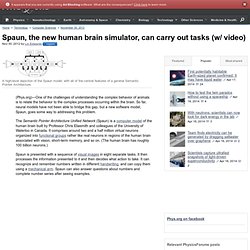
So far, neural models have not been able to bridge this gap, but a new software model, Spaun, goes some way to addressing this problem. The Semantic Pointer Architecture Unified Network (Spaun) is a computer model of the human brain built by Professor Chris Eliasmith and colleagues of the University of Waterloo in Canada. It comprises around two and a half million virtual neurons organized into functional groups rather like real neurons in regions of the human brain associated with vision, short-term memory, and so on. (The human brain has roughly 100 billion neurons.) Spaun is presented with a sequence of visual images in eight separate tasks. How powerful is a mind? Supercomputer takes 40 minutes to map 1 second of brain activity - Gadgets & Tech - Life & Style. The numbers may not sound too impressive, but this is an important breakthrough in simulation technology and has wide-reaching implications.

Using the K supercomputer, the fourth most powerful in world, scientists in Japan replicated a network of 1.73 billion nerve cells and 10.4 trillion synapses. It took the K computer, with over 700,000 processor cores and 1.4 million GB of RAM, 40 minutes to model the data. The most sophisticated of its kind, the project, a joint venture between Japanese research group RIKEN and German research group Forschungszentrum Jülich, was designed to gauge the limits of brain simulation technology. RIKEN’s success is the most significant development in the global brain race, wherein the world’s major economies are racing to map the human brain and unlock its secrets.
Stanford Artificial Intelligence Laboratory. Watson. Watson Is Now Commercially Available, Set To Help Doctors Treat Cancer. [Source: ibmbusinessanalytics via YouTube] IBM’s most promising medical student just graduated and is ready to join the workforce and help people – in the fight against cancer, to be specific.

IBM has just released a commercially available Watson whose cognitive computing could help doctors make better diagnoses and smarter treatment choices. IBM has partnered with WellPoint, Inc. and Memorial Sloan-Kettering Cancer Center to train Watson in oncology and utilization management. A team of clinicians and technicians spent thousands of hours “teaching” Watson how to process, analyze, and interpret complex clinical information through natural language processing. The hope is that Watson can help raise the quality of healthcare and make it more efficient.
Inside the Mind of Watson: Cognitive Computing. Artificial Intelligence. A new era of cognitive computing. IBM says it is possible to build a new computing architecture that is more human-like and biologically inspired than traditional systems.

After a year of “medical school”, IBM’s intelligent supercomputer, Watson, has produced its first commercially available applications for doctors and health insurance companies. Now that Watson is proving itself in the medical field, the door is being flung open for other industries and a new era of cognitive computing. According to IBM, Watson’s performance has improved by 240% since it rose to prominence by beating the reigning human champions at the popular US quiz show, Jeopardy, two years ago. Artificial Intelligence authors/titles recent submissions. The detection of intermediate-level emergent structures and patterns. University CS 221 Introduction to Artificial Intelligence. IIIA - CSIC - Web Page. OpenAi - - Creating the standard for Artificial Intelligence.
Physicist Proposes New Way To Think About Intelligence. (ISNS) -- A single equation grounded in basic physics principles could describe intelligence and stimulate new insights in fields as diverse as finance and robotics, according to new research.
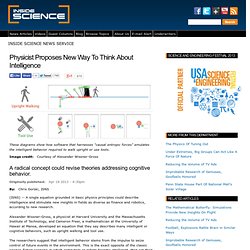
Alexander Wissner-Gross, a physicist at Harvard University and the Massachusetts Institute of Technology, and Cameron Freer, a mathematician at the University of Hawaii at Manoa, developed an equation that they say describes many intelligent or cognitive behaviors, such as upright walking and tool use. The researchers suggest that intelligent behavior stems from the impulse to seize control of future events in the environment. This is the exact opposite of the classic science-fiction scenario in which computers or robots become intelligent, then set their sights on taking over the world. "It's a provocative paper," said Simon DeDeo, a research fellow at the Santa Fe Institute, who studies biological and social systems. The emergence of complex behaviors through causal entropic forces. (Phys.org) —An ambitious new paper published in Physical Review Letters seeks to describe intelligence as a fundamentally thermodynamic process.

The authors made an appeal to entropy to inspire a new formalism that has shown remarkable predictive power. To illustrate their principles they developed software called Entropica, which when applied to a broad class of rudimentary examples, efficiently leads to unexpectedly complex behaviors. By extending traditional definitions of entropic force, they demonstrate its influence on simulated examples of tool use, cooperation, and even stabilizing an upright pendulum.
The familiar concept of entropy which states that systems are biased to evolve towards greater disorder, gives little indication about exactly how they evolve. A grand unified theory of AI. In the 1950s and ’60s, artificial-intelligence researchers saw themselves as trying to uncover the rules of thought.

But those rules turned out to be way more complicated than anyone had imagined. Since then, artificial-intelligence (AI) research has come to rely, instead, on probabilities — statistical patterns that computers can learn from large sets of training data. The probabilistic approach has been responsible for most of the recent progress in artificial intelligence, such as voice recognition systems, or the system that recommends movies to Netflix subscribers.
But Noah Goodman, an MIT research scientist whose department is Brain and Cognitive Sciences but whose lab is Computer Science and Artificial Intelligence, thinks that AI gave up too much when it gave up rules. Entropica. Big Data is the new Artificial Intelligence. This is the first of a couple columns about a growing trend in Artificial Intelligence (AI) and how it is likely to be integrated in our culture.
Computerworld ran an interesting overview article on the subject yesterday that got me thinking not only about where this technology is going but how it is likely to affect us not just as a people. but as individuals. How is AI likely to affect me? The answer is scary. Henry Markram: A brain in a supercomputer. SciContrib34.pdf. DARPA Looks To New Form Of Computation That Mimics The Human Brain. Artificial Intelligence Center @ SRI. RoboEarth [Artificial Intelligence] Knowledge-Exchange between Robots The purpose of the RoboEarth project is to create a giant network through which robots and their programmers can easily share information about actions and the world.
![RoboEarth [Artificial Intelligence]](http://cdn.pearltrees.com/s/pic/th/artificial-intelligence-53159308)
Similar to what the World Wide Web has done for humans, RoboEarth will enable robotic systems to benefit from the experience of other robots in a way that can be easily translated to their own case. Data stored in RoboEarth include software components, environment maps, task knowledge, and object recognition models. The network will provide a key infrastructure for advancing machine cognition and behavior incrementally on a collective level. In addition the RoboEarth Cloud Engine will make powerful computation available to robots. Our role in the RoboEarth consortium is to investigate knowledge representation and mechanisms for uploading, exchanging and applying action recipes.
For more information and news, visit www.roboearth.org Partners: SpirOps AI - Scientific Research Lab in Artificial Intelligence. The AI Sandbox™ Rethinking artificial intelligence. The field of artificial-intelligence research (AI), founded more than 50 years ago, seems to many researchers to have spent much of that time wandering in the wilderness, swapping hugely ambitious goals for a relatively modest set of actual accomplishments. Now, some of the pioneers of the field, joined by later generations of thinkers, are gearing up for a massive “do-over” of the whole idea. This time, they are determined to get it right — and, with the advantages of hindsight, experience, the rapid growth of new technologies and insights from the new field of computational neuroscience, they think they have a good shot at it.
The new project, launched with an initial $5 million grant and a five-year timetable, is called the Mind Machine Project, or MMP , a loosely bound collaboration of about two dozen professors, researchers, students and postdocs. I² Home page. Computerized brain made of GPUs could be the future of artificial intelligence. For decades computer scientists have been struggling to design an artificial intelligence sophisticated enough that it could pass for a living being. The fruits of that labor so far are snarky chatbots and systems that can crunch large amounts of data and spit out factoids. Google began working on a new method of replicating neural networks using 1,000 computers tied together. Now, one of the researchers that helped Google do it has laid out the framework for an even better brain model that costs a fraction as much.
Ray Kurzweil Plans to Create a Mind at Google—and Have It Serve You. Ray Kurzweil’s How to Create a Mind to be published Nov. 13. Ray Kurzweil’s next book — How to Create a Mind: The Secret of Human Thought Revealed* — will be published Nov. 13, Viking announced today. It can now be pre-ordered. In the book, Kurzweil explores the most important science project since the human genome: reverse-engineering the brain to understand precisely how it works, then applying that knowledge to create vastly intelligent machines.
Drawing on the most recent neuroscience research, compelling thought experiments, and his own research and inventions in artificial intelligence, he describes his new theory of how the neocortex (the thinking part of the brain) works: as a self-organizing hierarchical system of pattern recognizers. How to Create a Mind. How to Create a Mind: The Secret of Human Thought Revealed is a non-fiction book about brains, both human and artificial, by inventor and futurist Ray Kurzweil. First published in hardcover on November 13, 2012 by Viking Press[1] it became a New York Times Best Seller.[2] It has received attention from The Washington Post, The New York Times and The New Yorker.
Kurzweil describes a series of thought experiments which suggest to him that the brain contains a hierarchy of pattern recognizers. Based on this he introduces his Pattern Recognition Theory of Mind. He says the neocortex contains 300 million very general pattern recognition circuits and argues that they are responsible for most aspects of human thought. He also suggests that the brain is a "recursive probabilistic fractal" whose line of code is represented within the 30-100 million bytes of compressed code in the genome. How to Create a Mind - Homepage. How To Create A Mind: Ray Kurzweil at TEDxSiliconAlley.
Mind uploading. Whole brain emulation (WBE) or mind uploading (sometimes called "mind copying" or "mind transfer") is the hypothetical process of copying mental content (including long-term memory and "self") from a particular brain substrate and copying it to another computational device, such as a digital, analog, quantum-based or software based artificial neural network. The computational device could then run a simulation model of the brain information processing, such that it responds in essentially the same way as the original brain (i.e., indistinguishable from the brain for all relevant purposes) and experiences having a conscious mind.[1][2][3] MIT Computer Science and Artificial Intelligence Laboratory. Computer learns language by playing games. Computers are great at treating words as data: Word-processing programs let you rearrange and format text however you like, and search engines can quickly find a word anywhere on the Web.
Ai Research - Creating a new form of life. Common Sense Computing Initiative. Mind Children: The Future of Robot and Human Intelligence - Hans Moravec - Google Books. Open Mind. Open Mind Common Sense. Progress in artificial intelligence. Association for the Advancement of Artificial Intelligence. Ethical Issues In Advanced Artificial Intelligence. Stephen Hawking: 'Transcendence looks at the implications of artificial intelligence - but are we taking AI seriously enough?' - Science - News.
VUB Artificial Intelligence Lab. On Line Index of Artificial Intelligence Journals. Computational humor. It is a relatively new area, with the first dedicated conference organized in 1996.[1] Joke generators[edit] Pun generation[edit] Facebook Building Major Artificial Intelligence System To Understand Who We Are. I.B.M. Announces Brainy Computer Chip. Since the early days in the 1940s, computers have routinely been described as “brains” — giant brains or mathematical brains or electronic brains. Scientists and engineers often cringed at the distorting simplification, but the popular label stuck.
IBMDharmendra Modha, an I.B.M. researcher, is the leader of the project to create cognitive computer chips. Neurodudes. Artificial Superintelligence: A Futuristic Approach. Introduction. Chemical computer that mimics neurons to be created. IBM's "neurosynaptic" chips are the closest thing to a synthetic brain yet. AI Horizon: Computer Science and Artificial Intelligence Programming Resources. Category:Artificial intelligence publications. Category:Artificial intelligence researchers. Artificial Intelligence Researchers, Faculty + Professionals. List of artificial intelligence projects.
GPAI Project - GPAI. JAIR. Machine Intelligence Research Institute. Artificial Intelligence @ MIRI. Computer Vision. Google's Ray Kurzweil revs up search focus with AI vision. Mechanisation of Thought Processes: Artificial Intelligence in the 21st Century. Vision par ordinateur. Scientists See Advances in Deep Learning, a Part of Artificial Intelligence.