
Research at Princeton. Skip over navigation Research A to Z Contacts Research Research Areas Affiliated National Labs News & Events Celebrate Princeton Invention Reports Discovery: Research at Princeton University Research Board Annual Report Resources For Faculty & Staff Students Research Administration Office of the Dean for Research University Research Board Corporate and Foundation Relations Technology Licensing Office of Research and Project Administration Research Integrity and Assurance Laboratory Animal Resources Contact Us Join Our Mailing List Request a Printed Copy of Discovery Home Engineering and the Arts at Princeton Full Story Princeton establishes partnership with leading Chinese university Link between warming and past droughts questioned Pond-dweller uses tiny tags to mark DNA as "non-junk" previous next Research News Don't read my lips!
Princeton establishes strategic partnership with Humboldt University in Berlin Clay pot fragments reveal early start to cheese-making, a marker for civilization All Home Page Stories View all. Brain Games. Nación - Emite SRE normas para expedición de pasaportes. CIUDAD DE MÉXICO | Viernes 23 de noviembre de 2012NTX | El Universal09:51 La Secretaría de Relaciones Exteriores (SRE) dio a conocer en el Diario Oficial de la Federación, los lineamientos para el trámite de pasaportes y del documento de identidad y viaje en territorio nacional, así como para su renovación o cancelación.
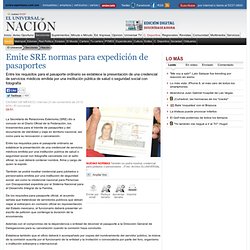
Entre los requisitos para el pasaporte ordinario se establece la presentación de una credencial de servicios médicos emitida por una institución pública de salud o seguridad social con fotografía cancelada con el sello oficial, la cual deberá contener nombre, firma y cargo de quien la expide. También se podrá mostrar credencial para jubilados o pensionados emitida por una institución de seguridad social, así como la credencial nacional para Personas con Discapacidad expedida por el Sistema Nacional para el Desarrollo Integral de la Familia. cg. Finanzas - Inflación llega a 4.73% a tasa anual. Lunes 24 de septiembre de 2012Notimex | El Universal09:29 En la primera quincena de septiembre, los precios al consumidor en el país aumentaron 0.25 por ciento y con ello, la inflación general a tasa anual se ubicó en 4.73 por ciento, informó el Instituto Nacional de Estadística y Geografía (INEGI).
La inflación quincenal fue superior al 0.21 por ciento registrado en la misma quincena de 2011, pero menor al 0.32 por ciento previsto por consenso del mercado para la primera mitad del mes en curso. En su reporte, el organismo explica que el incremento del Índice Nacional de Precios al Consumidor (INPC) se debió principalmente al alza de algunos productos agropecuarios como huevo pollo y jitomate, así como aumentos en colegiaturas y en energéticos. Machine Learning Video Library - Learning From Data (Abu-Mostafa) Knowledge. Simple face recognition using OpenCV « The Pebibyte.
Pointwise mutual information. Pointwise mutual information (PMI),[1] or point mutual information, is a measure of association used in information theory and statistics.
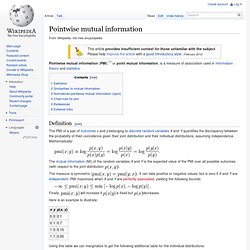
Definition[edit] The PMI of a pair of outcomes x and y belonging to discrete random variables X and Y quantifies the discrepancy between the probability of their coincidence given their joint distribution and their individual distributions, assuming independence. Mathematically: The mutual information (MI) of the random variables X and Y is the expected value of the PMI over all possible outcomes (with respect to the joint distribution The measure is symmetric ( ).
Finally, will increase if is fixed but decreases. Here is an example to illustrate: Using this table we can marginalize to get the following additional table for the individual distributions: With this example, we can compute four values for . (For reference, the mutual information would then be 0.214170945) Thumbs Up or Thumbs Down? Semantic Orientation Applied toUnsupervised Classification of Reviews.
Pointwise mutual information - MaltCourses. From MaltCourses This is a method discussed in Social Media Analysis 10-802 in Spring 2010 .
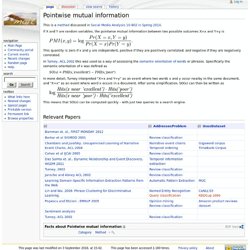
If X and Y are random variables, the pointwise mutual information between two possible outcomes X=x and Y=y is This quantity is zero if x and y are independent, positive if they are positively correlated, and negative if they are negatively correlated. In Turney, ACL 2002 this was used as a way of assessing the semantic orientation of words or phrases. Turney, ACL 2002 - MaltCourses. From MaltCourses Citation Turney, P.
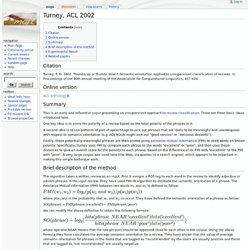
D. 2002. Thumbs up or thumbs down? Semantic orientation applied to unsupervised classification of reviews. Online version ACL anthology Summary This is an early and influential paper presenting an unsupervised approach to review classification . One key idea is to score the polarity of a review based on the total polarity of the phrases in it. A second idea is to use patterns of part of speech tags to pick out phrases that are likely to be meaningful and unambiguous with respect to semantic orientation (e.g. Finally, these potentially-meaningful phrases are then scored using pointwise mutual information (PMI) to seed words on known polarity.
Brief description of the method The algorithm takes a written review as an input. Where p ( w 1 , w 2 ) is the probability that w 1 and w 2 co-occur. Mutual information. Individual (H(X),H(Y)), joint (H(X,Y)), and conditional entropies for a pair of correlated subsystems X,Y with mutual information I(X; Y).
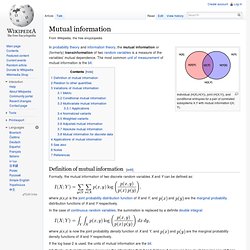
In probability theory and information theory, the mutual information or (formerly) transinformation of two random variables is a measure of the variables' mutual dependence. The most common unit of measurement of mutual information is the bit. Definition of mutual information[edit] Formally, the mutual information of two discrete random variables X and Y can be defined as: where p(x,y) is the joint probability distribution function of X and Y, and and are the marginal probability distribution functions of X and Y respectively.
In the case of continuous random variables, the summation is replaced by a definite double integral: Normalized Mutual Information Feature Selection. Normalized mutual information based registration usingk-means clustering and shading correction.