
Art & Technology. The Evolution of Aesthetics: The Origins Of Music And Visual Art. One of the great mysteries of art is why it exists.
Although our desire to create and enjoy art is so widespread that it appears as natural as eating or reproducing -– nearly every culture draws, dances, sings, recites poetry and tells stories -– the origins of human aesthetics are not clear-cut. What’s peculiar is that from a biological point of view art appears to serve no adaptive advantages whatsoever. Surreal architectural projection. The Rx. From “I Couldn’t Stop Watching” by Sasha Steensen, via Volta’s Evening Will Come: sentences on sentences I manage to write a handful of poems on sentences, but really, they turn out to be illustrations on sentence-making, organized by subject.

Here’s one such poem, written in bed: Sentences on Sadness I admit I have been terribly sad. Walker exhibit explores voyeurism as art. Listen Voyeurism as art May 19, 2011 Everyone is shooting pictures.
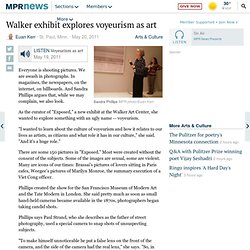
We are awash in photographs. In magazines, the newspapers, on the internet, on billboards. And Sandra Phillips argues that, while we may complain, we also look. As the curator of "Exposed," a new exhibit at the Walker Art Center, she wanted to explore something with an ugly name -- voyeurism.
"I wanted to learn about the culture of voyeurism and how it relates to our lives as artists, as citizens and what role it has in our culture," she said. There are some 150 pictures in "Exposed. " Phillips created the show for the San Francisco Museum of Modern Art and the Tate Modern in London. Phillips says Paul Strand, who she describes as the father of street photography, used a special camera to snap shots of unsuspecting subjects.
"To make himself unnoticeable he put a false lens on the front of the camera, and the side of the camera had the real lens," she says. "You've got people who are 'taking' a photograph. Real Clear Arts. Daily Arts News. Consumer Innovation as New Economic Pattern. Roland Penrose - 'Cryptic Coincidence II' Banksy’s True Identity Listed on eBay, Subsequently Pulled. Banksy is a British artist that has recently grown in fame due to some controversial, however well-done short films.

The unknown individual, who has kept a secret identity despite his growing fame, is perhaps best known for his spoof on the popular cartoon, The Simpsons. Banksy created a new opening sequence back in October, 2010, that seems to start off normal enough, but then towards the middle gets a bit more "interesting. " In an odd turn of events, an eBay seller has put up the "true identity" of Banksy on the popular bidding website, offering the name up for quite a bit of money. According to the seller, it was quite a bit of work to figure out who Banksy really is. "I have uncovered [Banksy's] identity by matching up the prices of his sold pieces to corresponding tax records.
Francis Bacon’s lost painting of Lucian Freud turns up after 45 years. Francis Bacon’s lost painting of Lucian Freud turns up after 45 years As Marc Campbell pointed out on DM last month, when a b&w Coke bottle by Andy Warhol sold for $35, “some things are recession proof.”
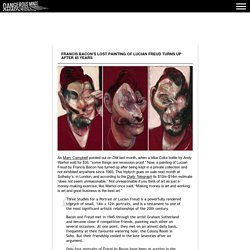
Now, a painting of Lucian Freud by Francis Bacon has turned up after being kept in a private collection and not exhibited anywhere since 1965. This triptych goes on sale next month at Sotheby’s, in London, and according to the Daily Telegraph its $10m-$14m estimate “does not seem unreasonable.” Not unreasonable if you think of art as just a money-making exercise, like Warhol once said, “Making money is art and working is art and good business is the best art.”
Previously on Dangerous Minds Warhol’s $35million Coke Bottle. Visual science in the art of Chuck Close. I’ve just found this amazing article on the work of artist Chuck Close from a 2008 edition of the Archives of Ophthalmology.
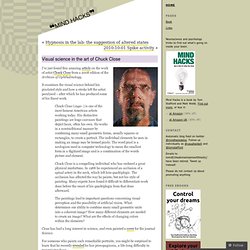
It examines the visual science behind his pixelated style and how a stroke left the artist paralysed – after which he has produced some of his finest work. Chuck Close (1940- ) is one of the most famous American artists working today. Feldman: "Rothko Chapel" Feldman: "Rothko Chapel" Macoto Murayama. Art Manifestos and Their Applications in Contemporary Design - S. Advertisement The way you express yourself with words is a crucial extension of your creative identity.

Professional designers are usually busy focusing on the visual aspects of their craft, but visual arts and literary arts collide and coincide regularly. The two fields meet not just in typography, but also in press releases, social networking communication, slogans, promotional materials, ‘About Me’ pages, marketing strategies, and every single pitch, contract, and email you’ve ever sent to a client.
What might happen if you injected some of those materials with a healthy dose of poetry, humor, or bravado? Obviously, doing so will not be appropriate in some forums, but when it is, this may be a good way to express yourself and differentiate your brand from the crowd. Some of the most electrifying examples of writing about art and design come in the form of the manifesto. What is a manifesto? Dada. Dada (/ˈdɑːdɑː/) or Dadaism was an art movement of the European avant-garde in the early 20th century.
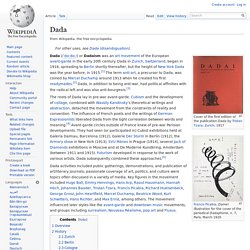
Dada in Zurich, Switzerland, began in 1916, spreading to Berlin shortly thereafter, but the height of New York Dada was the year before, in 1915.[1] The term anti-art, a precursor to Dada, was coined by Marcel Duchamp around 1913 when he created his first readymades.[2] Dada, in addition to being anti-war, had political affinities with the radical left and was also anti-bourgeois.[3] Francis Picabia, Dame! Illustration for the cover of the periodical Dadaphone, n. 7, Paris, March 1920 Overview[edit] Francis Picabia, (left) Le saint des saints c'est de moi qu'il s'agit dans ce portrait, 1 July 1915; (center) Portrait d'une jeune fille americaine dans l'état de nudité, 5 July 1915: (right) J'ai vu et c'est de toi qu'il s'agit, De Zayas!
Duchamp interviews. Art / CP30 descending the stairs Gr8 take off on NDS. Art / "Bride", by Marcel Duchamp (1912) Marcel Duchamp - On Indifferent Taste. Marcel Duchamp - In His Own Words (Part 1) Marcel Duchamp - In His Own Words (Part 2) Dadaism. Dada. Surrealism. Surrealism is a cultural movement that began in the early 1920s, and is best known for its visual artworks and writings.
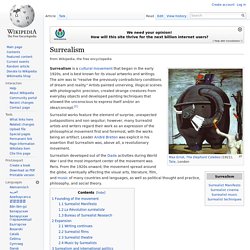
The aim was to "resolve the previously contradictory conditions of dream and reality. " Artists painted unnerving, illogical scenes with photographic precision, created strange creatures from everyday objects and developed painting techniques that allowed the unconscious to express itself and/or an idea/concept.[1] Surrealist works feature the element of surprise, unexpected juxtapositions and non sequitur; however, many Surrealist artists and writers regard their work as an expression of the philosophical movement first and foremost, with the works being an artifact.
Leader André Breton was explicit in his assertion that Surrealism was, above all, a revolutionary movement. Surrealism developed out of the Dada activities during World War I and the most important center of the movement was Paris. Founding of the movement[edit] Surrealist Manifesto[edit] Expansion[edit] Salvador Dali / Surrealism. Salvador Dali - Alka Seltzer. ANDRÉ BRETON, "L'Union libre"
A Hyperborean Adventure in Surrealism. Remedios Varo. Due to her Republican ties, her 1937 move to Paris with Péret ensured that she would never be able to return to Franco's Spain.
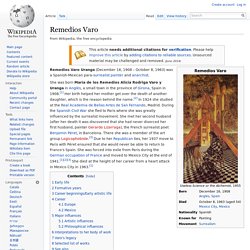
She was forced into exile from Paris during the German occupation of France and moved to Mexico City at the end of 1941. She initially considered Mexico a temporary haven, but would remain in Mexico for the rest of her life. At Mexico, she met native artists such as Frida Kahlo and Diego Rivera, but her strongest ties were to other exiles and expatriates, notably the English painter Leonora Carrington and the French pilot and adventurer, Jean Nicolle. Remedios Varo. Dorothea Tanning.
'The oldest work of art ever': 42,000-year-old paintings of seals found in Spanish cave. Six paintings were found in the Nerja Caves, 35miles east of MalagaThey are the only known artistic images created by Neanderthal man.