
Land of the Black Flag - By Casey Coombs. JAAR, Yemen - "Al Qaeda, they don't have a country," my Yemeni security guard said as we passed through the thirteenth and final military checkpoint along a rugged, potholed road leading to the town of Jaar, al Qaeda's newest stronghold in southern Yemen.

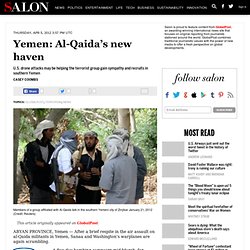
"When they see places quiet from the government -- a lazy government -- they go. " Under the moniker Ansar al-Sharia, or Partisans of Islamic Law, al Qaeda handily seized Jaar in March 2011. They quickly renamed the peaceful hamlet Waqar -- it means "respect" or "majesty," according to one of its new inhabitants -- and instituted a strict Islamic government. Yemen: Al-Qaida’s new haven. ABYAN PROVINCE, Yemen — After a brief respite in the air assault on al-Qaida militants in Yemen, Sanaa and Washington’s warplanes are again scrambling.
A five-day bombing campaign mid-March, for instance, killed at least 60 militants across central and southern parts of the country. Ceasefire in Yemen. Where to next for Yemen’s Arab Spring?
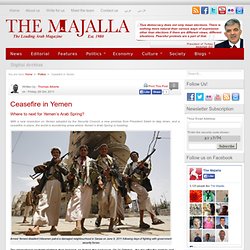
With a new resolution on Yemen adopted by the Security Council, a new promise from President Saleh to step down, and a ceasefire in place, the world is wondering anew where Yemen’s Arab Spring is heading. Armed Yemeni dissident tribesmen patrol a damaged neighbourhood in Sanaa on June 9, 2011 following days of fighting with government security forces The international spotlight alighted, then lingered, on Yemen this past week. On 21 October—the day after the capture and then death of Libya’s Qadhafi—the UN Security Council adopted a resolution calling on Yemen’s Present President Saleh to accept a Gulf Cooperation Council (GCC)-brokered deal to relinquish his 33-year hold on power. Yemen’s State Within a Failed State - Photos By Tom Finn. It was a year ago this week that young men and women first flooded into Yemen's streets en masse to demonstrate against the regime of President Ali Abdullah Saleh.
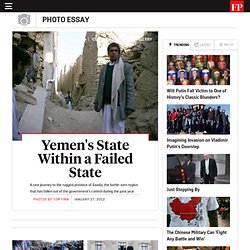
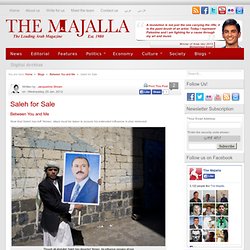
On Jan. 27, 2011, at least 16,000 Yemenis protested in the capital of Sanaa, demanding an end to Saleh's 33-year rule. It has been a strange, bloody, and maddening journey ever since. After 10 months of mass protests, violence, military defections, soaring food and gas prices, and daily power cuts, Saleh finally relinquished powers to his deputy in exchange for a promise of immunity from prosecution for him and his family. On Jan. 22, he left Yemen to seek medical treatment in the United States, and is reportedly seeking exile in Oman. But wherever Saleh ends up, the past year's political deadlock has done grievous damage to the country's already fragile social fabric. Saleh for Sale. Between You and Me Now that Saleh has left Yemen, steps must be taken to ensure his extended influence is also removed.
What’s next for Yemen? Three Scenarios for Yemen’s Future As the country teeters on the brink of potential civil war, The Majalla proposes three possible scenarios for Yemen’s near future. Yemen has endured the least productive uprising of a momentous year in the Arab World, and now is consumed by divisions. Examined here are the stress points of a divided nation, specifically looking at where the cracks will form should President Saleh cling to power, become the victim of a coup, or instigate transition.
Yemeni President Ali Abdullah Saleh addresses supporters in the southern city of Aden 11 September 1999. A Reluctant Leader. Yemen’s Turn. With presidential elections due in February, what lies ahead for Yemen?
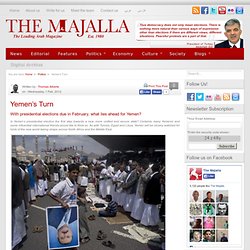
Is Yemen’s presidential election the first step towards a new, more unified and secure state? Certainly many Yemenis and some influential international friends would like to think so. As with Tunisia, Egypt and Libya, Yemen will be closely watched for hints of the new world taking shape across North Africa and the Middle East. A supporter of Ali Abdullah Saleh unwittingly carries the out-going President’s portrait upside-down Yemen will hold a presidential election on 21 February. Freezing Saleh’s Power. In a December speech at Chatham House, Nobel Laureate Tawakul Karman addressed the London public.
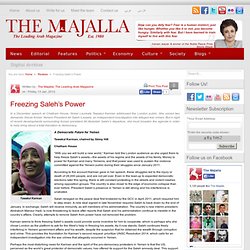
She voiced two demands: freeze former Yemeni President Ali Saleh’s assets, an independent investigation into alleged war crimes. But in light of recent developments surrounding former president Ali Abdullah Saleh’s departure, she must broaden the agenda in order to help bring about a total transition to democracy. A Nobel Prize for the Yemeni People. Yemeni human rights activist Tawakkul Karman was announced last night as one of the winners of the Nobel Peace Prize.

For once, the Nobel committee really got it right. Karman has been a tireless, creative and effective advocate for human rights, media freedoms, and democracy in Yemen for years. And Yemen's struggle for change has been largely forgotten by the world in spite of its almost unbelievable resilience in the face of dim prospects for success. She represents the very best of the new Arab public. Now let us hope that the award sparks the international community to refocus on Yemen's forgotten revolution and push hard for the political transition which it so desperately needs and deserves. My money for the Nobel Peace Prize had been on Egypt's Wael Ghoneim, who had been the administrator of the "We Are All Khaled Said" Facebook page which had helped to crystallize widespread rage over police abuse and unaccountable state bureaucracy. Fighter at a Neglected Front. Tawakkul Karman, Yemeni Activist and Nobel Prize Winner Tawakkul Karman, a Yemeni journalist and activist, is one of three women awarded the 2011 Nobel Peace Prize.
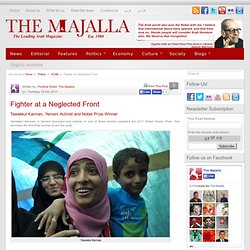
She becomes the first Arab woman to win the prize. The End(s) of Stability. 90 dead as suicide bomber strikes military parade in Yemen capital Sanaa. Monday 21 May 2012 22.12 At least 90 people are now known to have died in this morning's suicide bomb attack in the Yemeni capital, Sanaa.

A police source said a man in a soldier's uniform blew himself up at a military parade rehearsal. Hundreds of injured are being treated in seven hospitals across Sanaa. All the dead and injured are soldiers. Let’s Talk about Yemen. The Carnegie Endowment for International Peace dissects the economic challenges facing Yemen, and finds that political insecurity is the root cause of economic frailty. The Cultural Roots Of Kidnapping in Yemen. Students perform morning exercises before attending a lecture on the impact of terrorism in Sanaa.
(photo by REUTERS/Khaled Abdullah) Author: Al-Hayat (Pan Arab) Posted May 15, 2012 March 14 was an ill-fated day for Zu Yazen Sadeq Nasser, a 13-year-old Yemeni sixth grader. Yemen's Hijacked Revolution. What Next for Yemen? Patriotic Criticism. This post is in response to some people’s comments regarding my criticism of aspects of the Yemeni transitional government. I was told by someone that my criticism is “accusatory, and will cause the state to fail!” I am humbled by the power this person has given me, as I do not have the means to make the state fail or succeed, I wish I did. Let me start by saying that the transitional government has of course taken many positive steps, including: Giving employment contracts for waste collectors, which will reduce corruption and guarantee the workers their right to salaries.Removing twenty generals and numerous governors from their posts.Passing a decree to prevent phone tapping except through a court order.Passing the access of information law in parliament.
While these are positive steps, it does not mean that the government is perfect, no government is, and therefore no government is above criticism. Illegal detention continues, and many political prisoners have not been freed yet. Yemen Bomb Plot Thwarted. The struggle for security and against terrorism in Yemen: in whose interests? Signature Strikes in Yemen. Yesterday I teased an upcoming post about the US approach to disrupting and defeating AQAP.
Yémen - Yemen.