
Requirements Envisioning: An Agile Best Practice. 1.
Facebook Paper explained, plus four tips on how brands can use it. Announced late last week, it capitalises on the emerging trend that the immersive experience of content is just as important as the content itself (as also demonstrated recently by Jelly). The app has redesigned the Facebook user interface from scratch. Focusing on full-screen, bold images, the familiar "timeline" has been replaced with a Flipboardesque interface, with familiar looking mosaic-style posts appearing along the bottom. These posts however are re-dubbed as stories; text updates become full screen black text on white background affairs, while images also receive the full screen treatment, with text overlaid and the option to scroll panoramically by tilting the phone.
Albums are presented in an Instagram inspired vertical scrolling format, while videos (which, you guessed it, are full screen) play automatically. Interestingly, these feeds will be curated, and will focus on getting the most creative, most engaging content in front of users’ eyes. So what does this mean for brands? 11 Agile Myths and 2 Truths. 18inShare I deliver a lot of Agile training courses and I give a lot of talks about Agile (BCS Bristol tonight).
The Role of the Analyst in Agile Projects. There is a gap in much of the literature about Agile software development practices, and on many Agile teams.
This gap is the role of Analysis in Agile projects - who does it, what is the use and value, and how does it change? The implied (and I have heard stated at least once) attitude is "we don't need no stinkin' analysts" - needless to say I feel this is WRONG! In this article I make the case that the Business Analyst can play a useful in relation to Agile teamwork - when properly aligned with the business, rather than with the development team, as is too often the case.
Why be Concerned with the Business Analyst Role? It is my contention that, without the analyst, real gaps occur. Who looks at the bigger organizational problems?
The new design methodologies. Scrum. 10 ways to encourage customer reviews online. Customer reviews are a hugely important in ecommerce for improving your conversion rate, and can lead to an uplift of 18% in sales.
Research has shown that 61% of customers read online reviews before making a purchase decision and 63% of customers are more likely to make a purchase from a site that has user reviews. Annoyingly though, customers generally can’t be bothered to leave their feedback. As such you need to find ways of encouraging your customers to leave their feedback without coming across as desperate. It’s a topic we’ve previously touched on in posts looking at how to organise ecommerce product reviews and how to optimise reviews for higher conversion rates. And here are 10 tips to help you drive up the number of reviews on your site… 1. It’s an obvious one, but you need to make sure you’re asking people for their feedback wherever possible. 2. Moving from Scrum to Kanban. The invisible man. The crucial but undefined role of testers in agile. Outside-in.
Twelve (12) emerging best practice for adding user experience work to agile software development. Most things work…until they don’t. I have a secret to tell you when it comes to facilitating agile teams.
I’ll whisper it to you… Most things work, until they don’t. Yep, that’s it. Behavior Driven Development. In software engineering, behavior-driven development (abbreviated BDD) is a software development process based on test-driven development (TDD).[1][2] Behavior-driven development combines the general techniques and principles of TDD with ideas from domain-driven design and object-oriented analysis and design to provide software developers and business analysts with shared tools and a shared process to collaborate on software development,[1][3] with the aim of delivering "software that matters".[4] Although BDD is principally an idea about how software development should be managed by both business interests and technical insight, the practice of BDD does assume the use of specialized software tools to support the development process.[2] Although these tools are often developed specifically for use in BDD projects, they can be seen as specialized forms of the tooling that supports test-driven development.

History[edit] Principles of BDD[edit] Behavioral specifications[edit] See Also[edit] Skating On The Canals & Creating Customer Memories. I’m just back from a whirlwind trip to Amsterdam where I was honored to be invited to speak at Hippo’s Client Day as one of the key speakers.

My talk was on how context is such an important part of the content marketing process. But two things happened during my trip (well I also fell of a loaned bicycle and bruised a rib but that’s another story for different beverages) that I found particularly interesting as it relates to us as marketers and storytellers. So, the picture above is apparently a rare treat. Why (Most) Companies Don’t Learn.
I’ve been thinking about and researching the topic of organisational learning for some time now.
Last year, I presented on the topic at LESS 2011, but realized it was time to take some time and write about it. So this is the first post of a series to explore the topic, which I’m also hoping will help me clarify my view on the subject. Organisational learning. Should anyone care ? My hope is that this goes without saying, but I guess that the first question to be asked is why should anyone care about learning? While this could be true for established business in the past, it’s something that is not so clear anymore. The Agile Inception Deck « The Agile Warrior. Download Blank Inception Deck (pptx).
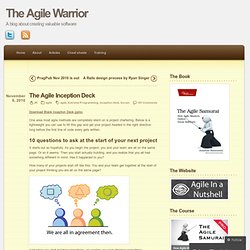
One area most agile methods are completely silent on is project chartering. Below is a lightweight you can use to fill this gap and get your project headed in the right direction long before the first line of code every gets written. 10 questions to ask at the start of your next project It starts out so hopefully. As you begin the project, you and your team are all on the same page.
Bringing User Centered Design to the Agile Environment. When the exciting opportunity to work in a post-bubble dot.com startup arose, I jumped to take it.
I had the luxury of doing things exactly as I thought right, and for a while it was truly fantastic. I built a team with a dedicated user researcher; information architect; interaction and visual designers and we even made a guerilla usability lab and had regular test sessions. Unfortunately, the enthusiasm I had for my new job waned after six months when an executive was appointed Head of Product Development — who insisted he knew SCRUM1 better than anybody.
As the Creative Director, I deferred authority to him to develop the product as he saw fit. Daily Stand-up Variations. When trying to instil a new habit with a team I often find it useful to add a new question (or two) to the daily standup. Perhaps the team needs to pay more attention to Code Smells or Unit Testing. In those cases I ask team members to mention one thing they discovered (or better improved) related to that idea during standup everyday. A sprinkle of agile, a dash of lean. (Page 1 of 3)Whether used separately or together, agile and lean are here to stay. Now it’s just a matter of how to describe the combination of agile and lean as a business process and how to make it fit within that business, according to experts in the processes. “The best way I can describe it is if you look at how agile and lean have been used in the last decade, and in the decade from 2000 to 2010, agile has predominantly been a software development methodology and lean has predominantly been a manufacturing process,” said Alex Adamopoulos, CEO of lean and agile consultancy emergn.
“And in the next decade, which we kind of have already started, I believe they are both going to become the transformation agents in business.” Aside from defining the combination itself, organizations also have a hard time defining the best combination for the business and its projects, explained Mike Gilpin, research director at Forrester Research. OpenAgile is an open learning system for delivering value. Ten Year Agile Retrospective: How We Can Improve In The Next Ten Years. Jeff Sutherland invented Scrum in 1993 and worked with Ken Schwaber to formalize Scrum at OOPSLA'95. Together, they extended and enhanced Scrum at many software companies and helped write the Agile Manifesto. Jeff's blog reviews the origins and best practices of Scrum at June 2011. 10 ways to better lead your agile team « The Agile Warrior. The Myths and Misconceptions - The Big Agile Toolkit - Deliver agile projects to quality to time and to budget.
Table of Contents - The Big Agile Toolkit - Deliver agile projects to quality to time and to budget. Agile Software Development. Agile Use Cases in Four Steps. Are use cases agile? They’re sometimes regarded as the lumbering, heavyweight cousin of user stories – the requirements technique favored by agile teams. Het institutionaliseren van agile. Kanban. Scrum. Methodologies.