
China. Nari Ward. Street Art & The Arab Spring. Joseph Beuys, Feet Washing. “Every man is an artist” What can art be?
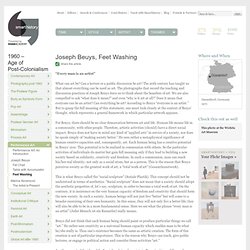
Can a lecture or a public discussion be art? The 20th century has taught us that almost everything can be used as art. The photographs that record the teaching and discussion practices of Joseph Beuys force us to think about the boarders of art. The best art is born from democracy. Jackson Pollock documentary. Portrait of the artist: Sebastião Salgado, photographer. What got you started? I discovered photography completely by chance. My wife is an architect; when we were young and living in Paris, she bought a camera to take pictures of buildings. For the first time, I looked through a lens – and photography immediately started to invade my life. I finished my PhD in economics, and become an economist, but the camera gave me 10 times more pleasure. Eventually, I abandoned everything and started a new life as a photographer.
Do you suffer for your art? I cannot really say I "suffer". Has the advent of digital photography been a good thing for the art form? Yes, an incredibly good thing. What's the best advice anyone gave you? Cultural Connectives: Understanding Arab Culture Through Typography. By Maria Popova What typography has to do with cross-cultural understanding and linguistic minimalism.
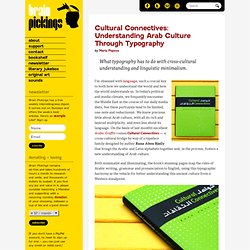
I’m obsessed with language, such a crucial key to both how we understand the world and how the world understands us. In today’s political and media climate, we frequently encounter the Middle East in the course of our daily media diets, but these portrayals tend to be limited, one-note and reductionist. We know precious little about Arab culture, with all its rich and layered multiplicity, and even less about its language. On the heels of last month’s excellent Arabic Graffiti comes Cultural Connectives — a cross-cultural bridge by way of a typeface family designed by author Rana Abou Rjeily that brings the Arabic and Latin alphabets together and, in the process, fosters a new understanding of Arab culture. For the Love of Books: A Sarajevo Story – in pictures. Frank Gehry: 'There's a backlash against me'
Noir Nouar. ‘ Noir Nouar is a dark haired girl, with dark subliminal meanings and jolly palatable paintings.
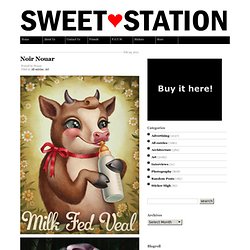
For example, you might think a robust shiny tomato lady is an enticing marketing icon; but three eager worms approach, their phallus shaped noses glowing red with excitement. A Bob’s Big Boy cameo also fits nicely in the genre of American advertising. But in the nude, he is a blatantly repulsive mascot for Fatty Happy Lard. 15 Amazing Tattoos Inspired by Science.
The Bomb and the General: A Vintage Semiotic Children's Book by Umberto Eco. By Maria Popova How symbols become symbols, or what keeping atoms in harmony has to do with language acquisition.
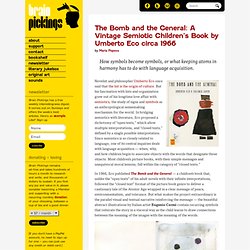
Novelist and philosopher Umberto Eco once said that the list is the origin of culture. But his fascination with lists and organization grew out of his longtime love affair with semiotics, the study of signs and symbols as an anthropological sensemaking mechanism for the world. In bridging semiotics with literature, Eco proposed a dichotomy of “open texts,” which allow multiple interpretations, and “closed texts,” defined by a single possible interpretation. Since semiotics is so closely related to language, one of its central inquiries deals with language acquisition — when, why, and how children begin to associate objects with the words that designate those objects.
This particular page presents a lovely wink at Brian Cox’s The Quantum Universe, featured here earlier today: Teju Cole (color photos)'s Photostream. R.k.vr.y. Picture Show: The Garden - - GOOD. Over the last few years, urban gardening has grown increasingly more prominent-as an emblem of demand for healthier, more natural food; as a centerpiece of community-minded interaction; and as a means of cultivating beautifully functional public spaces.
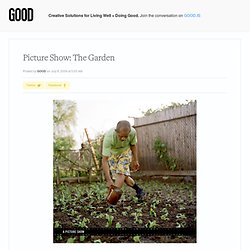
All these factors are in evidence at the Somerset Community Garden in South Providence, Rhode Island, where families of African, Cambodian, Dominican, European, Hmong, Laotian, Liberian, and other origins share a public space where they maintain all sorts of different crops. Photographed across many seasons over a two-year span by Lucas Foglia, "The Garden" covers an entire city block and continues to attract a vast array of individuals.
Www.arttrucks.com. Oh Freedom! Alejandro Escalona: 75 years of Picasso's Guernica: An Inconvenient Masterpiece. Take a closer look at Picasso's Guernica.
Let its powerful images of the ravages of war confront you: the screaming man engulfed in flames, the bewildered horse, and the howling mother carrying the dead body of her child--all forever unable to escape an unseen horror. The chaos unfolding seems to happen in closed quarters provoking an intense feeling of oppression. There is no way out of the nightmarish cityscape. The absence of color makes the violent scene developing right before your eyes even more horrifying.
The blacks, whites, and grays startle you--especially because you are used to see war images broadcasted live and in high-definition right to your living room. John Perivolaris - Migrados.