
A Quest to Clean Up Canada's Oil Sands Carbon. {*style:<b>The first large-scale effort to capture carbon dioxide emissions in the Canadian oil sands surmounted a crucial hurdle this summer with the signing of government agreements to underwrite nearly two-thirds of the $1.35 billion project's cost.

</b>*} Proponents say the large investment in a pilot effort is important, to prove that Alberta has both the technology and geology to address the CO2 emissions that have marred the exploitation of its vast oil wealth. Alberta's oil sands, also known as tar sands, are one of the world's largest petroleum reservoirs. It was long thought to be too expensive to extract oil from the mixture of sand, clay, and water there but the higher global oil prices of the past decade made it feasible. As a result, Canada catapulted to the top ranks of nations in proven oil reserves, behind only Saudi Arabia and Venezuela.
(Related: " The Canadian Oil Boom: Scraping Bottom " and Photos: Canadian Oil Sands ) Even so, the effort is an expensive one. TOXIC: Amazon. On May 24, 2011—the same day Brazil's Parliament voted to decrease logging restrictions in the country's Forest Code—married environmental activists Zé Cláudio Ribeiro and Maria do Espirito Santo were shot to death outside their house in the Amazonian state of Para. A month later we traveled to Zé Cláudio's hometown of Marabá, which was once in the middle of the rainforest and is now surrounded by miles and miles of clearcut cattle land. As the investigation into Zé and Maria's murders went nowhere, we drove into the forest to the site of the killings, followed the heavily armed men of Brazil's environmental protection agency as they busted up illegal timber mills, visited the militant squatters of Brazil's Landless Movement, met modern day slaves, and marveled at the lawless, violent atmosphere that permeates the town locals call Marabála (that means Mara-bullets).
Volunteer Programs. Volunteer in Argentina Projects Community DevelopmentChildcareElderly CareHealthcareTeaching/EducationSpecial Needs Who?
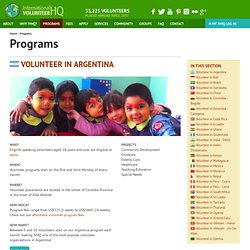
English speaking volunteers aged 18 years and over are eligible to apply. When? Volunteer programs start on the first and third Monday of every month. Where? Volunteer placements are located in the center of Córdoba Province in the town of Villa Allende. How Much? Program fees range from US$325 (1 week) to US$3460 (24 weeks). How Many? Between 5 and 20 volunteers start on our Argentina program each month, making IVHQ one of the most popular volunteer organizations in Argentina! Learn more Volunteer in Bali Construction and RenovationEnvironmental EducationHealthcare EducationKindergartenTeachingTurtle Conservation Volunteer placements are located in Bali's cultural heart of Ubud and on the island of Nusa Penida. Program fees range from US$250 (1 week) to US$1645 (12 weeks). Learn more Volunteer in Brazil Program fees range from US$560 (2 weeks) to US$3180 (24 weeks). Space Colony Art From The 1970s, page 1. Posted on Nov, 7 2011 @ 04:54 PM Beautiful pictures, very inspiring.
I have this nagging feeling that your question 'did we stop dreaming? ' is far too close to being reality than we would ever wish for. Flood-Gate: Perry Officials Try to Hide Sea Level Rise from Texans with... By Joe Romm on October 12, 2011 at 8:00 pm "Flood-Gate: Perry Officials Try to Hide Sea Level Rise from Texans with “Clear-Cut Unadulterated Censorship”" “We Live in the State of Denial, the State of Texas” Censored Rice University Oceanographer John Anderson Tells Climate Progress In one of the most flagrant recent instances of scientific censorship, the Texas Commission on Environmental Quality (TCEQ) refused to publish a report chapter unless all mention of climate change and its impact on sea level rise were eliminated.

The author — Rice University oceanographer John Anderson, a leading expert on sea level rise with more than 200 publications — refused. As a result, TCEQ killed his chapter in The State of the Bay, a regular publication of the Galveston Bay Estuary Program. Climate Progress interviewed Anderson along with other Texas scientists who revealed that this is not the first time officials removed references to climate change in a state report. Why did it happen? Related Posts: Alex Jones.