
Ocean acidification - rosemary mosco. Ocean acidification already well beyond natural variability. Trends can be difficult to detect in real-world data, and the noisier the data, the tougher the task becomes.
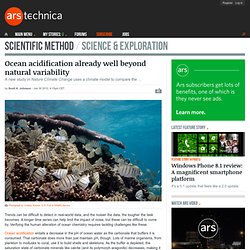
A longer time series can help limit the impact of noise, but these can be difficult to come by. Verifying the human alteration of ocean chemistry requires tackling challenges like these. Ocean acidification entails a decrease in the pH of ocean water as the carbonate that buffers it is consumed. That carbonate does more than just maintain pH, though. Lots of marine organisms, from plankton to mollusks to coral, use it to build shells and skeletons. Calcite and aragonite saturation states vary regionally and seasonally, so how can we make sure the acidification trend we’re measuring is real and human-caused? The researchers ran a climate model from 800 A.D. to 2100 A.D. using the best data available for the various forcings: solar activity, volcanic activity, changes in land use, and anthropogenic emissions of greenhouse gases and reflective aerosols.
Environment and Biodiversity. Ocean Acidity Rise Unprecedented in Past 21,000 Years, Researchers Say. Acidic oceans threaten fish. Ocean acidification — caused by climate change — looks likely to damage crucial fish stocks.
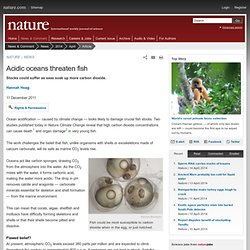
Two studies published today in Nature Climate Change reveal that high carbon dioxide concentrations can cause death1 and organ damage2 in very young fish. The work challenges the belief that fish, unlike organisms with shells or exoskeletons made of calcium carbonate, will be safe as marine CO2 levels rise. Hannes Baumann Fish could be most susceptible to carbon dioxide when in the egg, or just hatched. Oceans act like carbon sponges, drawing CO2 from the atmosphere into the water. This can mean that corals, algae, shellfish and molluscs have difficulty forming skeletons and shells or that their shells become pitted and dissolve. Flawed belief? At present, atmospheric CO2 levels exceed 380 parts per million and are expected to climb throughout the century to approximately 800 p.p.m. if emissions are not kept in check. Schooling's out “Right away, we saw results,” says Gobler. Ocean Acidification: The Other CO2 Problem.
Learn more about Ocean Acidification: The Other CO2 Problem To learn more about the science behind the film, see a list of citations.
ACID TEST, a film produced by NRDC, was made to raise awareness about the largely unknown problem of ocean acidification, which poses a fundamental challenge to life in the seas and the health of the entire planet. NRDC Acid Test Screening on Capitol Hill. Acid Test: The Global Challenge of Ocean Acidification. Acid Test: The Global Challenge of Ocean Acidification - YouTube. Ocean acidification: Connecting science, industry, policy and public - YouTube.
U.S. Geological Survey Teams Up for Exploration in Ocean Acidification. August 10, 2011 Scientists from the U.S.
Geological Survey will embark on a research cruise to the Arctic Ocean August 15 to collect water samples and other data to determine trends in ocean acidification from the least explored ocean in the world. For the second straight year, the researchers will set sail aboard the U.S. Coast Guard vessel Healy. Ocean Acidification. Les microalgues calcaires, témoins de l'acidification des océans. Un tiers du dioxyde de carbone atmosphérique qui est absorbé par les océans se transforme en ions acidifiant les eaux marines.
Des milliards de cellules microscopiques calcifient à la surface de l'océan et régulent ainsi les flux de carbone dans les grands cycles biogéochimiques. Parmi les plus abondantes, les coccolithophores produisent une grande part de la masse sédimentaire marine due à l'accumulation post-mortem de leur micro-squelette composée de petites plaques calcaires, appelées coccolithes. La réaction des coccolithophores à l'acidification n'avait jamais été étudiée dans leur élément naturel à l'échelle planétaire. Oregon Sea Grant videos on ocean acidification. Ocean acidification A news stream provided by the Ocean Acidification International Coordination Centre (OA-ICC) « Une scientifique monégasque en mission en Papouasie Nouvelle-Guinée (in French) OCB hosts first meeting for ocean acidification researchers » Oregon Sea Grant videos on ocean acidification Published 20 May 2011 Media coverage Leave a Comment Dr.
Ocean Acidification. For tens of millions of years, Earth's oceans have maintained a relatively stable acidity level.
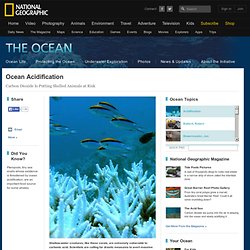
It's within this steady environment that the rich and varied web of life in today's seas has arisen and flourished. But research shows that this ancient balance is being undone by a recent and rapid drop in surface pH that could have devastating global consequences. Since the beginning of the industrial revolution in the early 1800s, fossil fuel-powered machines have driven an unprecedented burst of human industry and advancement. The unfortunate consequence, however, has been the emission of billions of tons of carbon dioxide (CO2) and other greenhouse gases into Earth's atmosphere. Scientists now know that about half of this anthropogenic, or man-made, CO2 has been absorbed over time by the oceans. Carbonic Acid When carbon dioxide dissolves in this ocean, carbonic acid is formed. Carbon Storehouse.
Ocean acidification: Some Winners, Many Losers. Posted on 10 June 2011 by Rob Painting Numerous lab experiments have shown that ocean acidification is harmful to marine life.
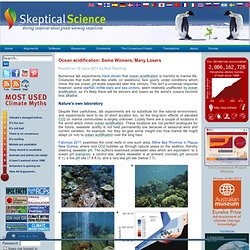
Creatures that build chalk-like shells (or skeletons) fare poorly under conditions which mimic the low ocean pH levels expected later this century. This isn't a universal response however; some starfish, brittle stars and sea urchins, seem relatively unaffected by ocean acidification, so it's likely there will be winners and losers as the world's oceans become less alkaline. Oregon Sea Grant videos on ocean acidification. Ocean acidification leaves clownfish deaf to predators. Baby clownfish use hearing to detect and avoid predator-rich coral reefs during the daytime, but new research from the University of Bristol demonstrates that ocean acidification could threaten this crucial behaviour within the next few decades.
Since the Industrial Revolution, over half of all the CO2 produced by burning fossil fuels has been absorbed by the ocean, making pH drop faster than any time in the last 650,000 years and resulting in ocean acidification. Recent studies have shown that this causes fish to lose their sense of smell, but a new study published today in Biology Letters shows that fish hearing is also compromised. Working with Professor Philip Munday at James Cook University, lead author Dr Steve Simpson of the School of Biological Sciences at the University of Bristol reared larvae straight from hatching in different CO2 environments.
The ability of fish to adapt to rapidly changing conditions is not known. Notes to editors: Changement de pH océanique 1700-1990. Ocean acidification: Connecting science, industry, policy and public