
How to Write the Financial Section of a Business Plan, Page 2. A business plan is all conceptual until you start filling in the numbers and terms.

The sections about your marketing plan and strategy are interesting to read, but they don't mean a thing if you can't justify your business with good figures on the bottom line. Financial planning (business) Financial planning is the task of determining how a business will afford to achieve its strategic goals and objectives.

Usually, a company creates a Financial Plan immediately after the vision and objectives have been set. The Financial Plan[1] describes each of the activities, resources, equipment and materials that are needed to achieve these objectives, as well as the timeframes involved. The Financial Planning activity involves the following tasks;- Assess the business environmentConfirm the business vision and objectivesIdentify the types of resources needed to achieve these objectivesQuantify the amount of resource (labor, equipment, materials)Calculate the total cost of each type of resourceSummarize the costs to create a budgetIdentify any risks and issues with the budget set Performing Financial Planning is critical to the success of any organization.
Financial plan. In general usage, a financial plan[1] is a series of steps or goals used by an individual or business, the progressive and cumulative attainment of which is designed to accomplish a financial goal or set of circumstances, e.g. elimination of debt, retirement preparedness, etc.

This often includes a budget which organizes an individual's finances and sometimes includes a series of steps or specific goals for spending and saving future [[]]. This plan allocates future income to various types of expenses, such as rent or utilities, and also reserves some income for short-term and long-term savings. A financial plan is sometimes referred to as an investment plan, but in personal finance a financial plan can focus on other specific areas such as risk management, estates, college, or retirement. Tax Relief for Listed Buildings and Other Heritage Assets. There are a number of tax breaks that can benefit the owners of heritage assets to assist with their conservation .

The conditions and qualifications are a matter of some complexity and specialist advice should be sought by anyone who believes they may qualify for relief. Vesting of Stock or Options. Universal Product Code. Composition[edit] Each UPC-A barcode consists of a scannable strip of black bars and white spaces, above a sequence of 12 numerical digits.
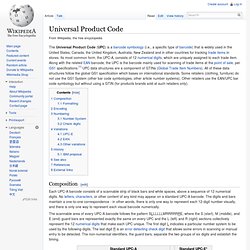
No letters, characters, or other content of any kind may appear on a standard UPC-A barcode. The digits and bars maintain a one-to-one correspondence - in other words, there is only one way to represent each 12-digit number visually, and there is only one way to represent each visual barcode numerically. The scannable area of every UPC-A barcode follows the pattern SLLLLLLMRRRRRRE, where the S (start), M (middle), and E (end) guard bars are represented exactly the same on every UPC and the L (left) and R (right) sections collectively represent the 12 numerical digits that make each UPC unique.
The first digit L indicates a particular number system to be used by the following digits. Note: UPC-A 123456789999 corresponds with UPC-E 234569 (with the EOOEOE parity pattern). GS1 US > RESOURCES > Standards > EAN/UPC. UPC Search. Drawing UPC-A Barcodes with C# Introduction On almost every product sold, there is typically a UPC barcode of some type which is used to identify the product.
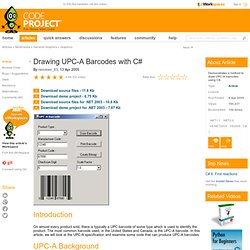
The most common barcode used, in the United States and Canada, is the UPC-A barcode. Underwriting. Underwriting refers to the process that a large financial service provider (bank, insurer, investment house) uses to assess the eligibility of a customer to receive their products (equity capital, insurance, mortgage, or credit).

The name derives from the Lloyd's of London insurance market. Financial bankers, who would accept some of the risk on a given venture (historically a sea voyage with associated risks of shipwreck) in exchange for a premium, would literally write their names under the risk information that was written on a Lloyd's slip created for this purpose.[1] Securities underwriting[edit] Gross income. Gross income in United States tax law is receipts and gains from all sources.

Gross income is the starting point for determining Federal and state income tax of individuals, corporations, estates and trusts, whether resident or nonresident.[1] "Except as otherwise provided" by law, Gross income means "all income from whatever source," and is not limited to cash received. However, tax regulations expand on this and say "all income from whatever source derived, unless excluded by law. " The amount of income recognized is generally the value received or which the taxpayer has a right to receive. Certain types of income are specifically excluded from gross income. The time at which gross income becomes taxable is determined under Federal tax rules, which differ in some cases from financial accounting rules. Net income. Overview[edit] The items deducted will typically include tax expense, financing expense (interest expense), and minority interest.
Likewise, preferred stock dividends will be subtracted too, though they are not an expense. For a merchandising company, subtracted costs may be the cost of goods sold, sales discounts, and sales returns and allowances. For a product company advertising, manufacturing, and design and development costs are included. An equation for net income[edit]
Balance sheet. A standard company balance sheet has three parts: assets, liabilities and ownership equity.
The main categories of assets are usually listed first, and typically in order of liquidity.[2] Assets are followed by the liabilities. The difference between the assets and the liabilities is known as equity or the net assets or the net worth or capital of the company and according to the accounting equation, net worth must equal assets minus liabilities.[3] Another way to look at the balance sheet equation is that total assets equals liabilities plus owner's equity. Looking at the equation in this way shows how assets were financed: either by borrowing money (liability) or by using the owner's money (owner's or shareholders' equity). Cash flow statement. In financial accounting, a cash flow statement, also known as statement of cash flows,[1] is a financial statement that shows how changes in balance sheet accounts and income affect cash and cash equivalents, and breaks the analysis down to operating, investing, and financing activities.
Essentially, the cash flow statement is concerned with the flow of cash in and out of the business. The statement captures both the current operating results and the accompanying changes in the balance sheet.[1] As an analytical tool, the statement of cash flows is useful in determining the short-term viability of a company, particularly its ability to pay bills. International Accounting Standard 7 (IAS 7), is the International Accounting Standard that deals with cash flow statements. People and groups interested in cash flow statements include: Purpose[edit] Income statement. An income statement (US English) or profit and loss account (UK English)[1] (also referred to as a profit and loss statement (P&L), revenue statement, statement of financial performance, earnings statement, operating statement, or statement of operations)[2] is one of the financial statements of a company and shows the company’s revenues and expenses during a particular period.[1] It indicates how the revenues (money received from the sale of products and services before expenses are taken out, also known as the “top line”) are transformed into the net income (the result after all revenues and expenses have been accounted for, also known as “net profit” or the “bottom line”).
One important thing to remember about an income statement is that it represents a period of time like the cash flow statement. This contrasts with the balance sheet, which represents a single moment in time. Usefulness and limitations of income statement[edit] Operating section[edit] Profit. From Wikipedia, the free encyclopedia Profit may refer to: Surname[edit] Joe Profit (born 1949), former American football playerLaron Profit (born 1977), professional basketball playerRichard Profit (born 1974), English mountaineer and adventurer. See also[edit] Fixed cost. In economics, fixed costs, indirect costs or overheads are business expenses that are not dependent on the level of goods or services produced by the business.[1] They tend to be time-related, such as salaries or rents being paid per month, and are often referred to as overhead costs.
This is in contrast to variable costs, which are volume-related (and are paid per quantity produced). In management accounting, fixed costs are defined as expenses that do not change as a function of the activity of a business, within the relevant period. For example, a retailer must pay rent and utility bills irrespective of sales. In marketing, it is necessary to know how costs divide between variable and fixed.
This distinction is crucial in forecasting the earnings generated by various changes in unit sales and thus the financial impact of proposed marketing campaigns. Convertible bond. Types[edit] The underwriters have been quite innovative and provided various variations of the initial convertible structure. Although no clear classification formally exists in the financial market it is possible to segment the convertible universe into the following sub-types: Vanilla convertible bonds are the most plain convertible structures.
They grant the holder the right to convert into certain amount of shares determined according to a conversion price determined in advance. Stock. Common stock. It is called "common" to distinguish it from preferred stock. If both types of stock exist, common stock holders cannot be paid dividends until all preferred stock dividends are paid in full. Preferred stock. Similar to bonds, preferred stocks are rated by the major credit-rating companies. Employee stock option. An employee stock option (ESO) is commonly viewed as a complex call option on the common stock of a company, granted by the company to an employee as part of the employee's remuneration package.[1] Regulators and economists have since specified that "employee stock options" is a label that refers to compensation contracts between an employer and an employee that carries some characteristics of financial options but are not in and of themselves options (that is they are "compensation contracts").
Tax free bikes for work through the Government's Green Transport Initiative - Cyclescheme, provider of Cycle to Work schemes for UK employers - Cyclescheme. Recurring Billing, Subscription Billing, Web 2.0 and SaaS Billing - Chargify. Expensify - Expense Reports That Don't Suck! FreshBooks - Online Invoicing, Accounting & Billing Software. Mint - Personal Finance, Budgeting, Money Management, Financial Management, Money Manager, Budget Planner, Free Budget Software, Online Banking. InDinero - Track Your Money with a Real-Time Financial Dashboard. Easy Business Budgeting and Cash Flow Planning. Credit Card Processing Companies, Fees, Rates. Business valuation. Market capitalization. The total capitalization of stock markets or economic regions may be compared to other economic indicators.
The total market capitalization of all publicly traded companies in the world was US$51.2 trillion in January 2007[4] and rose as high as US$57.5 trillion in May 2008[5] before dropping below US$50 trillion in August 2008 and slightly above US$40 trillion in September 2008.[5] Market cap terms[edit] Receipt. See also Voucher. FSCS > Home. Lost Accounts. NS&I - Premium bonds. Cookies NS&I uses cookies which are essential for this website to operate. Dividend. A dividend is allocated as a fixed amount per share, with shareholders receiving a dividend in proportion to their shareholding. Renewable energy. Real estate. Premium Bond. Interest. Compound interest. Online banking. Santander. HSBC. Personal budget. Personal account.
Transactional account. Individual Savings Account. Savings account. Activity. Growth. Economic growth. Dashboard « Wahooly. Budget. Tax accounting in the United States. Cost accounting. Financial accountancy. Cash flow forecasting. Accounting liquidity. Accountancy. Cash flow. The Three Things Rich People Do All Day Long. Blank Invoice Template. International Bank Account Number. Student Loans Company - Student Loans Company.
ISO 9362. Sort code. Investments. Voluntary National Insurance contributions - the basics : Directgov - Money, tax and benefits. National Insurance and your State Pension forecast : Directgov - Pensions and retirement planning. Investment Planning & Retirement Guidance - Fidelity. Dealing with a deceased person's money and property : Directgov - Government, citizens and rights. Private equity. Wealthfront - Online Financial Advisor, Asset Allocation, Modern Portfolio Theory. Pre-money valuation. Post-money valuation. Seed money. Venture round. Venture capital. Click here definition of Accumulation Shares, what is Accumulation Shares, what does Accumulation Shares mean? Finance Glossary - Search our financial terms for a definition.
7 Habits of Highly Frugal People. Credit score. Grant (money) Methuselah Foundation - Welcome to Methuselah Foundation. The hub of all charity donations online.