
Games: Improving Education. Educators increasingly recognize the impact of entertainment software and utilize games as a teaching device in a growing number of classrooms and business settings.
Register Any Product at Any Store / WeddingScan.
Online Fitness Website Oobafit offers FREE Online Fitness Plans & Online Nutrition Plans. App turns your iPhone, iPad into a 'Dropbox camera' I have mad love for Dropbox, the Web-based storage service that syncs your files across multiple devices and makes them available for sharing with others.

QuickShot with Dropbox (99 cents) automatically uploads new snapshots from your iPhone, iPod, or iPad to your Dropbox account. In other words, it effectively turns your iDevice into a "Dropbox camera. " After installing the app, you link it to your account. By default, uploaded photos will land in your eponymous Dropbox folder, though you can choose a different folder if you want (assuming you know its name; the app doesn't let you browse available folders). QuickShot also lets you choose photos to upload from your camera roll or library, though you must tick them individually; there's no "select all" option.
For taking new photos, the app works almost exactly like the stock Camera app. Register Any Product at Any Store / WeddingScan.
Math4Mobile - The mLearning Way. Super Mario Brothers - Play the Nintendo game Super Mario Brothers online. Mike Huckabee Ad: "Chuck Norris Approved" Web 2.0. World Wide Web sites that use technology beyond the static pages of earlier Web sites A tag cloud (a typical Web 2.0 phenomenon in itself) presenting Web 2.0 themes Web 2.0 (also known as participative (or participatory)[1] web and social web)[2] refers to websites that emphasize user-generated content, ease of use, participatory culture and interoperability (i.e., compatible with other products, systems, and devices) for end users.
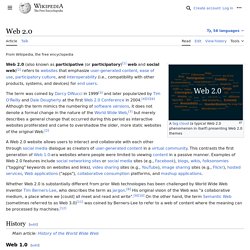
The term was coined by Darcy DiNucci in 1999[3] and later popularized by Tim O'Reilly and Dale Dougherty at the first O'Reilly Media Web 2.0 Conference in late 2004.[4][5][6] Although the term mimics the numbering of software versions, it does not denote a formal change in the nature of the World Wide Web, but merely describes a general change that occurred during this period as interactive websites proliferated and came to overshadow the older, more static websites of the original Web.[7] History[edit] Web 1.0[edit] Characteristics[edit] Survey Monkey - Online survey software tool. 2.0 Resources. Web 2.0. Top 15 Most Popular Web 2.0 Websites. Web20tools - List. Find New Artists & Indie Bands - MadeLoud. Eric Whitacre's Virtual Choir - 'Lux Aurumque'.
Eric Whitacre - Eric Whitacre's Virtual Choir 2.0, 'Sleep' Back to School with the Class of Web 2.0: Part 1. With the start of the new school year, many teachers and students are seeking new products and technologies to help them through their upcoming academics.
With the increase of teachers using blogs and wikis, and students networking and utilizing online tools, the demand for easier and more efficient ways of learning is on the rise. Mint - Personal Finance, Budgeting, Money Management, Financial Management, Money Manager, Budget Planner, Free Budget Software, Online Banking. Prezi - The Zooming Presentation Editor. Jack Stamp - Why Music Matters. SmartMusic interactive music software transforms the way students practice. The 4Cs. Thoughtful Learning: Curriculum for 21st Century Skills, Inquiry, Project-based Learning, and Problem-based Learning. So you’ve heard of the 4 C’s—critical thinking, creative thinking, communicating, and collaborating—but how are you supposed to teach your own subject and the 4 C’s?

The good news is that the 4 C’s help you teach your subject. They aren’t content. They’re skills for gaining content. Here are 3 simple steps that use the 4 C’s to help students learn your subject: Technology Integration Matrix. Technology Combined with Good Teaching Leads to Success. Interactive whiteboards are the future of educational strategies, and without proper adoption of these and other technology tools, teachers are doomed to become dinosaurs in their practices.

Who says so? Educational research and practice expert Robert Marzano. As he spoke at the CUE (Computer Using Educators) conference earlier this month, he warned educators, however, that although there are "no silver bullets," there are "silver BBs," and a teacher must decide which combination of silver BBs is best for his or her classroom. But, unquestionably, the use of the interactive whiteboard and its voter-response technology is a true breakthrough in education.
The Research Marzano recently divided 85 educators into two groups: One taught a lesson to students using interactive whiteboards and the other taught the same lesson using standard, more traditional tools. But he warns that there is such a thing as too much technology. A Balance Is Best. Hyping classroom technology helps tech firms, not students. Something sounded familiar last week when I heard U.S.
Education Secretary Arne Duncan and FCC Chairman Julius Genachowski make a huge pitch for infusing digital technology into America's classrooms. Every schoolchild should have a laptop, they said. Because in the near future, textbooks will be a thing of the past. Where had I heard that before? So I did a bit of research, and found it. The revolutionary technology being heralded in that statement wasn't the Internet or the laptop, but the motion picture. He was talking through his hat then, every bit as much as Duncan and Genachowski are talking through theirs now. Here's another similarity: The push for advanced technology in the schoolroom then and now was driven by commercial, not pedagogical, considerations. That should tell you that the nirvana sketched out by Duncan and Genachowski at last week's Digital Learning Day town hall was erected upon a sizable foundation of commercially processed claptrap.
Wimba - Text-based chat commands.