
How do we measure mobile learning’s impact on higher-order thinking? How Teachers Make Cell Phones Work in the Classroom. A.P.
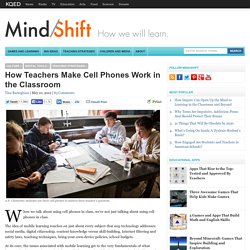
Chemistry students use their cell phones to answer their teacher's question. When we talk about using cell phones in class, we’re not just talking about using cell phones in class. The idea of mobile learning touches on just about every subject that any technology addresses: social media, digital citizenship, content-knowledge versus skill-building, Internet filtering and safety laws, teaching techniques, bring-your-own-device policies, school budgets. At its core, the issues associated with mobile learning get to the very fundamentals of what happens in class everyday. At their best, cell phones and mobile devices seamlessly facilitate what students and teachers already do in thriving, inspiring classrooms.
In the most ideal class settings, mobile devices disappear into the background, like markers and whiteboards, pencil and paper – not because they’re not being used, but because they’re simply tools, a means to an end. In Ramsey Musallam’s A.P. About. Revolutionising Education: iPad in South African Schools. Mobile in Ed Tech: Moving Beyond Browser Replacement. In 2003 Steve Jobs made a speech to the International Design Conference in Aspen, and the audio for this speech has just been re-discovered and shared.
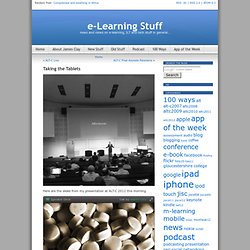
There is even a transcription from the Verge available here. The Future Of Mobile Learning. Taking the Tablets. Here are the slides from my presentation at ALT-C 2012 this morning.
The tablet computer is not a new idea, but recently has had an impact on learning and teaching across a range of institutions in the UK and elsewhere. In this session I will try to tackle the following questions. What do we currently understand to be a tablet? What is the primary functionality? How are tablets being used right now for supporting, and enhancing learning and teaching? Students Find E-Textbooks 'Clumsy' and Don't Use Their Interactive Features - Wired Campus. Several universities have recently tried a new model for delivering textbooks in hopes of saving students money: requiring purchase of e-textbooks and charging students a materials fee to cover the costs.
A recent report on some of those pilot projects, however, shows that many students find the e-textbooks “clumsy” and prefer print. The report is based on a survey conducted this spring of students and faculty at five universities where e-textbook projects were coordinated by Internet2, the high-speed networking group. Do smartphones make smarter students? Some educators think so. Can an app today keep bad grades away?
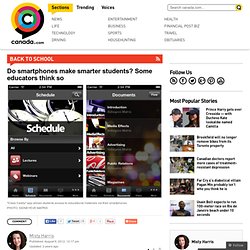
Long the banes of teachers’ existence, smartphones are being re-imagined by educators as a positive presence in the classroom. What’s more, a survey released Thursday shows more than half of Canadians – 56 per cent – agree that the mobile devices are an “invaluable tool” for students, while fully two-thirds see smartphones as a way for students to conduct online research any time, anywhere. Media professor Sidneyeve Matrix, whose Queen’s University class has its own app, says smartphones have become so ubiquitous that it makes less sense for teachers to fight them than to dial up their potential as a modern-day school supply.
“What drives most teachers mad is that they’re competing with these phones for attention,” says Matrix. “But with 1,400 students in the class, what am I supposed to do? “In the old model, the professor was the sage on the stage. But the trend isn’t without its doubters. Handbook_print.pdf (application/pdf objekt) Multi-tasking tablets on the horizon. Building a Mobile Strategy - Part 1a. As promised, the results of my conversation with the Mobility Guru. --------------------- What Is Mobile?

After some discussion, the Mobility Guru and I decided to treat mobile based on operating system (iOS, Android, Win8RT) vs. hardware or form factor. His original definition "can hold it in one hand" doesn't really account for netbooks or other forms that smoothly run pre-mobile operating systems (Like Windows 7, Linux and the Mac OSs). The complication with Mobile is not necessarily with the form factor. We plan to change this definition. Top 7 Myths Of Mobile Learning.
How Tablets Will Change Higher Ed. Tablets are set to change computing with intuitive operating systems, web browsing, access to hundreds of thousands of apps, and even the option to attach a keyboard.
Noste si vlastní přístroje! 10 Ways That Mobile Learning Will Revolutionize Education. Smartphones and tablet computers are radically transforming how we access our shared knowledge sources by keeping us constantly connected to near-infinite volumes of raw data and information.
We enjoy unprecedented instant access to expertise, from informal cooking lessons on YouTube to online university courses. Every day people around the globe are absorbed in exciting new forms of learning, and yet traditional schools and university systems are still struggling to leverage the many opportunities for innovation in this area. Recently frog has been researching how learning models are evolving—and how they can be improved—via the influence of mobile technologies. We’ve found that the education industry needs new models and fresh frameworks to avoid losing touch with the radically evolving needs of its many current and potential new constituencies.
Researchers develop ‘smart’ touch-responsive internet-enabled newspaper. My European speaking tour (ending today) has had two primary themes: crowdsourcing and the future of corporate IT.
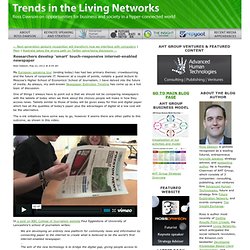
However at a couple of points, notably a guest lecture to Moscow’s Higher School of Economics’ School of Journalism, I have delved into the future of media. As always, my well-known Newspaper Extinction Timeline has come up as a hot topic of discussion. One of things I always have to point out is that we should not be comparing newspapers with the tablets of today when we think about the choices people will make in how they access news. Tablets similar to those of today will be given away for free and digital paper which has all the qualities of today’s paper plus the advantages of digital at a low cost will be the alternative. Mobile Apps Will Pass - History Will Repeat Itself. Over the past few years the big sexy conversation at conferences has slowly morphed from social media to mobile.
It is partially because social media is better understood now but it’s also because mobile is the shiny new toy that everyone is trying to figure out. We have seen incredible inroads that mobile traffic is making up a larger and larger portion of web traffic. Mobile traffic to websites has doubled across the year alone in 2011.With all these discussions it has me thinking more and more of the future of mobile apps.
With recent data suggesting that the average user has well over 50 apps installed on their smartphone it is a great time to be an app developer. Mobile learning in developing countries in 2012: What's Happening? In recent chats with officials from [an un-named country], I learned of the desire of educational policymakers there to leap frog e-learning through m-learning. This made an impression on me -- and not only because it succinctly was able to encapsulate four educational technology buzzwords within a five-word "vision statement". In many ways, this encounter helped confirm my belief that a long-anticipated new era of hype is now upon us, taking firm root in the place where the educational technology and international donor communities meet, with "m-" replacing "e-" at the start of discussions of the use of educational technologies.
5 Myths about mobile learning. Mobile Learning Proves to Benefit At-Risk Students. Digital Tools Teaching Strategies Wireless Reach/Qualcomm As we explore the potential of mobile learning, especially as it relates to reaching out to disenfranchised students, the most recent results from Project K-Nect seem that much more relevant. The pilot program based in North Carolina, which we covered here on MindShift, was designed to make math more engaging for low-income kids with the use of mobile phones in Onslow County School System. This is just a math program.
- The history of the cell phones for learning movement. 0 Comments January 3, 2012 By: Lisa Nielsen Jan 3. 3 Must-Have Technology Tools For Your Classroom. Classrooms need more than just chalk and a few notebooks. Students' math scores jumped 20% with iPad textbooks, publisher says. By AppleInsider Staff A yearlong pilot program with digital textbooks on Apple's iPad found that students' algebra scores increased by 20 percent when compared to a curriculum with traditional books.
A $100 Solar-Powered Tablet: Will This Be “The One”? Digital Tools. The Digital Learning Farm and iPad Apps 21st Century Learning Socratic Seminar and The Backchannel Humanities teacher, Shannon Hancock, at Graded, the American School of São Paulo, read and worked through The Alchemist by Paulo Coehlo with her 8th grade students. Not only did they read the text, learn about literary elements, but also learned to articulate and discuss in a professional manner the text …
M-Learning. Mobile Learning. The iPad and the academy. Tara Brabazon identifies 10 scholarly uses for Apple’s latest gadget, and the new ways of reading, writing, watching and thinking that the platform supports Among his 10 rules for successful design, Dieter Rams, the German industrial designer, listed usefulness as a key attribute. Other characteristics included consistency, simplicity, honesty, understandability, unobtrusiveness and innovation. Mobile Learning Likely to ‘Gamify’ - But Not Systematically. Mobile Learning. The Failure of One Laptop Per Child. "25 million laptops later," Mashable announced today, "One Laptop Per Child doesn't increase test scores. " "Error Message," reads the headline from The Economist: "A disappointing return from an investment in computing. " iPads For All: One Sales Team's Story - Global-cio - Executive insights/interviews. Level 3 just gave iPads to its entire North American sales team, and IT packed them with apps customized to their jobs.
Sky’s the limit: the world’s cheapest touch-screen tablet. iPads and Tablets in Education.