
Dokkōdō. The "Dokkōdō" [ (Japanese: 独行道?)

; "The Path of Aloneness", "The Way to Go Forth Alone", or "The Way of Walking Alone"] is a short work written by Miyamoto Musashi (宮本 武蔵) a week before he died in 1645. It consists of either nineteen or twenty-one precepts; precepts 4 and 20 are omitted from the former version. "Dokkodo" was largely composed on the occasion of Musashi giving away his possessions in preparation for death, and was dedicated to his favorite disciple, Terao Magonojō (to whom the earlier Go rin no sho [The Book of Five Rings] had also been dedicated), who took them to heart. "Dokkōdō" expresses a stringent, honest, and ascetic view of life. Precepts[edit] References[edit] The 48 Laws of Power. Background[edit] Greene initially formulated some of the ideas in The 48 Laws of Power while working as a writer in Hollywood and concluding that today's power elite shared similar traits with powerful figures throughout history.[5] In 1995, Greene worked as a writer at Fabrica, an art and media school, and met a book packager named Joost Elffers.[4][8] Greene pitched a book about power to Elffers and six months later, Elffers requested that Greene write a treatment.[4] Although Greene was unhappy in his current job, he was comfortable and saw the time needed to write a proper book proposal as too risky.[10] However, at the time Greene was rereading his favorite biography about Julius Caesar and took inspiration from Caesar's decision to cross the Rubicon River and fight Pompey, thus inciting the Great Roman Civil War.[10] Greene would follow Caesar's example and write the treatment, which later became The 48 Laws of Power.[10] He would note this as the turning point of his life.[10]
Journal of Non-lethal Combatives: Cpt. Smith, jujutsu 4. Journal of Non-lethal Combatives, Oct 2000 By Captain Allan Corstorphin Smith, U.S.A.
Winner of the Black Belt, Japan, 1916. Free Information on Flexibility, Stretching, and Training for Sports and Martial Arts from Thomas Kurz's Column on Training. Miyamoto Musashi quotes. Toyama Ryu Batto Do Japanese Swordsmanship. Secrets of Shuriken-do, the Japanese art of blade throwing homepage. Grounded Cat Martial Arts. Bushido: The Samurai Creed. Thirty-Six Stratagems. Chi Gong 101: How to Feel Your Chi Energy. Tags: 84 Comments A Simple Guide In Plain English Introduction Chi (qi) is an ancient Chinese term, which can be translated as energy.
Like energy, the word chi is used in both abstract and concrete terms, and applied to both general concepts and specific phenomena. Qigong Exercises – Qigong for Beginners. Basically there are 2 types of qi gong exercises. 1st: Internal qigong exercises: Health maintainance exercises 2nd: External qigong exercises: To break bricks etc.
The Chakra System. Boxing Hand Wrap Reviews and Sales - How To Wrap Hands Instructional Videos. When it comes to wrapping a Boxing Hand Wrap correctly there are various schools of thought.
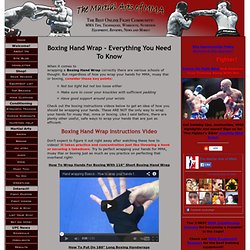
But regardless of how you wrap your hands for MMA, muay thai or boxing, consider these key points: Not too tight but not too loose eitherMake sure to cover your knuckles with sufficient paddingHave good support around your wrists Check out the boxing instructions videos below to get an idea of how you should be wrapping your hands.
10 Martial Arts Sparring Tips. Here are 10 Martial Arts Sparring Tips.
Sparring is one of the best martial arts training drills. Nine Ryu page. The ninjutsu ryu of the Togakure family was not formalised until three generations after Daisuke Togakure began to develop it.
Allied with a clan that was defeated in a series of battles against superior forces, Daisuke lost all, including his samurai status, and escaped to the mountain wilderness south east of Kyoto. Wandering among the pine forests and marshes of the Ku Peninsula in A.D. 1162, he met the warrior monk Kain Doshi, who had fled to Japan from the political and military upheaval in China. Muay Thai Conditioning Tips - Thai Boxing Workout Routine - Thai Boxing Training. Muay Thai Conditioning is unlike any regular form of cardiovascular or endurance training.
In order to be in muay thai shape it takes time, dedication and constant repetition of the techniques of muay thai. Now you might think your in shape because you can run a couple miles or lift some weight, but all of that is shit compared to the grueling kick boxing workout routine s you go through to prepare your body for an all out brawl. There are some forms of cardio and strength you can do so you have a base before you start training, but nothing is like actually getting in the ring and hitting the pads with a trainer. If your considering trying to get in shape for Muay Thai before actually trying it, the best workouts you can do are short, intense and equivalent to the time you would be in the ring for a round. Journal of Non-lethal Combatives: Cpt. Smith, jujutsu 1. Journal of Non-lethal Combatives, July 2000 By Captain Allan Corstorphin Smith, U.S.A.
Winner of the Black Belt, Japan, 1916. Instructor of Hand-to-Hand Fighting, THE INFANTRY SCHOOL, Camp Benning, Columbus, Georgia and at United States Training Camps and Cantonments, 1917 and 1918. In Seven Books. Black Arts Society. What is Black Arts Military Unarmed Combat? Black Arts Military Unarmed Combat is a Canadian Martial Arts system developed by Grandmaster Gus Michalik of London, Ontario. The Black Arts combines the best of many Martial Arts streaming mainly from Hapkido, Kenpo and Jiu-Jitsu. The Black Arts was designed as a straight forward self defence system utilizing simple movements in combination with pressure point manipulation to achieve effective and sometimes devastating results. Safety > Pressure Points. As of July 1, 2013 ThinkQuest has been discontinued. We would like to thank everyone for being a part of the ThinkQuest global community: Ninjutsu. Www.martialartsstyles.org. The Target Areas-Nerve Centers And Pressure Points.