
Reference Tools. Useful (self-improvement) Websites. Gale Catalog - Opposing Viewpoints in Context (formerly Opposing Viewpoints Resource Center) Busuu - Learn languages for free online. Dictionnaire anglais-français. Bab.la, il portale delle lingue. Italian Popular Gestures (3 pics) The written word is a powerful form of communication.
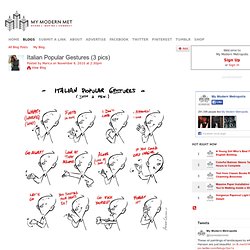
In fact, it even has the capability to connect generations, revealing our shared history. Most would believe that more important than words, however, is body language or gestures. In Roman times, a simple thumbs up or thumbs down could even decide the fate of a gladiator. If you've ever been to Italy or watched a Fellini film, you've seen people who just naturally employ familiar gestures to express themselves. Italians have a way of using body language and hand gestures to punctuate an expression and give it that extra touch that the word or phrase itself lacks. The Italian hand gestures illustrated here are some of the more common ones realized by Alfredo Cassano, an Italian animator and storyboard artist.
Finally, a piece of advice (or forewarning). Alfredo Cassano. Www.tolingo.it/manualetto/candidatura-traduzione/americano/conversione-dei-voti-usa. Apprendre l'allemand - cours d'allemand gratuits. Happy Birthday in all languages. MyMemory - Machine translation meets human translation. Ipse dixit, S.P.Q.R., locuzioni latine, motti e proverbi latini, Language Learning with Livemocha. Verb conjugation on-line in 10's of languages. OnlineWindowsFor DevelopersAbout ...
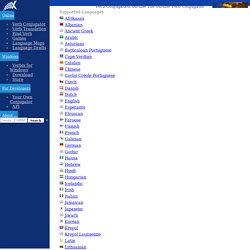
Verb Conjugation On-line The On-line Verb Conjugator Supported Languages Afrikaans Albanian Ancient Greek Arabic Asturiano Batticaloan Portuguese Cape Verdian Catalan Chinese Corlai Creole Portuguese Czech Danish Dutch English Esperanto Etruscan Faroese Finnish French Galician German Gothic Hausa Hebrew Hindi Hungarian Icelandic Irish Italian Jamaican Japanese Jiwarli Korean Kreyol Kreyol Louisienne Latin Lithuanian Martiniquais Middle High-German Norwegian (Nynorsk) Norwegian (bokmål) Occitan Old English Old Norse Old Occitan Old Scandinavian Old Swedish Papiamento Papiá Cristang Polish.
Learn Greek words, learn how to speak Greek. Greek language is considered as one of the most difficult languages to learn.
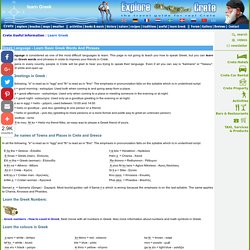
This page is not going to teach you how to speak Greek, but you can learn some basic Greek words and phrases in order to impress your friends in Crete. As it happens in every country, people in Crete will be glad to hear you trying to speak their language. Even if all you can say is "kalimera" or "Yassou", people will smile and open up. Learn Greetings in Greek : In all the following, "e" is read as in "egg" and "th" is read as in "this". Kalimera = good morning - καλημέρα. Kalispera = good afternoon - καλησπέρα. Kalinihta = good night - καληνύχτα. Herete (e as in egg) = hello - χαίρετε, used between 10:00 and 14:00 yassou = hello or goodbye - γειά σου (greeting to one person or a friend) yassas = hello or goodbye - γειά σας (greeting to more persons or a more formal and polite way to greet an unknown person) adio = goodbye - αντίο Learn the names of Towns and Places in Crete and Greece Learn the Greek Numbers:
Dizionari e Traduttori - Corriere.it. Latin proverbs. Omniglot. Meaning of Names, Baby Name Meanings. Glovico.org.
Word Dynamo. Arabic. English. French. Russian. Spanish. Dictionaries. Glossaries. Grammar. My Japanese Tube.