
Egypt's Corruption Probes: Justice or a Witch Hunt? While most attention has focused on the origins of the wealth of Hosni Mubarak and his family, allegations of corruption run far deeper into Egyptian society — and pursuit of the charges may result not only in the punishment of cronies but also a wider witch hunt against businessmen that may stymie an economy that needs as much growth as possible.
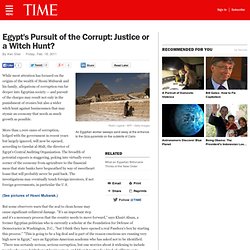
More than 1,000 cases of corruption, lodged with the government in recent years but largely ignored, will now be opened, according to Gawdat al-Malt, the director of Egypt's Central Auditing Organization. The breadth of potential exposés is staggering, poking into virtually every corner of the economy from agriculture to the financial mess that state banks have bequeathed by way of sweetheart loans that will probably never be paid back.
The investigations may eventually touch foreign investors, if not foreign governments, in particular the U.S. But some observers warn that the zeal to clean house may cause significant collateral damage. POURQUOI LES PROGRESSISTES EGYPTIENS MARQUENT DES POINTS, par Paul Amar * Billet invité.
Traduction par Jeanne, avec l’aide de l’auteur. Suleiman a tenté de s’allier les Frères musulmans pour casser la dynamique révolutionnaire mais les groupes organisés des femmes et des jeunes égyptiens ne pouvaient plus être arrêtés Le 6 février 2011, Omar Suleiman, vice-président égyptien désigné à la hâte, a invité la vieille garde, ou ce qu’on pourrait appeler le « courant des businessmen » des Frères musulmans, à une réunion au sommet, dans le cabinet au décor de bois de rose du palais présidentiel de Moubarak.
Le but de leur rendez-vous secret était de discuter d’un accord qui mettrait fin au soulèvement national et rétablirait la «normalité». Quand la nouvelle de ce rendez-vous éclata, la blogosphère fut parcourue d’expressions de joie et de terreur. Une fraction d’une faction Faisant mentir Nile TV et les pessimistes, un million et demi de personnes se sont dirigées vers la place Tahrir le 7 février – la plus grande mobilisation depuis le début de ce soulèvement.
Palestine : Colère contre les “Documents Palestine” · Global Voices. [liens en arabe et anglais] La publication par Al Jazeera des “Palestine Papers”, des centaines de documents relatifs aux négociations israélo-palestiniennes, a provoqué des réactions virulentes dans toute la blogosphère palestinienne.
Dans ce billet nous lisons les blogueurs de Cisjordanie et de la bande de Gaza, qui ont exprimé leurs opinions tant sur les documents que sur le rôle d'Al Jazeera qui les a publiés. A Gaza Seeran Nofal s'en prend à la chaîne d'information dans un billet intitulé “Ça suffit, Al Jazeera”. Elle fait allusion aux supposés inclinations islamistes et soutien de la télévision (arabophone) au Hamas, et écrit : أعتقد بأن الوقت ليس مُناسباً لبث مثل هذه الوثائق حتى لو كانت تتمتع بالمصداقية ، فنحن نعاني من “فسخ” بين أكبر فصيلين ، تأتي هذه القناة لتعزز الإنقسام بنشرها لهذه الوثائق؟ أعتقد أن الجزيرة لعبت وما تزال دوراً في ترسيخ الإنقسام بين الفلسطينين Mahmoud Abbas.
من حق من يريد الرد على الجزيرة وتفنيد كل ما عرضت وستعرض، فهي ليست من الملائكة…. Palestine papers: Now we know. Israel had a peace partner. Who will be most damaged by this extraordinary glimpse into the reality of the Israeli-Palestinian peace process?
Perhaps the first casualty will be Palestinian national pride, their collective sense of dignity in adversity badly wounded by the papers revealed today. Many on the Palestinian streets will recoil to read not just the concessions offered by their representatives – starting with the yielding of those parts of East Jerusalem settled by Israeli Jews – but the language in which those concessions were made. To hear their chief negotiator, Saeb Erekat, tell the Israelis that the Palestinians are ready to concede "the biggest Yerushalayim in Jewish history" – even using the Hebrew word for the city – will strike many as an act of humiliation.
Referring to Ariel Sharon as a "friend" will offend those Palestinians who still revile the former prime minister as the "Butcher of Beirut" for his role in the 1982 Israeli invasion of Lebanon. Where does this leave the peace process itself?