
Tweak's BookStore - Songwriting: Essential Guide to Rhyming: A Step-by-Step Guide to Better Rhyming and Lyrics (Songwriting Guides) Product Description (Berklee Press).
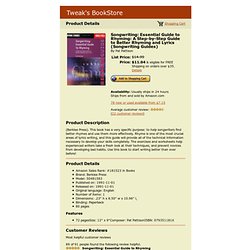
This book has a very specific purpose: to help songwriters find better rhymes and use them more effectively. Rhyme is one of the most crucial areas of lyrics writing, and this guide will provide all of the technical information necessary to develop your skills completely. The exercises and worksheets help experienced writers take a fresh look at their techniques, and prevent novices from developing bad habits. Use this book to start writing better than ever before! Product Details Amazon Sales Rank: #181523 in Books Brand: Berklee PressModel: 50481583Published on: 1991-11-01Released on: 1991-11-01Original language: EnglishNumber of items: 1Dimensions: .23" h x 8.50" w x 10.96" l, Binding: Paperback80 pages Features 72 pagesSize: 12" x 9"Composer: Pat PattisonISBN: 079351181X Customer Reviews Most helpful customer reviews 89 of 91 people found the following review helpful.
The Swing Rhythm. The Swing Rhythm [Each example has a corresponding audio file] One of the rhythmic concepts integral to Jazz relates to the notion of what makes a rhythm a “swing” rhythm. Simply put, a “swing rhythm” is based on a subdivision of each single beat into groups of 3, or “triplets”. Previous convention and much classical music (but not all) often divided the beat into groups of 2. Below is a diagram, using music notation, showing how one may convert any given rhythm into a “swing” rhythm. We may distinguish between the conventional and jazz concepts by calling the triplet-based rhythm a “swing” rhythm, and calling the division of the beat into 2 as a “straight” rhythm. *Remember, in terms of time-feel, or “groove”: Swing = beat subdivided into groups of 3; Straight = beat subdivided into groups of 2.
In Example 1 we see two measures, each divided into 4 equal beats. Note: All examples are played with a tempo of approximately 70 beats per minute Example 1. – Two measures, 4 beats each. Counting Music by David Tulga. How to read music — How to read rhythms — How to count music Reading Rhythms - Counting Music- how music is measured and counted - Welcome to our page on Reading Rhythms and Counting Music.
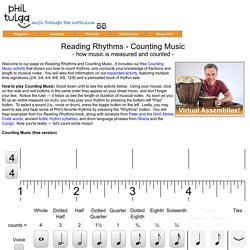
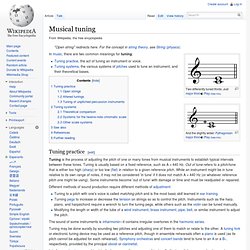
It includes our free Counting Music activity that shows you how to count rhythms, and connects your knowledge of fractions and length to musical notes. You will also find information on our expanded activity, featuring multiple time signatures (2/4, 3/4, 4/4, 6/8, 9/8, 12/8) and a preloaded book of rhythm sets. How to play Counting Music: Scroll down until to see the activity below. Counting Music (free version) Musical tuning. In music, there are two common meanings for tuning: Tuning practice[edit] Different methods of sound production require different methods of adjustment: Open strings[edit] The pitches of open strings on a violin.
Play. Jazz standard. Pollstar. Music News, Reviews, Articles, Information, News Online & Free Music. How to Play Jazz Piano: 14 steps. Edit 21 authors | 82 revisions | Last updated: June 18, 2012 June 18, 2012 Jazz is an art form that has grown from its blues origins to draw influences from just about every genre of music there is.
For the beginner, though, it's perhaps best to focus on early swing and learning to improvise. Here's a pretty easy way to get going! . . : Cole Porter, Gershwin, etc. . . . : learn to play CM7 like (C, E, G, B), (E, G, B, C), (G, B, C, E) and (B, C, E, G). . . . . . How To Play Jazz Piano Chords Experiment! Love jazz, and learn to love the craft of songwriting. Gravitate towards the best pianists, if only to try and understand why they're considered the best. Do not forget: you learn to play the piano by the piano, not by reading a book or a wikiHow. Edit Warnings During your search through Jazz piano history, you'll eventually come across Art Tatum. But if you are wise, after hearing Art Tatum or Oscar Peterson will motivate you to work harder. Edit Related wikiHows Featured Article. Recording Industry Association of America. Bandcamp. The Flow's sounds.
Piano. Percussion. VClub Live.