
ESL Music Activities. Fun Games For ESL - ESL Printable, Interactive Fun Games Pronunciation & Intonation: Teach English pronunciation using printable worksheets, IPA Charts, and more>> Speaking Activities: Using these worksheets, you can get a number of communicative activities going Reading Exercises -Printable Text Mazes, Reading Comprehension printable exercises Matching & Collocation Exercises- Printable Matching & Collocation Exercises Lesson Plan Resources for ESL Adults classes.
Worksheet Templates: Easily customize activities according to the lesson plan of the day using our free board game templates, writing templates Survival English & Business English: English for travels worksheets, Powerpoint and other lesson plan resources - Students Survival English self-study. Theme or Topic Worksheets : Plan your lesson around a theme with ready made pintables. 80 Journal Ideas. Learning Style Questionnaire. Writing Objectives Using Bloom's Taxonomy. Various researchers have summarized how to use Bloom’s Taxonomy.
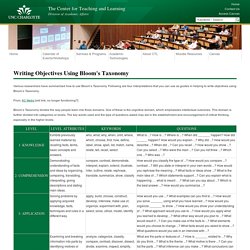
Following are four interpretations that you can use as guides in helping to write objectives using Bloom’s Taxonomy. From: KC Metro [old link, no longer functioning?] Bloom’s Taxonomy divides the way people learn into three domains. One of these is the cognitive domain, which emphasizes intellectual outcomes. This domain is further divided into categories or levels. From: UMUC From: Stewards Task Oriented Question Construction Wheel Based on Bloom’s Taxonomy Task Oriented Question Construction Wheel Based on Bloom’s Taxonomy. ©2001 St. From: GA Tech According to Benjamin Bloom, and his colleagues, there are six levels of cognition: Ideally, each of these levels should be covered in each course and, thus, at least one objective should be written for each level. Bloom's Wheel.
Bloom's Taxonomy. Bloom's wheel, according to the Bloom's verbs and matching assessment types.
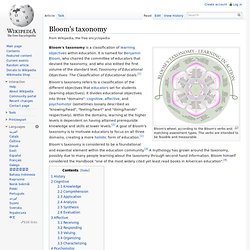
The verbs are intended to be feasible and measurable. Bloom's taxonomy is a classification of learning objectives within education. It is named for Benjamin Bloom, who chaired the committee of educators that devised the taxonomy, and who also edited the first volume of the standard text, Taxonomy of Educational Objectives: The Classification of Educational Goals. Bloom's taxonomy refers to a classification of the different objectives that educators set for students (learning objectives). It divides educational objectives into three "domains": cognitive, affective, and psychomotor (sometimes loosely described as "knowing/head", "feeling/heart" and "doing/hands" respectively).
Bloom's taxonomy is considered to be a foundational and essential element within the education community. Types of Test Questions. Selecting Test Items. Reading Exercises. About the Study Zone The Study Zone is for students of the English Language Centre (ELC) at the University of Victoria.
ELC teachers create the English language lessons and practice exercises. The site is designed for our adult English language learners, but all are welcome to read the lessons and use the exercises. News and Feedback The comments on the Study Zone blog have been great! Who visits Study Zone? This map shows the visitors to this page only. All levels: Grammar Index What do I do? First, choose your level. Study Zone is made up of levels. 20 Things to Include. 100 ESL Resources. Teaching ESL requires a lot of creativity.

Students can range from tiny tots to adults, and their skill level can be very experienced or at the basic level. With all these variables, teaching ESL can be challenging, so this list offers 100 of the best resources and guides to help you be the best teacher you can be. Whether you are teaching ESL in a public school in Peoria or a classroom in Kyoto, you will find tons of useful information in the list below. Lesson Plans and Handouts Every teacher has sat down to write up a lesson plan and been struck with the teacher’s version of writer’s block.
Lesson Plans and Classroom Activities. Teaching Tips One of the wonderful aspects about teaching is that you are also always learning. Liz Regan’s 20 Teaching Tips. Specifically for Teachers All of these resources below offer information, activities, job openings, support, ideas, and more to enhance your teaching. 75 ESL Teaching Ideas. The Internet TESL Journal Hall Houstonallhou [at] yahoo.
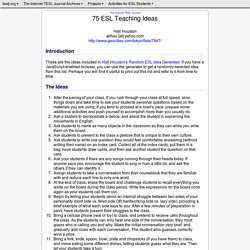
Introduction These are the ideas included in Hall Houston's Random ESL Idea Generator. If you have a JavaScript-enabled browser, you can use the generator to get a randomly-selected idea from this list. Perhaps you will find it useful to print out this list and refer to it from time to time. The Ideas Alter the pacing of your class. The Internet TESL Journal, Vol. Teaching Tips. ESL Cafe.
Stickyball.