
Проблема при загрузке страницы. GE Healthcare Life Sciences - Products - Affinity, Immobilized Lectin. Introduction to Immobilized Lectin Affinity Con A Sepharose™ 4B Concanavalin A (Con A) binds molecules that contain a -D-mannose, a -D-glucose, and sterically related residues with available C-3, C-4, or C-5 hydroxyl groups. Con A coupled to Sepharose™ 4B via cyanogen bromide activation. Generally applicable as the group-specific adsorbent for molecules containing sugars. The concentration of immobilized Con A is ~ 13 mg/ml medium. Ideal for isolation of cell surface glycoproteins from detergent-solubilized membranes. The medium is delivered in 0.1 M acetate buffer pH 6.0 containing 1 M NaCl, 1 mM CaCl 2 , 1 mM MgCl 2 , 1 mM MnCl 2 and 20% ethanol. Real Time PCR Tutorial.
In real-time PCR using SYBR green binding to amplified cDNA, we are simply measuring the fluorescence increase as the dye binds to the increasing amount of DNA in the reaction tube.
We hope that this increase in fluorescence is coming from the DNA that we wish to measure but some of the signal could come from DNA other than that which we are trying to amplify. Is there any way to check that the correct fragments were amplified? One way to do some checking of the products is to do a melting curve. The real-time machine not only monitors DNA synthesis during the PCR, it also determines the melting point of the product at the end of the amplification reactions. The melting temperature of a DNA double helix depends on its base composition (and its length if it is very short). MicroSolv CE Primer. Main Page - Proteopedia, life in 3D. Обучение биохимии. Downward 328 (7450): 1245. Julian Downward, principal scientist (downward@cancer.org.uk)1 Author Affiliations Introduction Over the past decade “RNA interference” has emerged as a natural mechanism for silencing gene expression.
This ancient cellular antiviral response can be harnessed to allow specific inhibition of the function of any chosen target genes, including those involved in causing diseases such as cancer, AIDS, and hepatitis. RNA interference is already proving to be an invaluable research tool, allowing much more rapid characterisation of the function of known genes. This article is based on a review of the literature on RNA interference and post-transcriptional gene silencing appearing in the PubMed database, along with personal experience of working in this field for the past four years. Current understanding of RNA interference For some time this remained an unexplained … RNA-interference & qRT-PCR. Variation among organisms Organisms vary in their ability to take up foreign dsRNA and use it in the RNAi pathway.
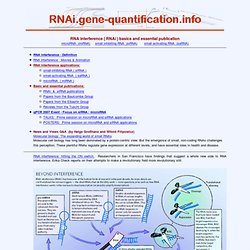
The effects of RNA interference can be both systemic and heritable in plants and C. elegans, although not in Drosophila or mammals. In plants, RNAi is thought to propagate by the transfer of siRNAs between cells through plasmodesmata (channels in the cell walls that enable communication and transport). The heritability comes from methylation of promoters targeted by RNAi; the new methylation pattern is copied in each new generation of the cell. A broad general distinction between plants and animals lies in the targeting of endogenously produced miRNAs; in plants, miRNAs are usually perfectly or nearly perfectly complementary to their target genes and induce direct mRNA cleavage by RISC, while animals' miRNAs tend to be more divergent in sequence and induce translational repression.
Related prokaryotic systems. Биохимия. Lewin's genes 10. Cell Size and Scale. Some cells are visible to the unaided eye The smallest objects that the unaided human eye can see are about 0.1 mm long.
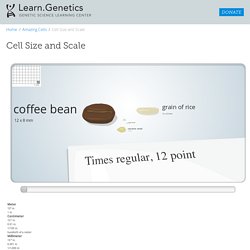
That means that under the right conditions, you might be able to see an ameoba proteus, a human egg, and a paramecium without using magnification. A magnifying glass can help you to see them more clearly, but they will still look tiny. Smaller cells are easily visible under a light microscope. It's even possible to make out structures within the cell, such as the nucleus, mitochondria and chloroplasts. To see anything smaller than 500 nm, you will need an electron microscope. Adenine The label on the nucleotide is not quite accurate. How can an X chromosome be nearly as big as the head of the sperm cell? No, this isn't a mistake. The X chromosome is shown here in a condensed state, as it would appear in a cell that's going through mitosis. A chromosome is made up of genetic material (one long piece of DNA) wrapped around structural support proteins (histones). Carbon. Biochem of Metabolism. Biochemistry of Metabolism Instructional materials for a studio-format course * Information for Students *including needed software Note: I am retiring from teaching at Rensselaer.
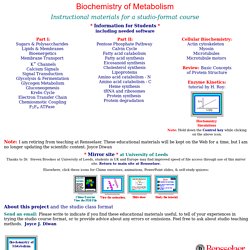
These educational materials will be kept on the Web for a time, but I am no longer updating the scientific content. Joyce Diwan * Mirror site * at University of Leeds Thanks to Dr. Elsewhere, click these icons for Chime exercises, animations, PowerPoint slides, & self-study quizzes: About this project and the studio class format Send an email: Please write to indicate if you find these educational materials useful, to tell of your experiences in trying the studio course format, or to provide advice about any errors or omissions.