
Rien à jeter Canibal, grand vainqueur de la BFM Académie 2011. Eliminate Waste – The Elegant 1 Liter Faucet Design. Elegance meets functional design with the 1?

Imit faucet. The glass holds exactly one liter of water, sufficient for any hand wash. The elegant design hopes to conserve water, as we almost use six liters when one is sufficient. Once the liter has been used, the waiting game begins and you must wait until the liter fills again. Roland-Garros : et si on recyclait nos balles de tennis ?
Quatorze millions de balles de tennis sont utilisées chaque année, en France.
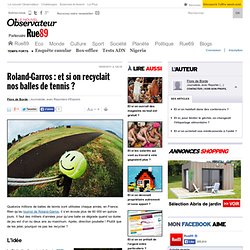
Rien qu’au tournoi de Roland-Garros, il s’en écoule plus de 60 000 en quinze jours. Il faut des milliers d’années pour qu’une balle se dégrade quand sa durée de jeu est d’un ou deux ans au maximum. Après, direction poubelle ! Plutôt que de les jeter, pourquoi ne pas les recycler ? Scientists Argue That Methane from the Gulf Oil Spill Was Not Eaten by Microbes. Last year, in the midst of the Deepwater Horizon crisis in the Gulf of Mexico, we wrote about a study that said that microbes in the Gulf had consumed a lot of the rogue oil plume caused by the disaster.

Now a group of scientists have joined together to argue against those findings. They have published a comment in the May 27th issue of the journal Science that points out flaws in the original study and other data from oil and methane leaks around the world that prove microbes in the ocean aren’t capable of consuming large quantities of oil or methane. The group of scientists making the argument is led by Samantha Joye, a University of Georgia Athletic Association Professor in Arts and Sciences and seeks to dispute a claim made in the January 21, 2011 issue of Science that “nearly all” of the methane released in the oil spill was consumed in the water column within 120 days.
Via Science Daily. Oyster Mushrooms Can Break Down Disposable Diapers in Just 4 Months. Dirty diapers have long been the bane of moms and dads, but they’re also a horrible burden on the environment.

Did you know that not a single disposable diaper ever made has decomposed yet, and it actually takes about 500 years – yes 500 years – for them to biodegrade? You might be wondering if anything can be done and one of the solutions may surprise you being that it involves mushrooms. Oyster mushrooms to be exact. One scientist is saying that the delectable fungi might actually accelerate the 500 year figure down to a mere 4 months. La "bouteille végétale", pas si écolo que Volvic le prétend. Entre l’eau du robinet chlorée, bourrée de pesticides ou d’hydrocarbures aromatiques polycycliques, et l’eau en bouteille génératrice de déchets, Volvic pensait avoir trouvé la solution rêvée.
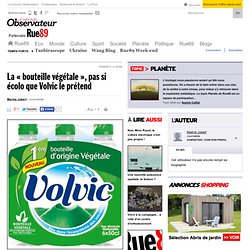
Las, sa « bouteille végétale » n’est pas écolo : elle est en plastique 100% plastique. Le plastique de cette bouteille-là est un PET (un mélange d’acide téréphtalique et d’éthylène glycol), comme ses cousines plus « classiques ». Sauf que les 20% d’éthylène glycol de la « bouteille végétale » sont issus d’une mélasse de canne à sucre. Ce déchet est issu de la production de sucre de canne, cultivée et transformée en Inde, alors que les autres bouteilles sont à 100% constituées d’hydrocarbures. Chez Danone, maison-mère de Volvic, on indique que : « La molécule issue du végétal remplace ainsi une des molécules du PET, mais sa composition chimique finale est exactement la même. »
Waste to Energy. How Landfills Work" The basic parts of a landfill, as shown in Figure 3, are: Bottom liner system - separates trash and subsequent leachate from groundwaterCells (old and new) - where the trash is stored within the landfillStorm water drainage system - collects rain water that falls on the landfillLeachate collection system - collects water that has percolated through the landfill itself and contains contaminating substances (leachate)Methane collection system - collects methane gas that is formed during the breakdown of trashCovering or cap - seals off the top of the landfill Each of these parts is designed to address specific problems that are encountered in a landfill.
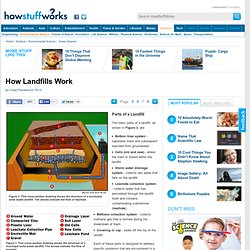
So, as we discuss each part of the landfill, we'll explain what problem is solved. Bottom Liner System.