
Economix Comix. Milton Friedman & John Kenneth Galbraith’s Present Their Opposing Economic Philosophies on Two TV Shows (1977-1980) What Happened with LEGO. “What happened with Legos?
They used to be simple. Oh come on, I know you know what I’m talking about. Legos were simple. Something happened out here while I was inside. Harry Potter Legos, Star Wars Legos, complicated kits, tiny little blocks. LEGO® sets are not cheap toys. Evaluating the price history of LEGO sets In order to come to some sort of conclusion about the price of LEGO, I needed to get some data on the historic retail prices of LEGO sets. 1) They have a price listed. There is not a way to qualify the price of a LEGO brick without first knowing the price of the set the brick is in. 2) The set contains at least 25 pieces. EVE Fanfest 2013: The Invisible Hand of EVE Online. By Brendan Caldwell on May 3rd, 2013 at 12:00 pm.
One of the most fascinating and enduring things about EVE Online is the depth of its economics. The player-driven economy has got a full decade of history behind it, operating on its own strange breed of anarcho-capitalism. In Free Market economics, there is an idea called the ‘invisible hand’. This is the idea that the marketplace ultimately regulates itself, whether it wants to or not. Maïs, cuivre ou or, les matières premières industrielles et agricoles racontent des empoignades techniques, économiques et géostratégiques qu’Alain Faujas décrit comme autant d’expressions telluriques de la mondialisation. La boule de cristal du FMI.
The Red Herring - Economics - June 1998. ECONOMICS Why most economists' predictions are wrong.
Matières premières, Indices et Cotations : tout savoir sur usinenouvelle.com. Rare Earths, Rare Metals, REE, Critical Minerals ProEdgeWire reviewProEdgeWire. April 11, 2014 (Source: Marketwired) -- Ucore Rare Metals Inc.
(TSX VENTURE:UCU), ("Ucore" or the "Company") is pleased to announce that it has closed the first tranche of a non-brokered private placement ("Private Placement") of 10,577,631 units ("Units") at $0.38 per Unit for gross proceeds of approximately $4,019,500. Each Unit consists of one common share in the capital of the… April 11, 2014 (Source: Marketwired) -- Nuinsco Resources Limited ("Nuinsco" or the "Company") (TSX:NWI) (www.nuinsco.ca) today announces that, in connection with a review by the Ontario Securities Commission (the "OSC") of the Company's technical disclosure under National Instrument 43-101 - Standards of Disclosure for Mineral Projects ("NI 43-101") concerning the Prairie Lake property, the Company is issuing this news release to… April 10, 2014 (Source: Marketwired) -- Nemaska Lithium Inc.
April 10, 2014 (Source: Marketwired) -- Pele Mountain Resources Inc. Raw Materials Econ. This is America, Now: The Dow Hits a Record High With Household Income at a Decade Low - Matt Phillips. Stocks surpassed the nominal record set in 2007, while the last recorded real median US household income was 8% lower than its 2007 peak.
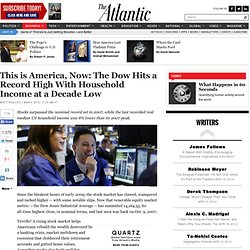
Reuters Since the bleakest hours of early 2009, the stock market has clawed, scampered and inched higher -- with some notable slips. Now that venerable equity market metric -- the Dow Jones Industrial Average -- has summited 14,164.53, its all-time highest close, in nominal terms, and last seen way back on Oct. 9, 2007. Wealth Inequality in America. Les cycles financiers. Www.pomorci.com/Zanimljivosti/TONNAGE MEASUREMENT OF SHIPS.pdf. The Used TV Price is Too Damn High. At Priceonomics, we’ve learned that our users don’t want to buy used products.
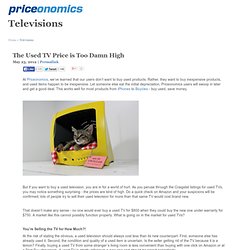
Rather, they want to buy inexpensive products, and used items happen to be inexpensive. Let someone else eat the initial depreciation, Priceonomics users will swoop in later and get a good deal. Dear Mr. President: price floors create surpluses. Raising the minimum wage = raising the cost of employment = you're killing jobs. I know you don't think laws apply to you, but. Game theory II: Dominant strategies.
Dominant strategies are considered as better than other strategies, no matter what other players might do.
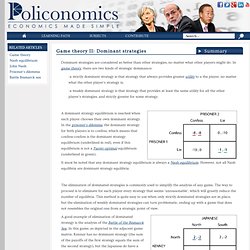
In game theory, there are two kinds of strategic dominance: -a strictly dominant strategy is that strategy that always provides greater utility to a the player, no matter what the other player’s strategy is; How Surprise Changes Your Appetite for Risk. Les rhinos sauvés par les maths? Rachel Botsman: The currency of the new economy is trust. Yield management. Un article de Wikipédia, l'encyclopédie libre.
Pour les articles homonymes, voir Yield. Le yield management, expression d'origine anglaise, en français gestion rendement, est un système de gestion des capacités disponibles telles des chambres en hôtellerie ou des sièges dans le transport aérien, qui a pour objectif l'optimisation du chiffre d'affaires. On l'appelle également revenue management, ou encore de manière restrictive tarification en temps réel (selon Cariou)[réf. nécessaire] ou tarification différenciée[1]. The Cost of Friendship. How Big Is the World Black Market? Economists Ceyhun Elgin and Oguz Oztunali are researching the size of shadow economies, or black markets, around the world.
Using a dataset with 7,395 observations for 161 countries from 1950 to 2009, they’re looking into how the size of black markets differs in rich and poor countries. They estimate that shadow economies account for 22.67 percent of world GDP, with a generally downward trend that seems to have been interrupted by the global recession: The Knowledge Effect - Thomson Reuters. Primo by Ex Libris - 041085620. Inclusive-Wealth-Report-2012-Embargoed-until-17-June-2012.pdf. Enjeux de long terme et crise économique. Ec.europa.eu/transport/sustainable/doc/2008_costs_handbook.pdf. Do fundamentals—or emotions—drive the stock market? - McKinsey Quarterly - Corporate Finance - Valuation.
Why bad multiples happen to good companies - McKinsey Quarterly - Corporate Finance - Valuation. Earnings multiples, particularly the price-to-earnings (P/E) ratio, are a common shorthand for summarizing how the stock market values a company.
The media often use them for quick comparisons between companies. Investors and analysts use them when talking about how they value companies. That there are generally more detailed models behind the shorthand seldom makes the headlines, and this contributes to a problem: executives who worry that their multiple should be higher than the one the market currently awards them. Agile operations for volatile times - McKinsey Quarterly - Operations - Performance. The specter of a catastrophic failure in one or more links of a company’s global supply chain haunts senior executives in many industries: for example, the overnight flood or fire that disrupts a key supplier and quickly grinds production to a halt half a world away.
Well founded as such worries are, given the increasingly globalized and interconnected operations of large organizations, they are hardly the only risks facing supply chains. No less significant are subtler, and more persistent, sources of disruption, such as fluctuating demand, labor rates, or commodity prices that together chip away at profits, increase costs, and force organizations to miss market opportunities. Commission on the Measurement of Economic Performance and Social Progress - Home page. U.S. Economy Needs Stimulus, Not Soothsayers. Here’s something you don’t often hear an economist admit: We have very little idea where the economy will be next year. Truth be told, our best guesses just aren’t very good. Government forecasts regularly go awry. - Fret maritime - Indicateurs cl s. Hype cycle. The Hype Cycle is a branded graphical presentation developed and used by IT research and advisory firm Gartner for representing the maturity, adoption and social application of specific technologies.
Five phases[edit] general Hype Cycle for technology Each Hype Cycle drills down into the five key phases of a technology’s life cycle. The term "Hype Cycle" and each of the associated phases are now used more broadly in the marketing of new technologies.
The Most IMPORTANT Video You'll Ever See (part 1 of 8) Jevons paradox. The Jevons paradox has been used to argue that energy conservation may be futile, as increased efficiency may increase fuel use. Nevertheless, increased efficiency can improve material living standards. Further, fuel use declines if increased efficiency is coupled with a green tax or other conservation policies that keep the cost of use the same (or higher).[3] As the Jevons paradox applies only to technological improvements that increase fuel efficiency, policies that impose conservation standards and increase costs do not display the paradox. Eight Questions: Andrew Wedeman, China's Corruption Paradox - China Real Time Report. Fulfilling the promise of India’s manufacturing sector - McKinsey Quarterly - Operations - Performance. India’s manufacturers have a golden chance to emerge from the shadow of the country’s services sector and seize more of the global market.
McKinsey analysis finds that rising demand in India, together with the multinationals’ desire to diversify their production to include low-cost plants in countries other than China, could together help India’s manufacturing sector to grow sixfold by 2025, to $1 trillion, while creating up to 90 million domestic jobs. Capturing this opportunity will require India’s manufacturers to improve their productivity dramatically—in some cases, by up to five times current levels.
The country’s central and state governments can help by dismantling barriers in markets for land, labor, infrastructure, and some products (see sidebar, “Four imperatives for India’s government”). La leçon d'économie de DSK à Cambridge. Le texte de l'intervention de DSK à Cambridge, Documents. Introducing: China Econtracker 2.0 - China Real Time Report. Glass-Steagall Act. Un article de Wikipédia, l'encyclopédie libre. Externalities. Positive externalities are benefits that are infeasible to charge to provide; negative externalities are costs that are infeasible to charge to not provide. Ordinarily, as Adam Smith explained, selfishness leads markets to produce whatever people want; to get rich, you have to sell what the public is eager to buy. Évaluation d'entreprise. Www.ladocumentationfrancaise.fr/var/storage/rapports-publics//104000183/0000.pdf. Mordecai Ezekiel. Mordecai Joseph Brill Ezekiel (May 10, 1899 – October 31, 1974) was an American agrarian economist who worked for the United States government and the United Nations for a number of years.
He is credited with formulating the details of what was to become the Agriculture Adjustment Administration, and helped prepare a draft of the Agricultural Adjustment Act. De l’analyste au comité de notation, le travail des agences de A à Z. Le Monde.fr | • Mis à jour le | Par Clément Lacombe et Anne Michel. Fichier:Public Deficit of France.png - Wikipédia. Arthur Laffer. Un article de Wikipédia, l'encyclopédie libre. Économie de l'offre. Courbe de Laffer. Téléchargement des cotations pour. CD-ROM de cotations boursières - Boutique de la bourse Abcbourse.com. Cotations intraday par E-mail - Boutique de la bourse Abcbourse.com. CD ROM de cotations intraday - Boutique de la bourse Abcbourse.com. Historical stock data. ABC Bourse, l'indispensable pour Investir en Bourse. Le démon du spéculateur est-il bien raisonnable? IV. Bulles rationnelles, phénomènes de mode et mimétisme.
50 articles pour comprendre les crises financières (13/50) : bulles et krachs. Www.cereg.dauphine.fr/UserFiles/File/EqMultiples.pdf. Jb.desquilbet.pagesperso-orange.fr/docs/A_M2_mafi_11&12.pdf. Barthélemy de Laffemas. Laffemas et la politique industrielle... d'Henri IV. James M. Buchanan. Modèle de Harrod-Domar. Arthur Cecil Pigou. Hotelling (1929) - Stability In Competition - Wikiedia. Courbe de Phillips. Monétarisme. Principal–agent problem. Classiques.uqac.ca/classiques/marshall_alfred/principes_eco_pol_1/principes_eco_pol_1_1.pdf. Physiological utility theory and the neuroeconomics of choice. Économie comportementale. Économie de l'information.
Catégorie:Théories et modèles économiques. Neuroéconomie. Arborescence des catégories. Histoire de la pensée économique. Histoire économique. Théorie de la dépendance. Thomas Malthus. Croissance économique. Paul Romer. Équivalence ricardienne. Facteurs de production. Analyse entrée-sortie. Tableau entrées-sorties. Wassily Leontief. Modèle Heckscher-Ohlin-Samuelson. Termes de l'échange. Concurrence imparfaite. Francis Ysidro Edgeworth. Théorie de la dépendance. Adam Smith.
Recherches sur la nature et les causes de la richesse des nations. Portail:Économie. Théorie de la valeur (marxisme)